How Direct Air Capture Works—and Why It's So Hard
Direct air capture technology pulls carbon dioxide straight from the atmosphere using chemical sorbents and solvents, but enormous energy demands and high costs remain major barriers to scaling it up.
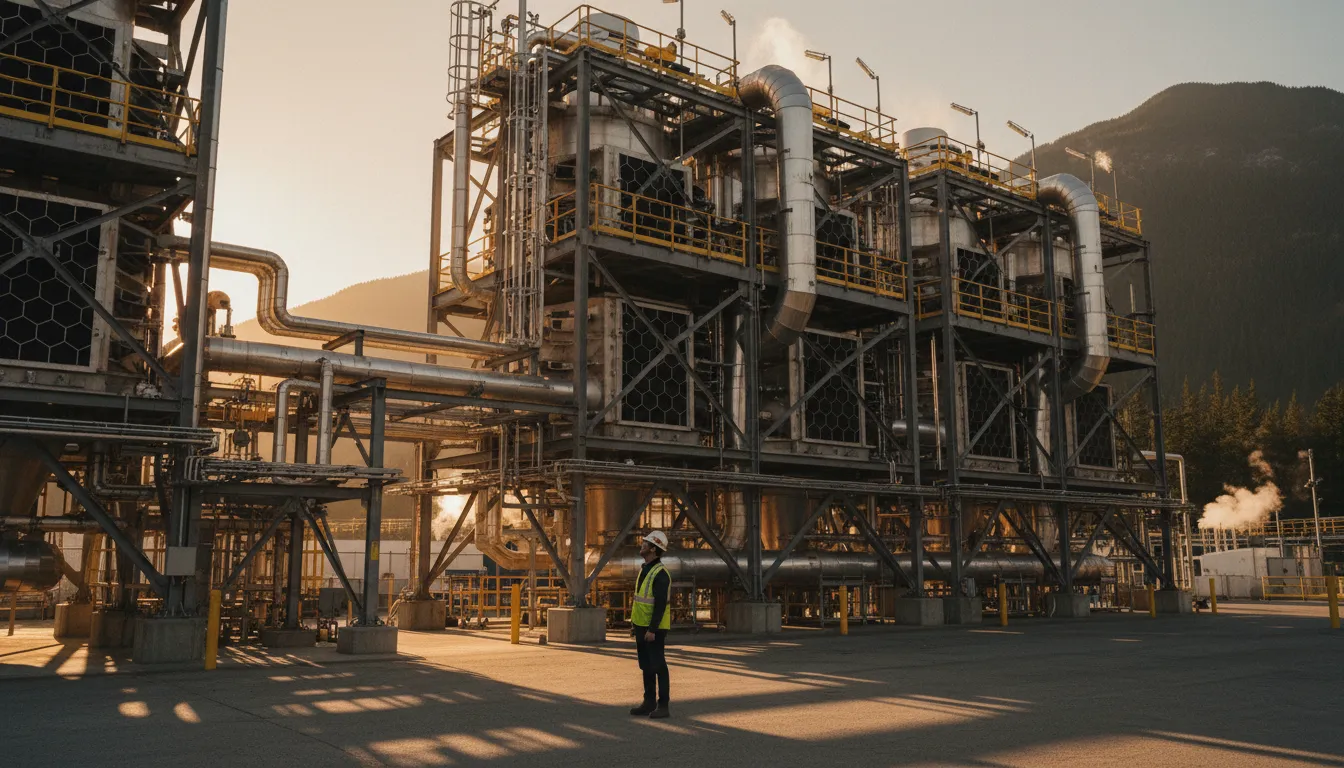
Pulling CO₂ From Thin Air
The atmosphere contains roughly 420 parts per million of carbon dioxide—a tiny fraction of the air we breathe, yet enough to warm the planet. Direct air capture (DAC) is a technology designed to reverse that buildup by extracting CO₂ directly from ambient air, concentrating it, and either storing it permanently underground or converting it into useful products. Unlike capturing emissions at a smokestack, DAC can operate anywhere and remove carbon that has already been released, making it one of the few tools that could actually reduce atmospheric CO₂ levels rather than merely slow their rise.
Two Approaches, One Goal
DAC systems rely on two main methods: solid sorbents and liquid solvents. In solid-sorbent systems, large fans draw ambient air through modular collectors filled with a highly porous filter material. The sorbent chemically binds CO₂ molecules while letting nitrogen, oxygen, and other gases pass through. Once saturated, the collector is sealed and heated—typically to around 100°C—which releases a concentrated stream of CO₂ for collection and storage. The sorbent then cools and the cycle repeats.
Liquid-solvent systems work differently. Air passes through a solution—often a potassium hydroxide mixture—that absorbs the CO₂. The solution is then processed through a series of chemical steps that strip out the carbon dioxide at high temperatures (up to 900°C) and regenerate the solvent. This approach can handle larger volumes but demands significantly more energy.
What Happens to the Captured Carbon
The most permanent disposal method involves injecting concentrated CO₂ deep underground into geological formations such as saline aquifers or basalt rock. In Iceland, the storage company Carbfix dissolves captured CO₂ in water and pumps it roughly 1,000 metres below the surface, where it reacts with basaltic rock and mineralises—literally turning into stone within a few years. Alternatively, captured CO₂ can be used as a feedstock for synthetic fuels, building materials, or chemicals, though these uses delay rather than eliminate its return to the atmosphere.
The Scale Challenge
The world's largest operational DAC facility is Climeworks' Mammoth plant in Iceland, capable of removing up to 36,000 tonnes of CO₂ per year—roughly the annual emissions of 7,800 cars. That sounds significant until you consider that global CO₂ emissions exceed 37 billion tonnes annually. Around 130 DAC plants are currently planned or operating worldwide, but their combined capacity barely scratches the surface of what climate scientists say is needed.
Two much larger projects are under construction in Texas and Louisiana as part of the U.S. Department of Energy's DAC Hubs programme, each targeting one million tonnes of CO₂ removal per year when fully operational.
The Energy and Cost Problem
DAC's biggest obstacle is energy. Because CO₂ makes up just 0.04% of the atmosphere, enormous volumes of air must be processed. Removing one million tonnes of CO₂ requires an estimated 300–500 megawatts of power—comparable to a mid-sized power plant. If that energy comes from fossil fuels, the process can actually emit more carbon than it captures, which is why viable DAC projects rely on clean energy sources like geothermal, solar, or wind.
Costs remain steep. Current estimates range from $250 to $600 per tonne of CO₂ at small-scale facilities. At larger scales of one million tonnes per year, analysts project costs could fall to $150–$230 per tonne, but achieving those economies requires massive capital investment and cheap, reliable clean electricity.
A Necessary Piece of the Puzzle
Climate models from the International Energy Agency and IPCC consistently show that reaching net-zero emissions will likely require some form of carbon removal alongside drastic emissions cuts. DAC is not a substitute for reducing fossil fuel use, but it may prove essential for offsetting hard-to-eliminate emissions from aviation, agriculture, and heavy industry. Whether the technology can scale fast enough—and cheaply enough—remains one of the defining questions of climate policy.