'El Mencho' Falls: Biggest Blow to Drug Trafficking in Mexico
The Mexican Army killed CJNG leader Nemesio 'El Mencho' Oseguera in Tapalpa, Jalisco, unleashing roadblocks and violence in seven states. His death opens a power crisis in Mexico's most dangerous cartel.
The Operation That Ended the World's Most Wanted Drug Lord
On the afternoon of Sunday, February 22nd, units of the Mexican Army carried out an operation in the municipality of Tapalpa, Jalisco, which culminated in the death of Nemesio Rubén Oseguera Cervantes, alias «El Mencho», founder and leader of the Jalisco New Generation Cartel (CJNG). Wounded during the confrontation with soldiers, the drug lord died while being transported by helicopter to Mexico City, as confirmed by the Secretary of National Defense.
The operation—coordinated by the Defense Department, the National Intelligence Center (CNI), the Attorney General's Office, and the National Guard—also had intelligence support from the United States, according to official sources. In the initial clash, seven members of the cartel died and two others were arrested; three more, including «El Mencho», died during the air transport.
The Man Behind the CJNG
Originally from Michoacán, Oseguera Cervantes co-founded the CJNG around 2007 and transformed it into the most powerful criminal organization in Mexico, according to the FBI. The cartel controlled the bulk of the cocaine, heroin, methamphetamine, and fentanyl trafficking destined for the United States, with distribution networks spread across several continents.
The U.S. Department of Justice offered a reward of ten million dollars for information leading to his capture. His hallmark was extreme violence: filmed decapitations, militarized drones, and armored vehicles that openly defied state forces. For years, he evaded the authorities of both countries.
A Night of Chaos in Seven States
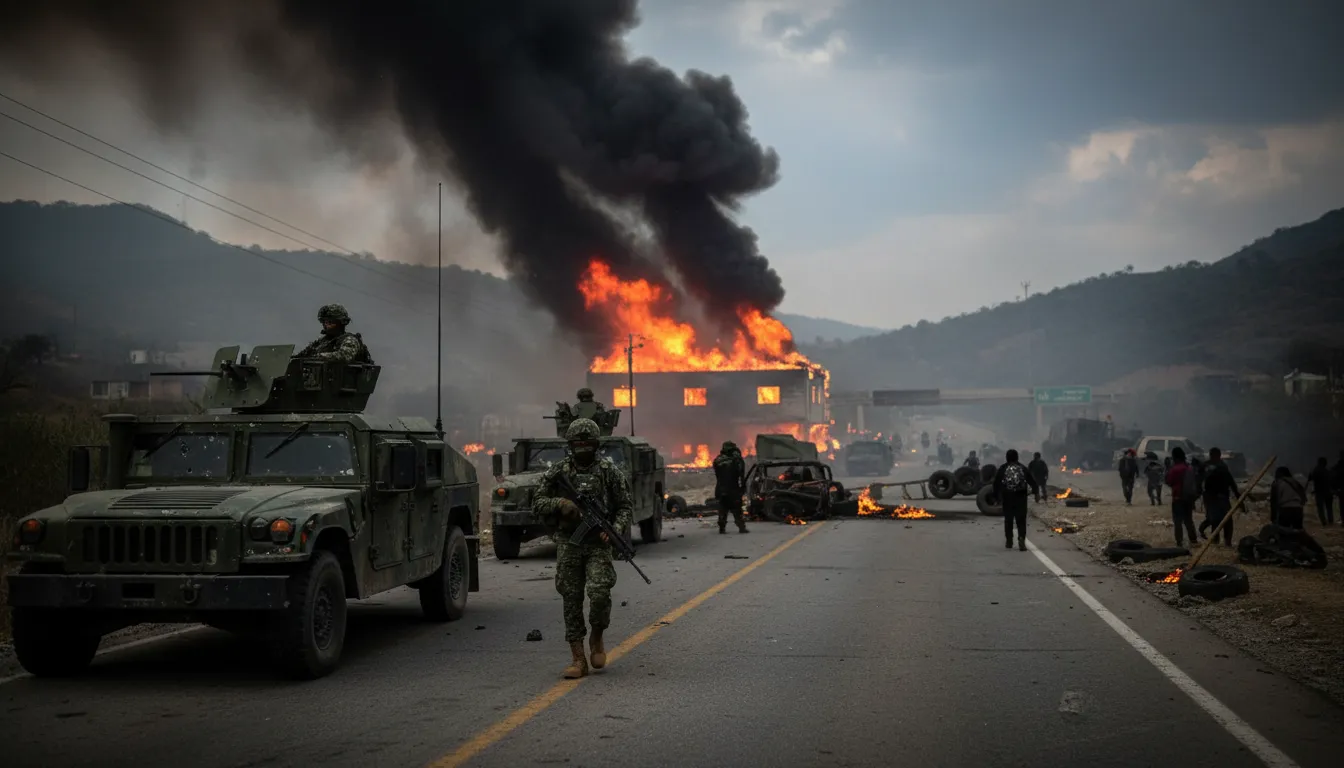
The confirmation of his death triggered a coordinated and immediate response from the CJNG. In a few hours, Mexican authorities registered 252 roadblocks across the country, with burning vehicles and armed clashes in at least seven states: Jalisco, Michoacán, Nayarit, Colima, Guanajuato, Zacatecas, and Tamaulipas.
Guadalajara, the capital of Jalisco, became a ghost town. Empty streets, closed businesses, and widespread panic at the international airport—with passengers fleeing through the smoke—marked a night of terror. The situation was especially alarming given that Guadalajara will host four matches of the 2026 FIFA World Cup, including one of the Mexican national team, which kicks off in less than four months.
The Power Vacuum and the Government's Challenge
The death of «El Mencho» raises questions that security experts describe as critical. Unlike the Sinaloa Cartel, with a more shared leadership, the CJNG was built around the omnipresent figure of its founder. Without a clear successor, analysts warn of two scenarios: an orderly internal restructuring or, more likely, fragmentation into rival factions that would unleash a devastating internal war.
The Mexican government described the operation as a historic milestone in the fight against organized crime, but acknowledged that the security situation will remain volatile in the coming days. The U.S. Embassy issued an alert for its citizens in Mexico, urging them to avoid non-essential travel.
A Historic Blow, An Uncertain Future
The fall of «El Mencho» is the most resounding success against Mexican drug trafficking since the capture of Joaquín «El Chapo» Guzmán in 2016. However, historical experience warns that the elimination of a cartel leader rarely extinguishes violence: it usually intensifies it in the short term. Mexico now faces its most demanding test: turning this operational blow into the beginning of a lasting peace.