AI Discovers 25 New Magnets to Cut EVs' Rare Earth Reliance
Scientists at the University of New Hampshire used AI to build a database of 67,573 magnetic compounds and identify 25 new materials that stay magnetic at high temperatures — a potential breakthrough for reducing China's stranglehold on the rare earth supply chain.
A Smarter Way to Hunt for Magnets
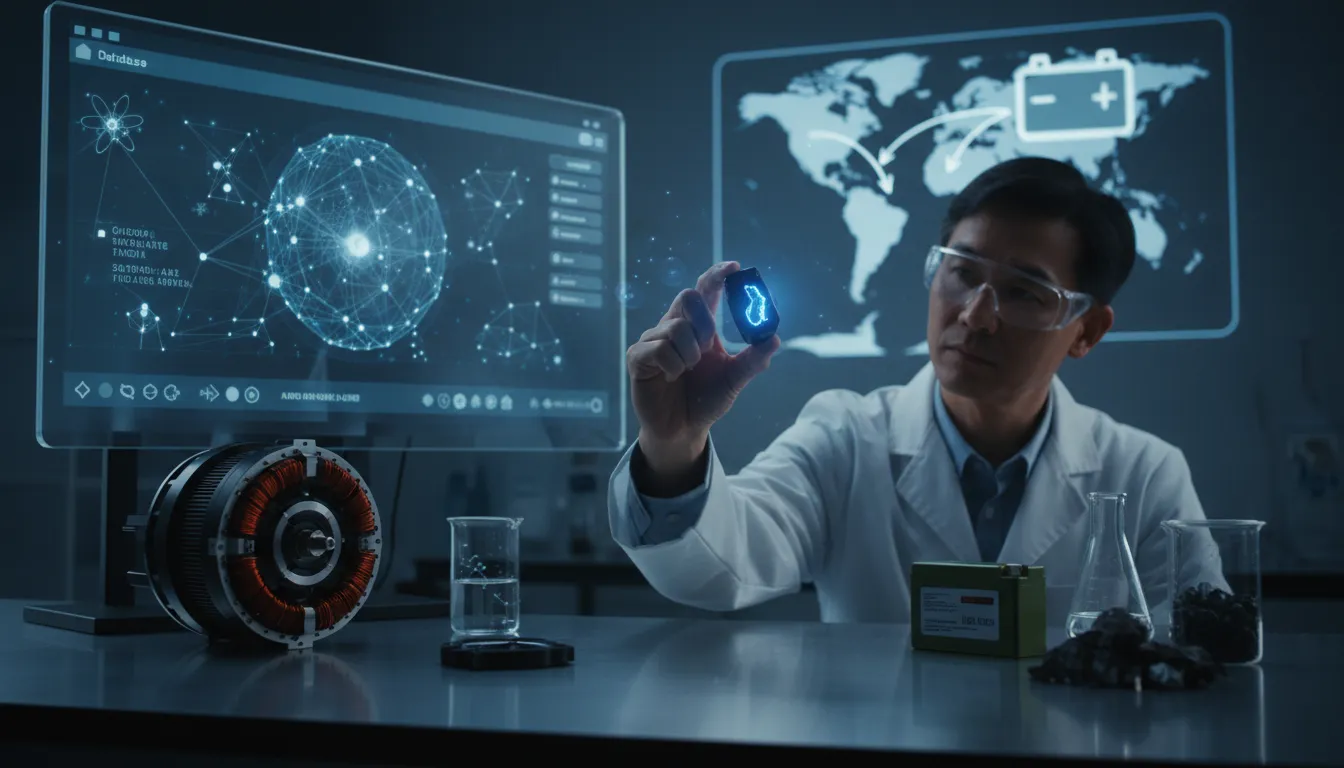
Scientists at the University of New Hampshire have deployed artificial intelligence to tackle one of modern industry's most pressing challenges: ending dependence on rare earth magnets dominated by China. By training machine learning models to autonomously parse thousands of scientific papers, researchers built the Northeast Materials Database — a catalogue of 67,573 magnetic compounds — and identified 25 previously unknown materials that retain magnetism at high temperatures.
The study, published in Nature Communications in October 2025 and led by Suman Itani, Yibo Zhang, and senior physicist Jiadong Zang, represents a significant leap in materials science. Funded by the U.S. Department of Energy's Office of Basic Energy Sciences, the project used natural language processing to extract experimental data from the scientific literature at a scale no human team could replicate alone.
Why Curie Temperature Is the Decisive Test
The key property the AI was tasked with predicting is the Curie temperature — the point at which a material loses its magnetism due to heat. For electric motors in cars or wind turbines, magnets must remain stable under intense operating conditions. Most candidate materials fail this test. The 25 newly identified compounds pass it, making them viable candidates for real-world industrial applications.
"Accelerating the discovery of sustainable magnetic materials can reduce dependence on rare earth elements and lower the cost of electric vehicles and renewable-energy systems," said lead researcher Suman Itani.
The AI system narrows down the most viable magnetic compounds for experimental focus, dramatically reducing the research and development timeline compared to traditional trial-and-error laboratory testing.
The Geopolitical Stakes
The urgency behind this research is not purely scientific. China processes approximately 90% of global rare earth elements and dominates production of sintered permanent magnets — materials critical for EV drivetrains, wind turbines, data centers, and defense systems. On April 4, 2025, Beijing escalated tensions by imposing export licensing requirements on seven heavy rare earth elements, including dysprosium and terbium.
The consequences were swift. Prices for neodymium-praseodymium oxide spiked nearly 40% in a single month, and automakers including Tesla, Ford, and GM scrambled to secure supplies. Some factories briefly cut utilization rates as the supply chain felt the squeeze. The UNH database offers a structural long-term answer: many of its 67,573 catalogued materials contain no rare earth elements at all, opening potential pathways for affordable, geopolitically secure magnets.
A Broader Wave of Rare-Earth-Free Research
The UNH findings arrive amid a wider surge in alternative magnet research. At the University of Minnesota, physicist Jian-Ping Wang has developed iron-nitride (Fe₁₆N₂) magnets that rival the performance of some conventional rare-earth magnets. His startup, Niron Magnetics, is advancing toward commercial-scale production using existing industrial equipment — bypassing the specialized, China-dominated rare-earth processing chain entirely.
Western governments are simultaneously racing to secure alternative supply chains. The United States has struck domestic processing agreements with MP Materials, while the European Union is investing in rare earth separation facilities and building strategic stockpiles as part of its Critical Raw Materials Act.
From Database to Factory Floor
The gap between laboratory discovery and industrial deployment remains real. The 25 newly identified compounds still require extensive experimental validation before they can be incorporated into motor manufacturing. Nevertheless, the Northeast Materials Database fundamentally shortens that journey — allowing researchers worldwide to filter and prioritize the most promising candidates computationally rather than through years of hands-on testing.
As the race to electrify transport intensifies, breakthroughs like the one from UNH may prove as strategically significant as they are scientifically elegant — reshaping both the supply chains and the geopolitics of the clean energy transition.