Microsoft Stores 2 TB on Glass, Lasting 10,000 Years
Microsoft Research published a landmark study in Nature showing ordinary borosilicate glass can store over 2 TB of data for more than 10,000 years using a novel phase-voxel laser encoding technique, bringing long-term archival storage closer to commercial reality.
A Kitchen Material, a Cosmic Timescale
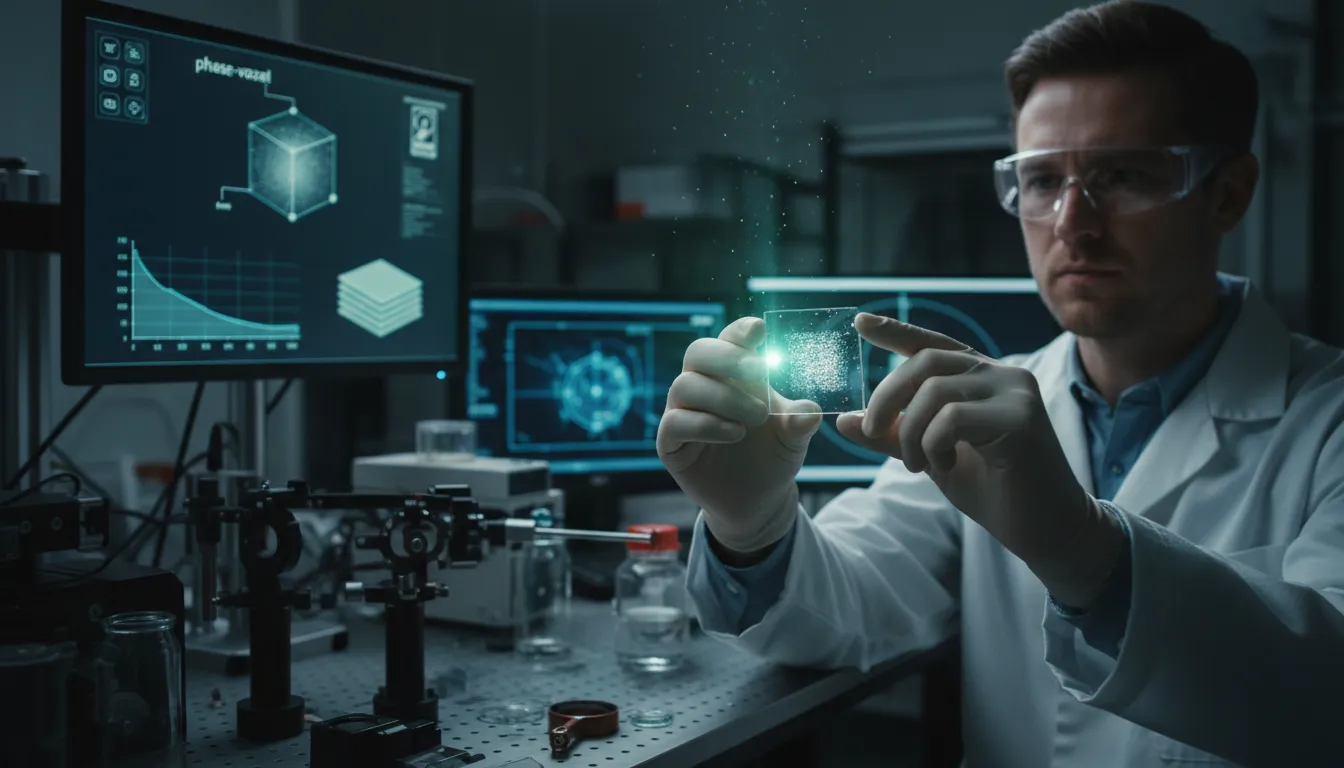
The glass in your oven door may soon have a second career as a data archive. On February 18, 2026, Microsoft Research published a landmark paper in Nature detailing the latest advances in Project Silica — a decade-long effort to encode data permanently in glass using femtosecond lasers. The results are striking: a 120-mm square, 2-mm-thick sheet of ordinary borosilicate glass can hold 2.02 terabytes of data, and accelerated aging tests suggest it will remain readable for at least 10,000 years.
From Expensive Silica to Cheap Cookware Glass
Earlier iterations of Project Silica relied on fused silica — a high-purity, costly material that is up to three times more expensive than borosilicate glass and far less widely manufactured. The new paper's central breakthrough is demonstrating that the same archival quality can be achieved in borosilicate glass, the everyday material found in Pyrex bakeware and laboratory equipment. This dramatically lowers the cost and complexity of scaling the technology toward commercial deployment.
The key enabling innovation is a new encoding method called phase voxels. Unlike the earlier birefringent voxel approach — which required multiple laser pulses and three cameras to read — phase voxels alter the physical microstructure of the glass with a single femtosecond laser pulse, changing how light waves travel through the material. Reading is simplified to a single camera, cutting hardware costs considerably. Machine learning algorithms compensate for the increased light interference that phase voxels introduce in borosilicate glass.
Write Speed and Density
Performance has improved substantially. The system achieves write speeds of 18.4 to 65.9 megabits per second on borosilicate glass — faster than the 25.6 Mbps previously demonstrated with fused silica. Data is encoded across 258 layers within the 2-mm glass plate, reaching a volumetric density of 0.678 gigabits per cubic millimeter. While this is roughly half the density achievable with fused silica (which stores up to 4.84 TB per plate), the cost advantage of borosilicate makes it a more viable pathway to mass adoption.
For context, current magnetic tape — the standard medium for cold archival storage — typically degrades and must be replaced within a decade. Glass requires no power, no cooling, and no periodic refreshing. It resists heat, moisture, electromagnetic pulses, and physical abrasion far better than any conventional storage medium.
The Road to Data Centers
Microsoft says the research phase is now complete and the company is exploring how to translate these findings into commercial applications, particularly for data centers handling vast volumes of rarely accessed "cold" data. The global datasphere is projected to reach hundreds of zettabytes by 2030, and the energy and maintenance costs of storing archival data on tape and spinning disks are mounting rapidly. Glass storage, which is passive and maintenance-free, could address both the economic and environmental burden.
No firm commercialization timeline has been announced. Earlier reporting had suggested pilot deployments for government archives and intelligence agencies could begin between 2025 and 2027, with broader commercial availability by the end of the decade. Microsoft has not confirmed these projections.
Why It Matters
Data permanence has long been a concern for libraries, cultural institutions, scientific repositories, and governments. The Nature paper arrives at a moment when the digital preservation community is acutely aware of the fragility of existing storage. Magnetic tape carries decades; optical discs centuries at best. Glass, if the Silica team's projections hold, carries millennia — long enough to outlast civilizations.
The shift from exotic fused silica to a material already manufactured at industrial scale worldwide is not a minor footnote. It is the difference between a laboratory curiosity and an industry-ready technology. Microsoft's glass may yet become the most durable storage medium humanity has ever made.