How Humanoid Robots Work—and Why Factories Want Them
Humanoid robots are entering real factories for the first time. Here is how their actuators, sensors, and AI systems work—and why the human-shaped form factor matters for industrial automation.
Why Build a Robot That Looks Like Us?
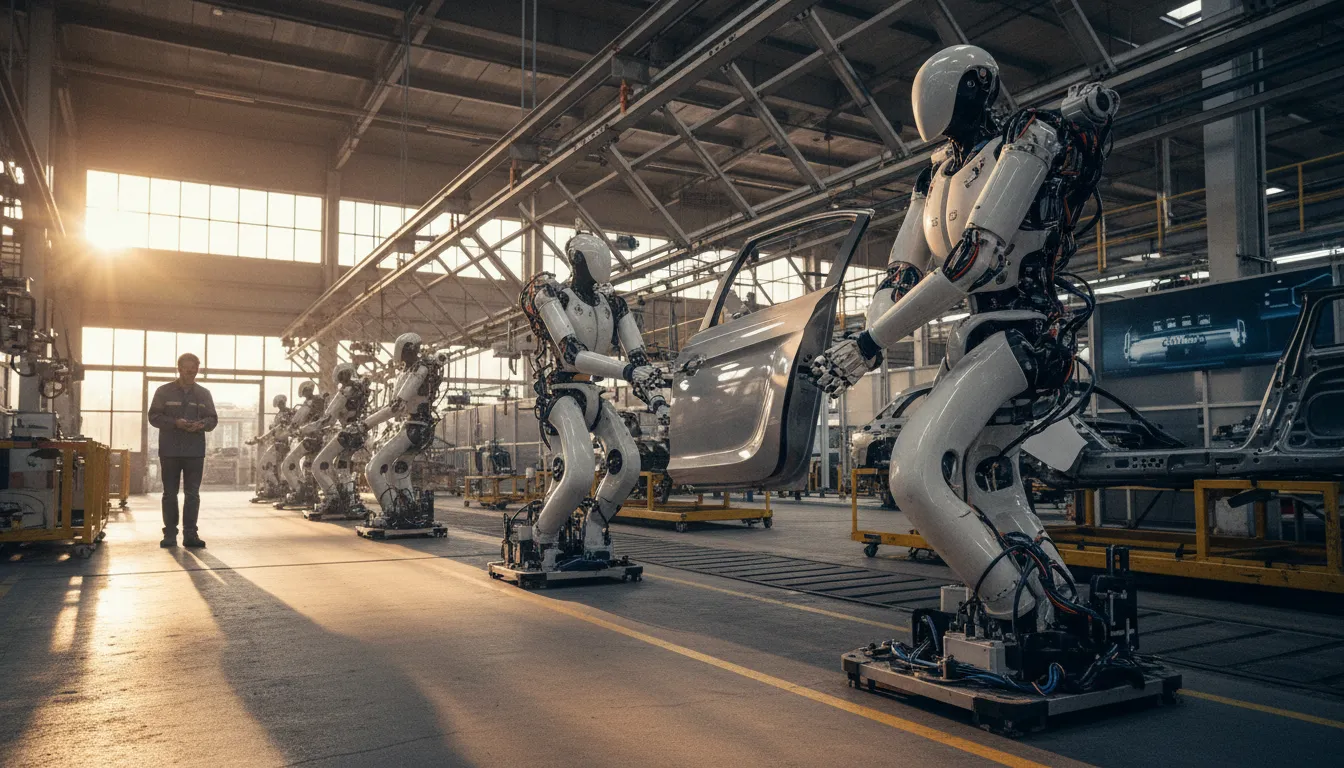
Factories already use thousands of industrial robots—bolted-down arms that weld, paint, and pick with inhuman speed. So why spend billions developing robots shaped like people? The answer is deceptively simple: the built environment was designed for the human body. Door handles, stairs, hand tools, control panels, and safety gates all assume an operator with two arms, two legs, grasping hands, and a sense of balance. A humanoid robot can slot into that same environment without costly retooling.
At Hannover Messe 2026, the world's largest industrial trade fair, companies from NVIDIA to BMW demonstrated humanoid robots performing real logistics and assembly work on factory floors—a signal that the technology is crossing from lab demo to pilot deployment.
Actuators: The Muscles
Every humanoid robot depends on actuators—devices that convert energy into physical motion. Most platforms use electric actuators built around frameless torque motors paired with precision reducers. The most common reducer is strain wave gearing (often called a Harmonic Drive), which delivers extremely high reduction ratios in a compact, lightweight package with near-zero backlash. This gives joints the torque needed to lift objects or maintain posture while keeping limbs slim enough to navigate human-sized spaces.
Some next-generation designs experiment with hydraulic actuators for heavier payloads, while researchers are exploring artificial muscles—materials that contract when electrically stimulated—and shape-memory alloys that change form when heated. For now, however, electric servo systems dominate commercial humanoids.
Sensors: The Nervous System
To operate safely alongside humans, a humanoid needs rich sensory feedback. Stereo vision cameras positioned like eyes provide depth perception, while LiDAR creates precise 3D maps of surroundings using laser pulses. Force and torque sensors embedded in joints and fingertips let the robot gauge grip pressure and detect slip—critical for handling fragile parts on an assembly line.
Balance relies on inertial measurement units (IMUs), the robotic equivalent of the inner ear. These combine accelerometers and gyroscopes to track orientation in three dimensions, feeding data to control algorithms that adjust dozens of motors hundreds of times per second to keep the robot upright.
AI: The Brain
Hardware alone cannot make a humanoid useful. Modern platforms run on foundation models—large neural networks trained on massive datasets of video, language, and simulated physics. Rather than programming each task manually, engineers train robots in simulation environments where they accumulate billions of virtual manipulation experiences before touching a real object—a technique known as sim-to-real transfer.
At Hannover Messe, NVIDIA demonstrated its physical AI stack powering robots from multiple manufacturers. The result: humanoids that can follow spoken commands like "pick up that box" without task-specific code, adapting to new objects and layouts on the fly.
Who Is Building Them?
The race is global. Chinese companies dominate early sales—Unitree shipped roughly 5,500 humanoid robots and Agibot about 5,100 units in recent periods, according to Rest of World. Western rivals include Figure AI (deployed at BMW's Spartanburg plant), Agility Robotics (building a factory for 10,000 Digit robots per year), and Tesla, which plans to begin preparations for a million-unit Optimus factory in 2026. Germany's Agile Robots debuted its Agile One at Hannover Messe, targeting European manufacturers.
Market analysts project the global humanoid robot market will grow from under $1 billion in 2025 to roughly $4.6 billion by 2030, a compound annual growth rate near 40 percent.
What They Can't Do Yet
For all the momentum, humanoid robots remain far slower and less reliable than traditional industrial arms. None yet operates at automotive-line production speeds. Key hurdles include dynamic collision avoidance in cluttered environments, battery life measured in hours rather than shifts, and the absence of safety certifications equivalent to those held by conventional robots. Most factory deployments remain pilot programs—proof-of-concept runs rather than full-scale production.
Still, the trajectory is clear. As AI models improve, actuator costs fall, and simulation environments grow more realistic, humanoid robots are poised to become a standard part of the factory workforce—not because they outperform specialized machines, but because they can go where specialized machines cannot.