How Soft Tissue Survives Inside Dinosaur Fossils
Scientists have found blood vessels, proteins, and flexible tissue inside bones millions of years old. Here is how iron chemistry, mineral sealing, and rapid burial preserve biological material across deep time.
A Discovery That Stunned Paleontology
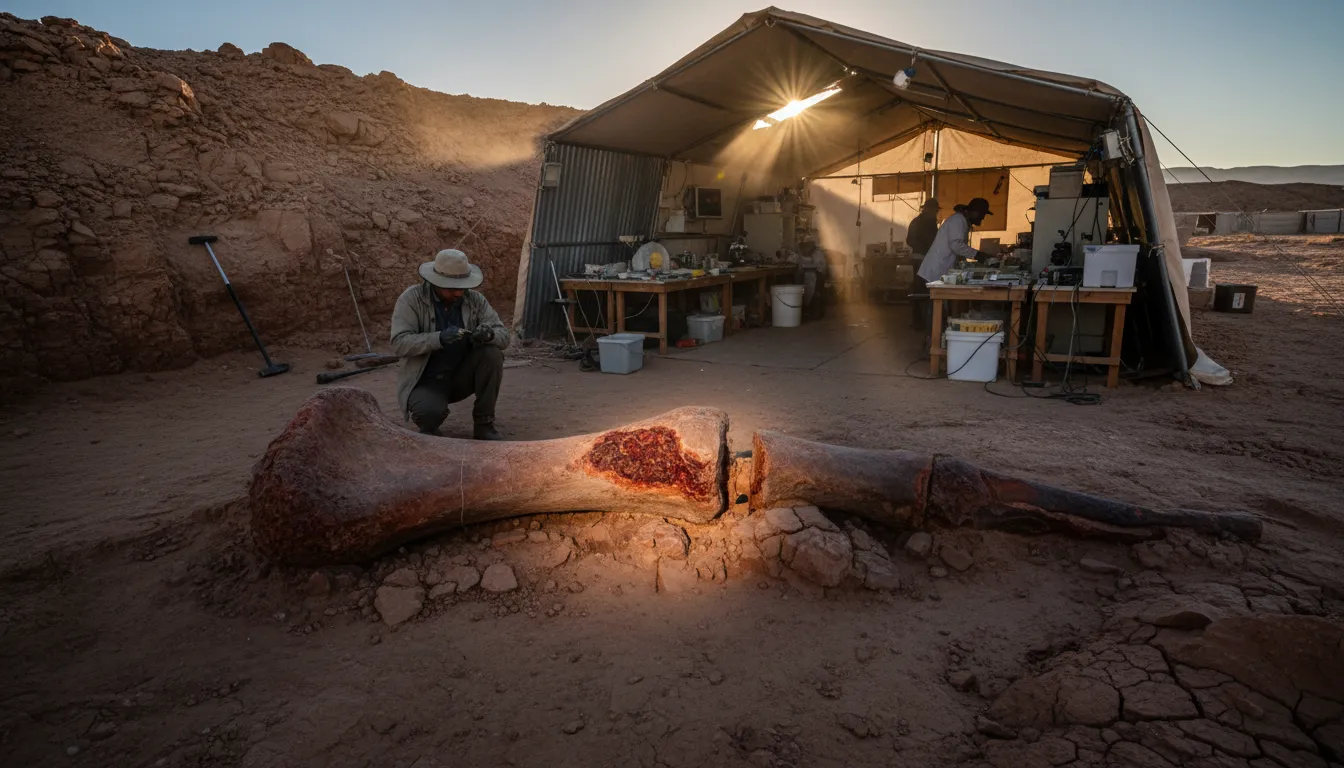
In 2005, paleontologist Mary Schweitzer at North Carolina State University cracked open the leg bone of a 68-million-year-old Tyrannosaurus rex and found something that should not have been there: soft, flexible tissue. Blood vessels stretched like rubber bands. Structures resembling red blood cells dotted the sample. Collagen — the protein that gives bone its strength — was still detectable.
The announcement shook paleontology. Conventional wisdom held that organic material breaks down completely within tens of thousands of years, replaced atom by atom with minerals during fossilization. Schweitzer's find suggested the textbooks were missing a chapter.
Iron: Nature's Formaldehyde
The leading explanation centers on iron. When an animal dies, hemoglobin in its red blood cells releases iron atoms. Those atoms react with oxygen to generate highly reactive molecules called free radicals. The radicals cause nearby proteins and cell membranes to form chemical crosslinks — bonds that tie biological molecules into tight, stable knots.
The effect is strikingly similar to what formaldehyde does when pathologists preserve tissue in a lab. Schweitzer's team demonstrated this with a vivid experiment: ostrich blood vessels soaked in a hemoglobin solution showed no degradation for over two years, while identical vessels in plain water fell apart within three days. The iron, in essence, embalms the tissue from the inside out.
Synchrotron X-ray studies have confirmed that preserved dinosaur vessels are coated in iron-rich nanoparticles, primarily the mineral goethite — a very stable iron oxyhydroxide that acts as both a chemical shield and a physical barrier against microbial attack.
Sealed in Stone
Iron chemistry alone is not the whole story. Several other factors work together to lock soft tissue away from decay:
- Mineral sealing. Tissue trapped in tiny pores within dense cortical bone is physically isolated from enzymes, bacteria, and groundwater that would otherwise digest it.
- Rapid burial. Quick sediment coverage limits oxygen exposure, slowing decomposition before crosslinking can take hold.
- Early mineralization. In some cases, phosphate minerals coat cell surfaces almost immediately after death — a process called phosphatization — creating a mineral cast of the original structure.
- Desiccation. If tissue dries out before it decays, the resulting chemical changes make it far more resistant to breakdown, even if it is later rehydrated underground.
More Common Than Anyone Thought
Schweitzer's original find was treated as a freak occurrence. It is not. Research published by NC State in 2025 showed that soft-tissue preservation can occur across multiple species, burial environments, and geologic ages. Scientists have recovered flexible structures from hadrosaurs, Brachylophosaurus, and even 80-million-year-old marine reptiles.
A striking recent example involves "Scotty," the largest known T. rex, housed at the Royal Saskatchewan Museum. Using synchrotron imaging, researchers found a network of preserved blood vessels inside a rib that had fractured and was still healing when the dinosaur died 66 million years ago. The incomplete healing process appears to have created conditions especially favorable for vessel preservation — suggesting that pathological bone, bone altered by injury or disease, may be a particularly rich target for future soft-tissue studies.
Why It Matters
Preserved soft tissue opens doors that mineralized bone alone cannot. Proteins carry information about an animal's physiology, metabolism, and evolutionary relationships that skeletal shape cannot reveal. Collagen sequences have already been used to confirm that T. rex is more closely related to modern birds than to living reptiles — a conclusion consistent with skeletal evidence but now supported at the molecular level.
The field remains young and sometimes contentious. Critics have questioned whether some reported tissues might be bacterial biofilms mimicking original structures. But advancing imaging technology — particularly synchrotron X-rays that can probe fossils without destroying them — is steadily strengthening the case that genuine biological material can endure across deep time, locked in iron and sealed in stone.