How Iran's Supreme Leader Is Chosen—and Why It Matters
Iran's Supreme Leader holds near-absolute power, but the selection process involves a little-known clerical body, heavy vetting, and a constitutional design that makes oversight nearly impossible.
The Most Powerful Office You've Never Voted For
Iran's Supreme Leader is the single most powerful figure in the Islamic Republic — commander of the armed forces, arbiter of foreign policy, and final authority over every branch of government. Yet this position is not filled by popular vote. Instead, a closed circle of senior clerics selects the leader through a process designed to keep power within a tightly controlled ideological orbit.
Understanding how the Supreme Leader is chosen reveals the inner logic of Iran's political system — a hybrid of theocracy and managed democracy that concentrates ultimate authority in a single religious figure.
Velayat-e Faqih: The Governing Doctrine
The office rests on velayat-e faqih — the "Guardianship of the Islamic Jurist." Developed by Ayatollah Ruhollah Khomeini before the 1979 revolution, this concept holds that a learned Shia cleric should govern the state until the return of the Twelfth Imam, a messianic figure in Twelver Shia Islam who is believed to have gone into hiding in 874 C.E.
Under articles 57 and 110 of Iran's constitution, the Supreme Leader sets domestic and foreign policy, supervises all three branches of government, controls the judiciary through his appointment of the chief justice, and commands the armed forces, including the Islamic Revolutionary Guard Corps. He also controls state media and, through the Guardian Council, holds effective veto power over who may run for public office.
The Assembly of Experts: The Electoral Body
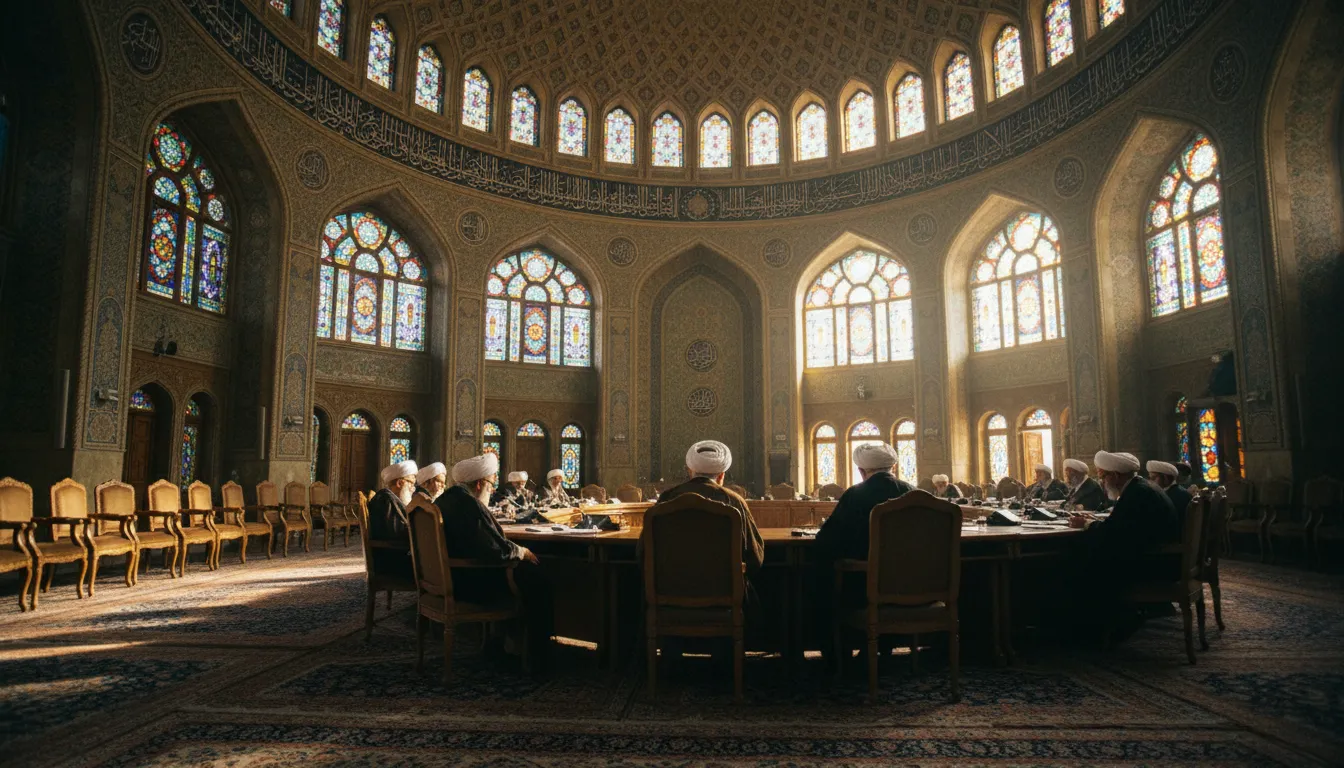
The Supreme Leader is formally elected — and can theoretically be dismissed — by the Assembly of Experts, an 88-member body of senior Shia clerics. Members serve eight-year terms and are themselves elected by the Iranian public.
The Assembly was first established after the revolution to draft a new constitution. It was reconstituted in 1983 with its current mandate: selecting, supervising, and if necessary removing the Supreme Leader. In practice, however, the Assembly has never dismissed or even publicly questioned a sitting leader.
Iran has had only one leadership succession. When Khomeini died in June 1989, the Assembly chose Ali Khamenei — then a relatively junior cleric — as his replacement. The original heir apparent, Ayatollah Montazeri, had been stripped of the position months earlier after clashing with Khomeini over mass executions of political prisoners.
The Guardian Council: The Real Gatekeeper
The process appears democratic on paper, but the Guardian Council ensures it functions as a closed loop. This 12-member body — six clerics appointed directly by the Supreme Leader and six jurists nominated by his appointed chief justice — vets every candidate for every election in Iran, including the Assembly of Experts itself.
The result is a constitutional paradox: the body tasked with overseeing the Supreme Leader is staffed exclusively by candidates pre-approved by institutions the Supreme Leader controls. In the 2016 Assembly elections, the Guardian Council approved only 166 of 801 applicants. Reformists and independents are routinely disqualified.
Powers Without Parallel
What makes this selection process so consequential is the scope of the office it fills. Unlike a constitutional monarch or ceremonial president, the Supreme Leader exercises day-to-day control over policy. He appoints the heads of the judiciary, state broadcasting, and major military and intelligence bodies. He can override the elected president and parliament. No law takes effect without the approval of his Guardian Council.
The position is held for life, with no term limits — making the succession question one of the most significant events in Iranian politics.
Why the System Resists Change
Critics argue that the interlocking appointment structure — where the leader shapes the very bodies meant to check his power — makes genuine accountability impossible. Defenders counter that the Assembly of Experts retains the constitutional right to dismiss a leader, providing at least a theoretical safeguard.
Either way, the architecture ensures that leadership transitions in Iran are not moments of democratic renewal. They are elite negotiations conducted behind closed doors, shaped by clerical networks, and ultimately determined by institutions that the outgoing leader helped build. For anyone seeking to understand Iran's political trajectory, the succession process is the place to start.