2025 German Federal Election: CDU Wins, AfD Reaches Record High
The CDU/CSU won the federal election on February 23, 2025, with 28.5 percent; the AfD doubled its result to 20.8 percent and became the second-strongest force. Friedrich Merz was elected Chancellor in May 2025 and leads a grand coalition with the SPD.
A Historic Election Night
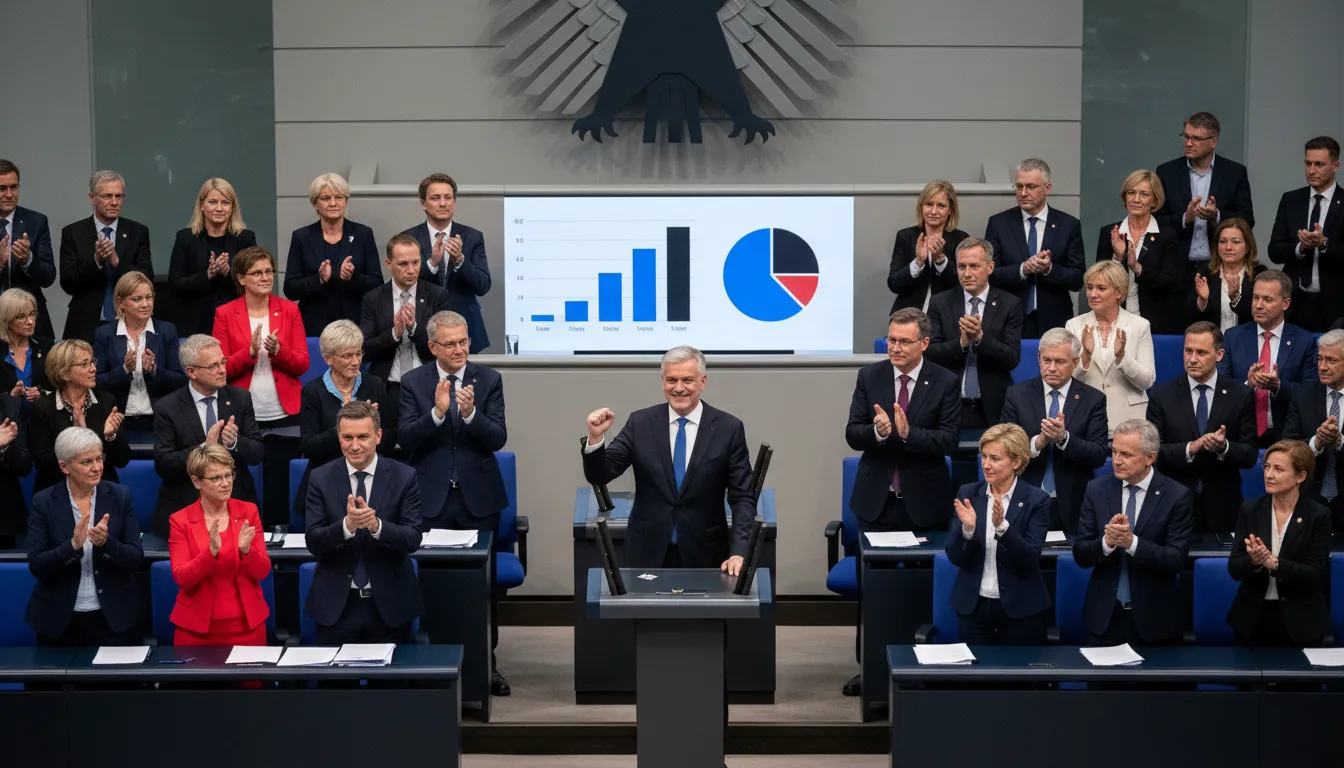
With a voter turnout of 82.5 percent—the highest in decades—Germany experienced a federal election on February 23, 2025, with far-reaching consequences. The CDU/CSU under Friedrich Merz achieved a clear victory with 28.5 percent of the second votes. But the real sensation of the evening was the performance of the Alternative for Germany: The AfD almost doubled its 2021 result and landed in second place with 20.8 percent—a historic record result for the party at the federal level.
AfD Rises to Second-Strongest Force
With 152 seats in the newly elected Bundestag, the AfD has risen to become the second-strongest parliamentary group for the first time. The party celebrated triumphs, especially in the east of the country: In Thuringia, it received 38.6 percent of the second votes, in Saxony 37.3 percent, and in Saxony-Anhalt 37.1 percent. The result is seen as an expression of deep-seated dissatisfaction among broad sections of the population with the policies of the previous traffic light coalition—and poses the question to the other parties of how they want to deal with the strengthened right-wing camp.
SPD at Historic Low
The SPD suffered the most painful slump: With only 16.4 percent, the party lost more than nine percentage points compared to its 2021 result (25.7 percent). The Social Democrats will in the future only provide 120 members in the 630-member Bundestag. Alliance 90/The Greens came in at 11.6 percent, The Left surprised with a strong result of 8.8 percent.
Grand Coalition with Clear Majority
On the election night itself, Friedrich Merz announced that he wanted to seek a coalition with the SPD. The so-called grand coalition has 328 seats and thus has a solid majority in the Bundestag. After weeks of negotiations, the party leaders signed the 144-page coalition agreement on May 5, 2025, under the title "Responsibility for Germany".
However, the chancellorship election on May 6 was bumpy: In the first ballot, Merz narrowly missed the required majority of 316 with 310 votes. Only in the second ballot did he receive 325 votes and was thus elected the tenth Chancellor of the Federal Republic. Lars Klingbeil (SPD) takes over the office of Vice-Chancellor and Finance Minister, Johan Wadephul (CDU) becomes Foreign Minister.
Strengthening Europe—Becoming Step-by-Step More Independent from the USA
Merz has made it clear from the start that his central foreign policy goal is to strengthen Europe. "We must not allow the USA and China alone to determine the technological future—for our prosperity, for our security, and ultimately also for our freedom," the Chancellor declared. The coalition agreement focuses on increased European defense cooperation and higher defense spending. At the same time, the new federal government is committed to the Paris Climate Agreement and to Germany's climate neutrality by 2045.
Far-Reaching Consequences for Europe
The election result is likely to have a lasting impact on European security and economic policy. A capable Germany under Merz is considered an important anchor of stability for the EU—especially in view of the ongoing Russian war of aggression against Ukraine and an unpredictable US foreign policy. However, the historic AfD result raises questions about social cohesion: More than one in five voters voted for a party that the Office for the Protection of the Constitution had classified as "definitely right-wing extremist." How the new federal government deals with this voter mandate will be one of the central challenges of the coming years.


