Chancellor Merz: Europe at a Crossroads
A year after Friedrich Merz's victory in the German federal elections, the Franco-German partnership remains weakened by tensions over the FCAS and nuclear deterrence, while Berlin undertakes a historic budgetary shift for European defense.
A Conservative Victory Amid Historic Far-Right Breakthrough
The German federal elections of February 23, 2025, saw the victory of Friedrich Merz's CDU/CSU with 28.5% of the vote, paving the way for a grand coalition with the SPD (16.4%). But the real shock of the evening was elsewhere: Alice Weidel's AfD achieved a historic score of 20.8%, doubling its 2021 result and establishing itself as the country's second-largest political force — a first for a far-right movement since World War II. Turnout reached 84%, a record in decades, revealing unprecedented citizen mobilization in a country grappling with a triple economic, security, and identity crisis.
Merz quickly confirmed his intention to form a coalition with the Social Democrats, rejecting any alliance with the AfD. The Chancellor, invested in May 2025, immediately set the course: strengthening Europe to enable it to acquire "strategic independence" from the United States.
Franco-German Partnership on the Brink of Impasse
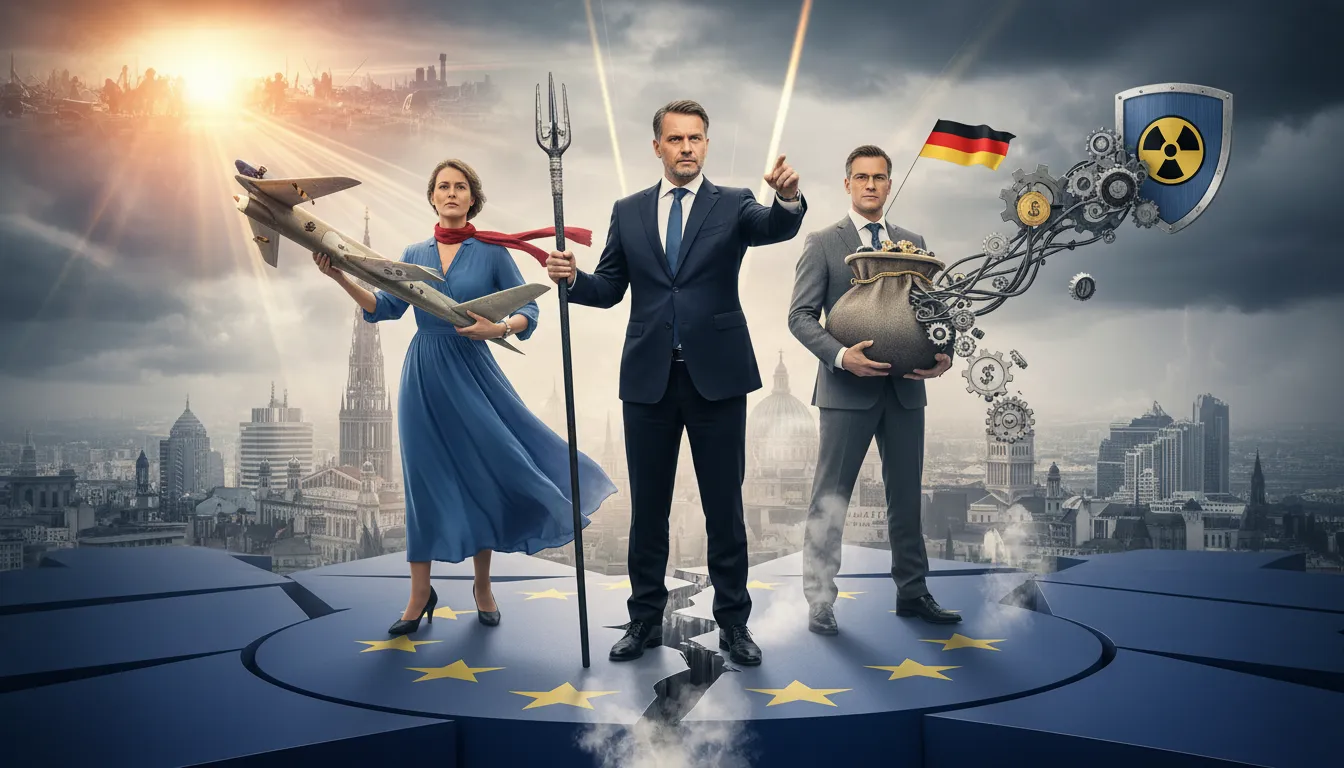
For Paris, the new German landscape opens a period that is both promising and fraught with tension. While Merz and Macron share the ambition of a more sovereign Europe, bilateral frictions are multiplying. The issue of the Future Combat Air System (FCAS) is a major point of contention: the Chancellor has publicly questioned the viability of the Franco-German-Spanish trilateral project, pointing out that Paris and Berlin are "in disagreement on the specifications and profiles" of the aircraft. The Élysée responded by deeming these blockages "incomprehensible" at a time when Europe must "show unity and performance."
Other points of friction are accumulating: Berlin accuses France of insufficient efforts in defense spending and of seeking to block a trade agreement with Mercosur countries. The Franco-German couple, which IFRI analysts describe as a "limping partnership," is struggling to find an operational compromise despite repeated summits.
Nuclear Deterrence, New Area for Dialogue
At the Munich Security Conference in February 2026, Merz revealed that he had engaged in confidential discussions with Macron on European nuclear deterrence. The Chancellor is advocating for a continental nuclear umbrella, while setting a clear limit: this mechanism must be "strictly within the framework of nuclear participation in NATO." Macron, for his part, is preparing to update the French nuclear doctrine to integrate a more explicit European dimension — an evolution that is being watched with particular attention in Brussels, Bern, and in French-speaking capitals.
Historic Budgetary Shift with European Repercussions
The CDU/CSU-SPD grand coalition has embarked on an unprecedented economic shift: it has relaxed the constitutional debt brake to exempt defense spending exceeding 1% of GDP, and created a special fund of 500 billion euros for infrastructure and security. This "fiscal bazooka," as IFRI has termed it, could give a decisive boost to joint European investment — provided that Paris and Berlin can overcome their structural disagreements.
The sustained rise of the AfD — now the leading opposition party with a fifth of the electorate — will subject German foreign policy to permanent populist pressure. For the Franco-German engine of European integration, the time is no longer for certainties, but for the patient reconstruction of a trust that has been severely tested.