Webb Detects Hydrogen Sulfide on Exoplanets First Time
For the first time in history, astronomers using the James Webb Space Telescope have identified hydrogen sulfide in the atmospheres of giant exoplanets orbiting HR 8799, reshaping our understanding of how gas giants form.
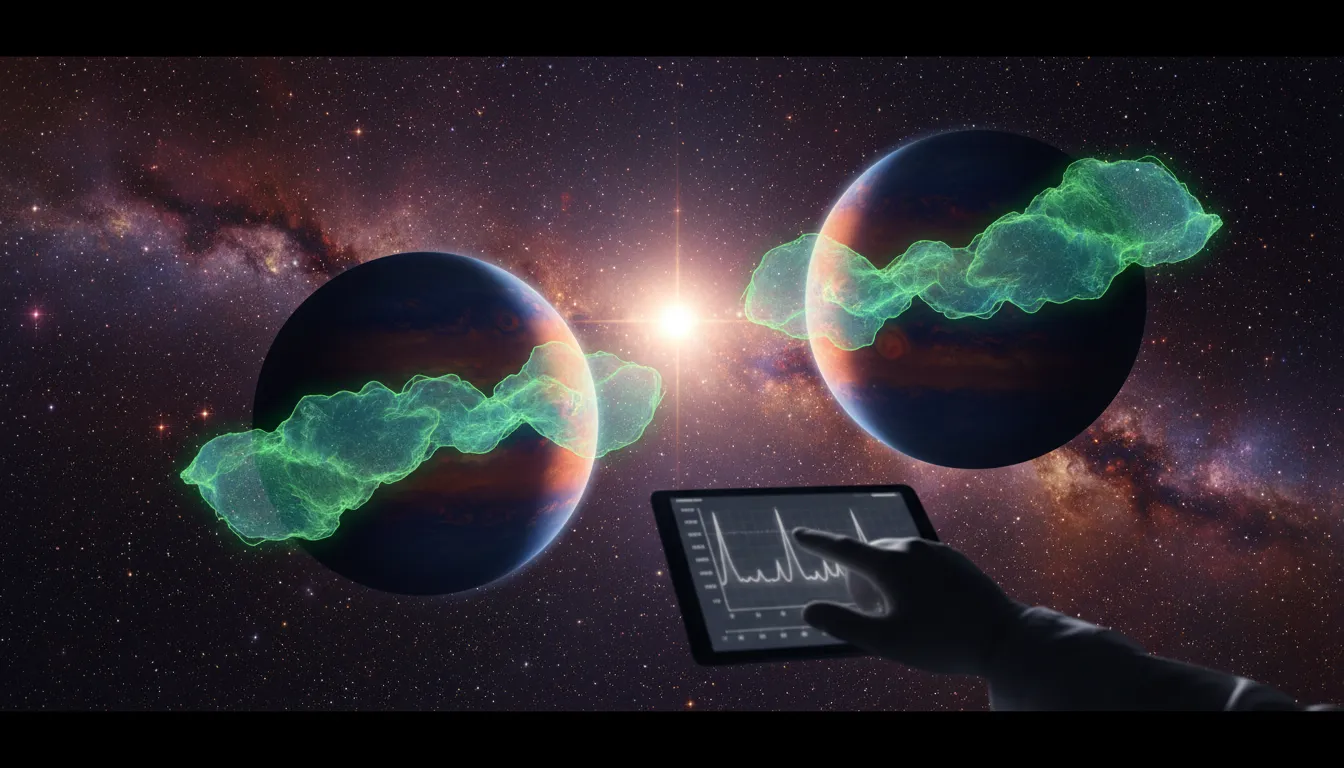
A Cosmic First: Rotten-Egg Gas Beyond Our Solar System
Astronomers have detected hydrogen sulfide — the gas best known for its rotten-egg odor — in the atmospheres of giant exoplanets for the very first time. Using the James Webb Space Telescope (JWST), a team from UCLA and UC San Diego identified the molecule in the atmospheres of planets orbiting HR 8799, a young star roughly 130 light-years away in the constellation Pegasus. The findings, published on February 9, 2026, in Nature Astronomy, mark a landmark moment in exoplanet science.
The HR 8799 System
HR 8799 hosts four massive gas giants — among the very few exoplanets ever imaged directly by ground-based telescopes. The planets range from five to ten times the mass of Jupiter and orbit at vast distances from their star, the closest sitting 15 times farther out than Earth is from the Sun. The star itself is only about 30 million years old, making the system a relatively pristine laboratory for studying planetary formation.
JWST's extraordinary sensitivity allowed the team to dissect the light from planets that are approximately 10,000 times fainter than their host star. The resulting spectra revealed a rich chemical inventory: water, carbon monoxide, methane, carbon dioxide, and crucially, hydrogen sulfide (H₂S) — along with rare isotopologues such as ¹³CO and C¹⁸O.
Why Sulfur Changes Everything
The detection of sulfur is more than a chemical curiosity — it is a powerful forensic clue about how these planets were born. At the enormous orbital distances of the HR 8799 planets, sulfur cannot exist as a gas in the protoplanetary disk; it is locked into solid grains and icy bodies.
"There's no way these planets could have accreted sulfur as gas," said Dr. Jerry Xuan of UCLA, a lead researcher on the study. "It has to be in the solids."
This means the planets must have first built up a substantial solid core — sweeping up sulfur-rich rock and ice — before gravitationally capturing surrounding gas. That mechanism, known as core accretion, is the same process that formed Jupiter and Saturn in our own solar system.
Rethinking Giant Planet Formation
The discovery is particularly surprising because these are super-Jupiters: objects so massive that astronomers long suspected they might have formed like stars rather than planets, through direct gravitational collapse of gas clouds. The sulfur evidence argues strongly against that hypothesis.
"With the detection of sulfur, we are able to infer that the HR 8799 planets likely formed in a similar way to Jupiter despite being five to ten times more massive, which was unexpected," said Jean-Baptiste Ruffio of UC San Diego, another key author. Co-author Quinn Konopacky added that older formation models are now outdated: "We're looking at ones where gas giants form solid cores really far away."
The levels of carbon, oxygen, and sulfur enrichment in these planets' atmospheres significantly exceed those of their host star — a pattern also seen in Jupiter and Saturn — suggesting a universal enrichment mechanism at work across planetary systems.
A Window Into the Future of Exoplanet Science
Beyond settling a decades-long debate about giant planet origins, the study demonstrates a powerful new spectroscopic toolkit. Researchers believe these techniques could eventually be adapted to search for biosignature gases on smaller, Earth-like worlds — though Xuan cautions that detecting a true Earth analog remains "probably decades away."
For now, the first whiff of hydrogen sulfide beyond our solar system has left an unmistakable mark on astronomy — rewriting formation theory one spectrum at a time.


