How Scientists Size Up Giant Prehistoric Snakes
Paleontologists reconstruct the length and mass of ancient mega-snakes like Titanoboa and Vasuki indicus from a handful of fossilized vertebrae, using mathematical models calibrated against living species.
A Backbone Is All They Need
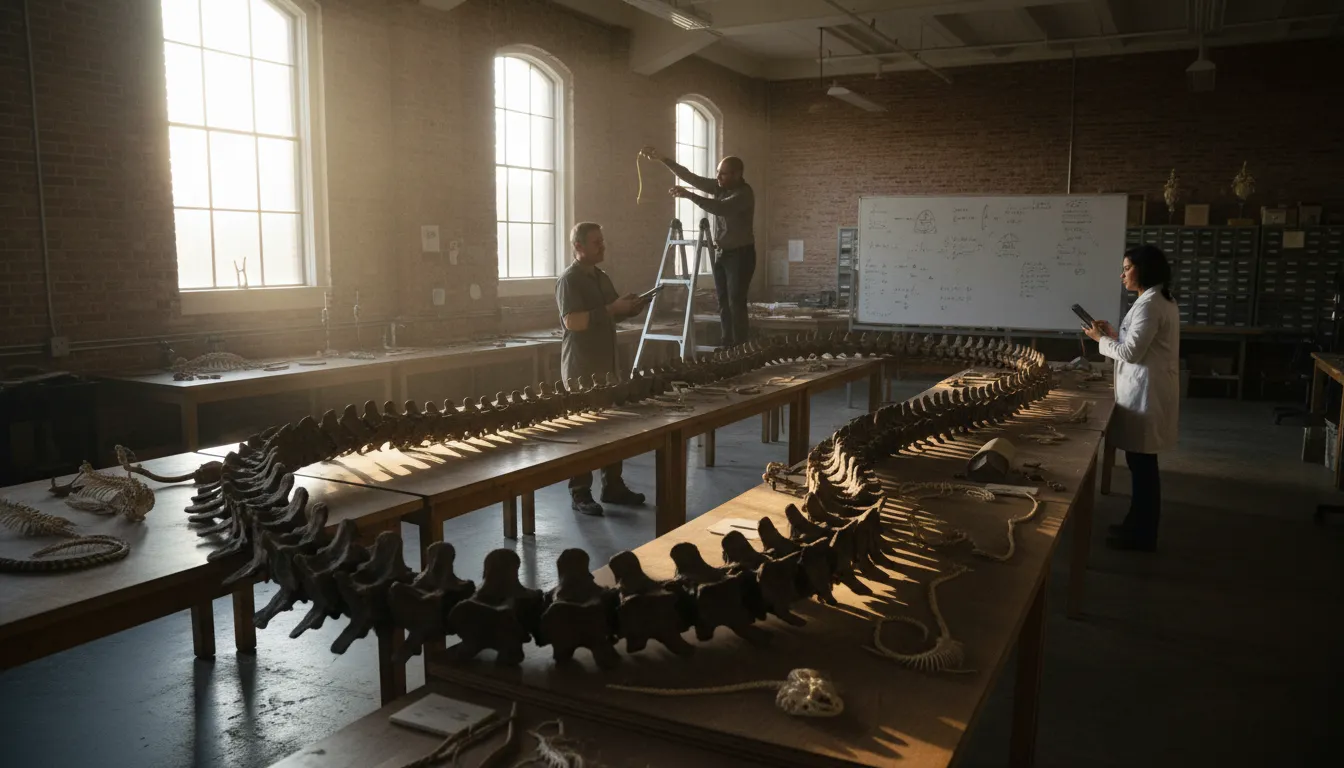
Snakes rarely leave complete skeletons behind. Their delicate ribs scatter, skulls crush easily, and soft tissue vanishes long before fossilization can preserve it. What does survive, remarkably well, are vertebrae—the interlocking bones that form a snake's spine. Because a single large snake can have more than 250 of them, the odds of at least a few turning to stone are decent. From those few bones, paleontologists can reconstruct an animal's entire body plan.
The method has revealed some staggering creatures. Titanoboa cerrejonensis, unearthed in Colombian coal mines, stretched an estimated 13 metres and weighed over a tonne. Vasuki indicus, described from fossils found in a lignite mine in Gujarat, India, may have reached 11 to 15 metres—rivalling or even exceeding Titanoboa. Both lived tens of millions of years ago, in climates far warmer than today's.
Why Vertebrae Work So Well
In modern constrictors such as boas, pythons, and anacondas, a bigger body means bigger vertebrae, not necessarily more of them. This principle is the foundation of every size estimate for fossil snakes. If a researcher measures the width and length of a single vertebra, and knows roughly where along the spine it sat, that measurement can be plugged into a regression equation built from data on living species.
Determining a vertebra's position is itself a science. Snake vertebrae change shape along the spine—those near the midsection are the widest, while those closer to the head or tail are narrower and structured differently. By comparing a fossil's geometry to the vertebrae of modern boine snakes, scientists can estimate that a given bone sat, say, about 60 to 65 percent down the spine from the skull.
The Math Behind the Monster
Once a vertebra's spinal position is established, researchers apply predictive regression equations. Two key measurements dominate the calculations: prezygapophyseal width and postzygapophyseal width—essentially the span of bony projections that lock each vertebra to its neighbours.
For Vasuki indicus, these two methods produced different length ranges. One equation estimated 10.9 to 12.2 metres; the other yielded 14.5 to 15.2 metres. The discrepancy highlights an inherent challenge: Vasuki belongs to the madtsoiidae, an extinct family only distantly related to the modern boas and pythons used to calibrate the models. As study co-author Debajit Datta has noted, "when you're using existing snakes to estimate body length, there may be uncertainties."
Titanoboa's size was pinned down with somewhat more confidence because researchers recovered 186 fossils from roughly 30 individuals at Colombia's Cerrejón coal mines, including at least one nearly complete specimen with a skull. Skull-based proportions later pushed estimates up to about 14.3 metres.
What Giant Snakes Reveal About Ancient Climates
Size estimation is not just about bragging rights. Because snakes are ectotherms—cold-blooded animals whose body temperature tracks their environment—their maximum body size is constrained by ambient temperature. A hotter world allows bigger snakes. When paleontologist Jason Head and colleagues first described Titanoboa in 2009, they used this relationship to calculate that equatorial temperatures 58 million years ago reached at least 32–33 °C, several degrees warmer than the modern tropics.
That conclusion sparked scientific debate. Some researchers argued the body-size–temperature link is not as clean-cut as the model assumed. Still, the core insight stands: fossil snakes serve as rough paleothermometers, offering a biological cross-check on temperature estimates derived from geochemistry alone.
Pushing the Limits of Fossil Evidence
Every giant-snake estimate carries caveats. The fossils may not come from the largest individual of the species. The regression models rely on modern relatives that diverged tens of millions of years ago. And each vertebra provides a range, not a precise figure. Yet the method has proved remarkably consistent: independent analyses using different calibration species and different statistical approaches converge on broadly similar sizes for both Titanoboa and Vasuki.
As new fossils surface from mines and quarries across the tropics, the roster of prehistoric mega-snakes continues to grow—and so does the toolkit for reading their bones. What started as an educated guess from a single backbone has matured into a quantitative science, one vertebra at a time.