How Nuclear Clocks Work—and Why They Beat Atomic Ones
Nuclear clocks use energy transitions inside atomic nuclei rather than electron shells, promising ten times the precision of today's best atomic clocks. Built around thorium-229, they could transform GPS, detect dark matter, and test whether the laws of physics truly stay constant.
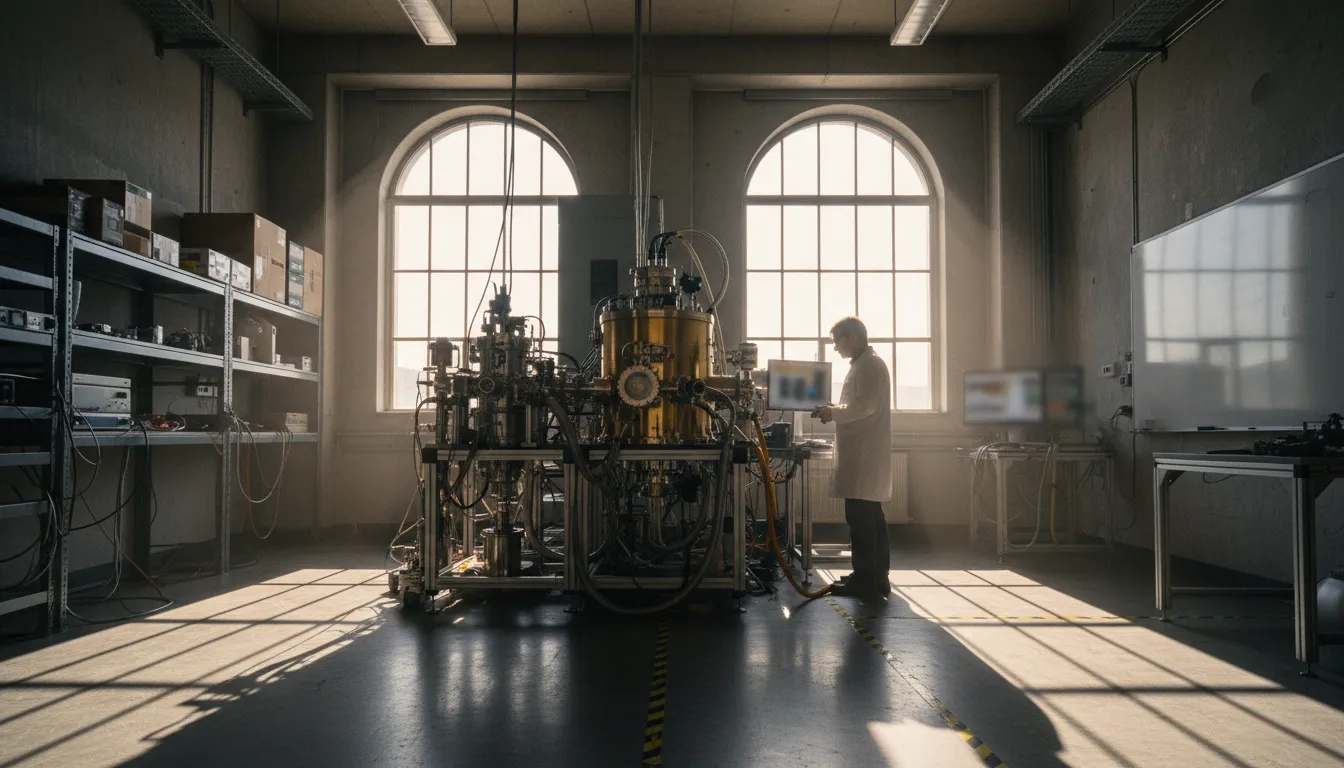
The Next Leap in Timekeeping
The best atomic clocks alive today lose roughly one second every 30 billion years. That already sounds absurd—yet physicists want to do better. A new breed of timepiece called the nuclear clock promises up to ten times greater precision by measuring energy shifts deep inside the atomic nucleus instead of in the surrounding electron cloud. After decades of theoretical work, multiple research teams across the United States, Europe, China, and Japan are now racing to build the first practical prototype.
How Atomic Clocks Keep Time
Every precision clock needs a reliable "tick." In an atomic clock, that tick comes from electrons jumping between energy levels when struck by microwave or laser light at exactly the right frequency. Scientists tune the laser until the atoms absorb maximally, then count the light's wave cycles. The higher the frequency, the finer the ruler—and the more precise the clock.
But electrons orbit far from the nucleus, making them sensitive to stray electric and magnetic fields, temperature shifts, and other environmental noise. Even the best shielding cannot eliminate every disturbance.
Going Nuclear: A Smaller, Steadier Tick
A nuclear clock works on the same principle but targets a transition inside the nucleus, where protons and neutrons are packed together by the strong nuclear force. Because the nucleus is roughly 100,000 times smaller than the electron cloud, it is far more shielded from outside interference. That natural isolation means fewer disruptions and, in theory, a much more stable frequency reference.
The catch is energy. Most nuclear transitions require X-rays or gamma rays—frequencies far too high for any practical laser. For decades, that made nuclear clocks a theoretical curiosity.
Why Thorium-229 Changes Everything
Among all known isotopes, thorium-229 is unique. It possesses a metastable nuclear state—called an isomer—at an extraordinarily low energy of about 8.4 electron volts. That puts the transition within reach of vacuum-ultraviolet lasers, the kind scientists can actually build and control on a tabletop.
Pinpointing that energy took decades of painstaking work. As physicist Eric Hudson of UCLA told Nature, finding the transition frequency was like searching for a needle in a haystack orders of magnitude larger than any literal one. A landmark 2024 experiment at JILA, a NIST–University of Colorado partnership, finally measured the thorium-229 nuclear transition with million-fold better precision than any previous attempt, establishing the first direct frequency link between a nuclear transition and an atomic clock.
From Lab Curiosity to Practical Device
Recent breakthroughs have accelerated the timeline. Researchers have discovered that electroplating tiny amounts of thorium onto steel can replace delicate crystals, dramatically simplifying the engineering. A solid-state approach—embedding thorium nuclei inside a crystal lattice—means thousands of emitters can be packed together, boosting the signal while keeping the device compact enough for field deployment.
Nearly a dozen teams worldwide are now assembling the key components: radioactive thorium-229 sources and powerful continuous-wave ultraviolet lasers. Early nuclear-clock measurements are widely expected in 2026, with physicists projecting that mature devices could eventually resolve 20 or 21 frequency digits—losing just one second over trillions of years.
What Nuclear Clocks Could Unlock
Ultra-precise timekeeping has consequences far beyond punctuality:
- GPS and navigation — Centimeter- or even millimeter-level positioning accuracy would benefit autonomous vehicles, precision agriculture, and assistive technology for the visually impaired.
- Dark matter detection — Dark matter interacts differently with nuclei than with electrons. Comparing a nuclear clock against an atomic clock might reveal subtle frequency drifts that conventional detectors miss.
- Fundamental physics — Because thorium's nuclear transition is sensitive to both the strong force and electromagnetic force, nuclear clocks can test whether the so-called constants of nature—such as the fine-structure constant—truly remain constant over time.
A Tick Worth Waiting For
Nuclear clocks will not replace atomic clocks overnight. The current best prototype resolves only 12 frequency digits, compared with 18 for top optical atomic clocks. But the physics community is optimistic that the gap will close rapidly as laser technology and thorium handling improve. When it does, the nuclear clock could become the most precise instrument humanity has ever built—and a new window into the deepest workings of the universe.