How the Radial Velocity Method Detects Alien Worlds
The radial velocity method—also called the wobble method—finds exoplanets by measuring tiny Doppler shifts in starlight caused by a planet's gravitational tug on its host star. Here is how it works and why it remains essential to planet hunting.
The Wobble That Reveals Hidden Planets
When a planet orbits a star, the star does not sit perfectly still. The planet's gravity pulls the star into a small orbit of its own around the pair's shared center of mass. The resulting back-and-forth motion is minuscule—often just a few meters per second—but it leaves a telltale fingerprint in the star's light. Detecting that fingerprint is the basis of the radial velocity method, one of the most powerful tools astronomers have for finding worlds beyond our solar system.
How Doppler Shifts Betray a Planet
The technique exploits the Doppler effect, the same phenomenon that makes an ambulance siren sound higher-pitched as it approaches and lower-pitched as it recedes. When a star moves toward Earth, its light waves compress slightly, shifting toward the blue end of the spectrum. When it moves away, the waves stretch toward the red end. By splitting starlight into a detailed spectrum and tracking these periodic blue-and-red shifts, astronomers can infer a planet's presence, its minimum mass, and the shape and size of its orbit.
No photograph of the planet is needed. The star itself acts as the messenger, its spectral lines rocking back and forth with clockwork regularity each time an unseen companion completes an orbit.
Instruments That Measure Centimeters per Second
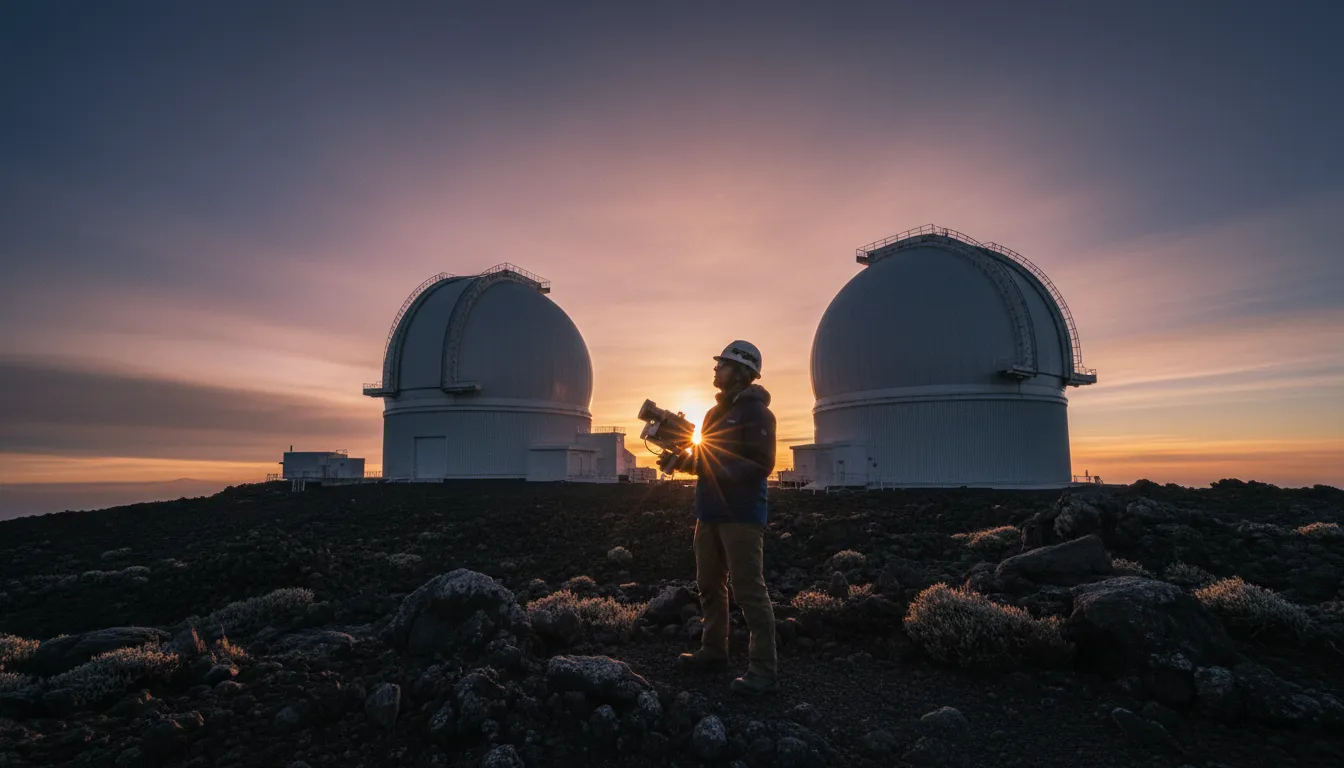
Detecting a wobble of a few meters per second across light-years of space demands extraordinary precision. The breakthrough came in the 1990s with purpose-built spectrographs. HARPS (High Accuracy Radial velocity Planet Searcher), installed in 2002 on the European Southern Observatory's 3.6-meter telescope at La Silla, Chile, can measure stellar velocities to about 1 meter per second—roughly walking pace. It achieved this by sitting inside a vacuum vessel, temperature-controlled to within a hundredth of a degree, and comparing starlight against a reference spectrum in real time.
Its successor, ESPRESSO, mounted on the Very Large Telescope in Chile, pushes precision down to roughly 10 centimeters per second—sensitive enough to detect Earth-mass planets from the ground. These instruments split starlight into thousands of narrow channels, hunting for shifts smaller than the width of an atom.
What It Finds Best—and Where It Struggles
The radial velocity method excels at finding massive planets on tight orbits. A heavy planet close to its star produces the largest, fastest wobble, making so-called "hot Jupiters" the easiest targets. In 1995, Michel Mayor and Didier Queloz used the technique to confirm 51 Pegasi b, the first exoplanet found orbiting a Sun-like star—a discovery that earned them the 2019 Nobel Prize in Physics.
Small, distant planets are harder. An Earth-like world orbiting a Sun-like star at Earth's distance induces a wobble of only about 9 centimeters per second—right at the edge of what current technology can reliably measure. Stellar surface activity, such as starspots and convection, can also mimic or mask planetary signals, forcing astronomers to develop sophisticated filtering techniques.
Partner to the Transit Method
Today, the transit method—watching for a star's brightness to dip as a planet crosses in front of it—accounts for the majority of known exoplanets, largely thanks to NASA's Kepler and TESS missions. But radial velocity remains indispensable. Transits reveal a planet's size; radial velocity reveals its mass. Combining both measurements lets scientists calculate density, which in turn hints at whether a world is rocky, gaseous, or something in between.
Moreover, transits require a precise geometric alignment—the planet must pass directly between its star and Earth. Radial velocity has no such restriction, meaning it can detect planets that transit methods miss entirely.
A Method With a Long Future
As of early 2026, more than 1,100 exoplanets—about 19 percent of all confirmed discoveries—have been found using radial velocity. Next-generation instruments aim to push precision below 1 centimeter per second, opening the door to detecting true Earth analogues around nearby stars. Combined with space telescopes that can directly image planetary atmospheres, the humble stellar wobble may ultimately help answer whether any of those distant worlds harbor conditions suitable for life.