What Are Super-Puff Planets and How Do They Form?
Super-puff exoplanets have the density of cotton candy despite being nearly the size of Jupiter. Scientists are using the James Webb Space Telescope to unravel how these bizarre worlds form and why they are losing their atmospheres into space.
Planets as Light as Cotton Candy
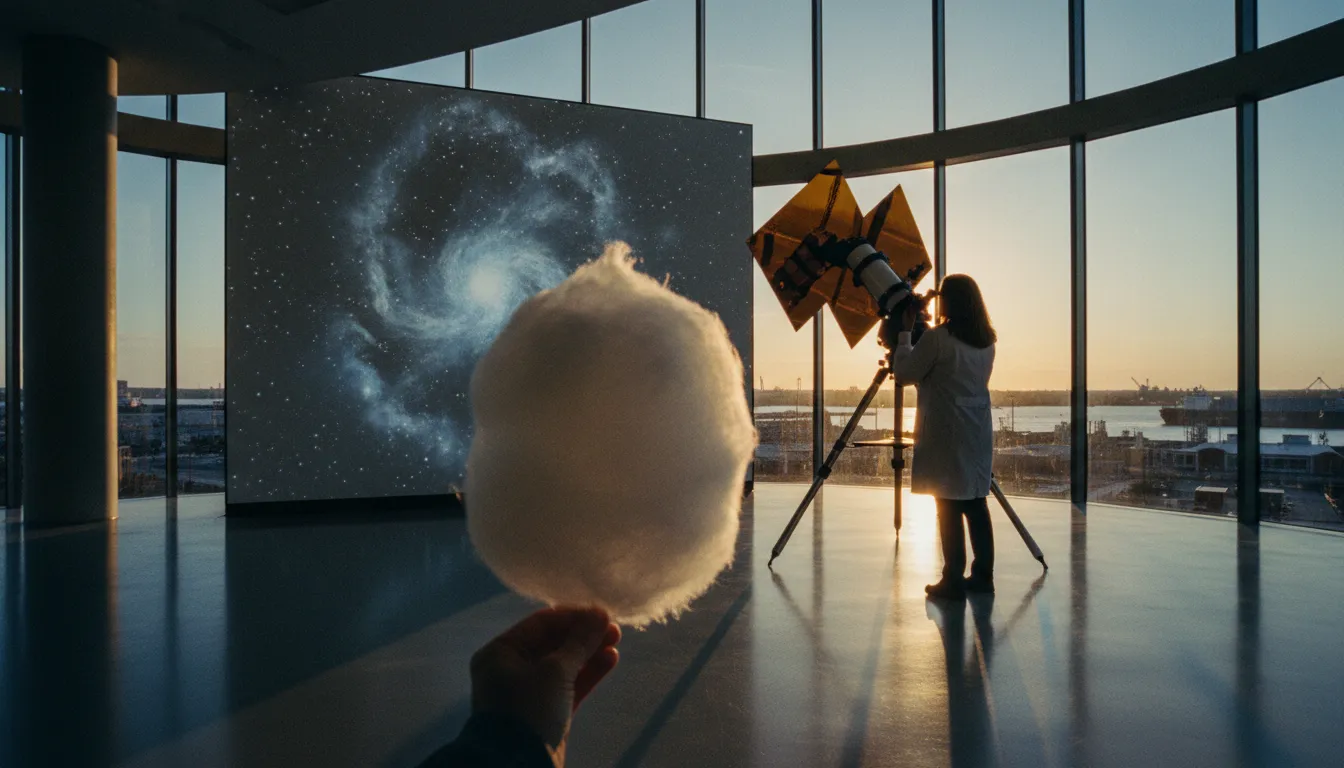
Somewhere in the Milky Way, planets the size of Jupiter weigh only a few times more than Earth. Their densities are so low—less than 0.1 grams per cubic centimeter—that scientists have nicknamed them super-puffs, or cotton candy planets. Nothing in our solar system comes close. Even Saturn, the least dense planet orbiting our Sun, is roughly ten times denser than the puffiest super-puff known.
First identified in data from NASA's Kepler space telescope around 2014, super-puffs have become one of the most puzzling classes of exoplanets. They challenge fundamental models of how planets form and evolve, and recent observations with the James Webb Space Telescope (JWST) are finally starting to peel back the layers—sometimes literally.
What Makes a Super-Puff?
A super-puff is an exoplanet with a mass only a few times that of Earth but a radius comparable to Neptune or even Jupiter. The result is an extraordinarily low mean density. These worlds are thought to consist of a small rocky or icy core surrounded by a vastly bloated envelope of hydrogen and helium. According to researchers at the University of Colorado Boulder, high-altitude photochemical hazes made partly of methane further inflate how large the planets appear during transit observations.
The best-studied examples orbit the young Sun-like star Kepler-51, roughly 2,400 light-years from Earth. All three originally known planets in the system qualify as super-puffs. The outermost, Kepler-51d, holds the record: a density of just 0.038 g/cm³, roughly one hundred times less dense than water.
Why They Puzzle Scientists
Standard planet-formation theory struggles to explain super-puffs. Gas giants typically need a core massive enough—around ten Earth masses—to gravitationally capture and retain a thick hydrogen-helium atmosphere. Super-puffs appear to have done this with cores far smaller, and often while orbiting close to their host stars where stellar radiation should strip gas away.
One hypothesis is that these planets formed farther out in cooler regions of their protoplanetary disk, where gas accretion is easier, and then migrated inward. Another suggestion, supported by a 2026 study, is that super-puffs are simply young planets that have not yet contracted. Over hundreds of millions of years, they may shrink into ordinary sub-Neptunes as their atmospheres cool and settle, according to research discussed by Penn State University.
Webb Telescope Breakthroughs
The James Webb Space Telescope has transformed the study of super-puffs. In late 2025, JWST observed enormous helium streams pouring off WASP-107b, another well-known super-puff about 200 light-years away. The escaping gas cloud stretched nearly ten times the planet's radius, marking the first detection of helium on an exoplanet by JWST, as reported by ScienceDaily.
JWST also revealed that WASP-107b's atmosphere contains water vapor, carbon dioxide, sulfur dioxide, and ammonia—but surprisingly little methane. Researchers at the Max Planck Institute concluded the planet's interior must be far hotter than expected, likely heated by tidal forces from its elliptical orbit. The planet even has clouds made of silicate particles—essentially sand droplets cycling through its atmosphere in a process analogous to Earth's water cycle.
Meanwhile, when scientists pointed JWST at Kepler-51d, they noticed the planet transited its star two hours earlier than predicted. The timing anomaly led to the discovery of a fourth planet in the Kepler-51 system, designated Kepler-51e, whose gravity was subtly tugging on the orbits of its siblings.
Why Super-Puffs Matter
Super-puffs are more than cosmic curiosities. Because their atmospheres are so extended, they are ideal laboratories for spectroscopy—the technique astronomers use to identify molecules in exoplanet atmospheres by analyzing starlight filtered through them. Understanding how these worlds gain and lose their gas envelopes informs broader theories about planetary evolution, atmospheric escape, and ultimately which planets can retain conditions suitable for life.
As JWST continues to observe these cotton candy worlds, each new spectrum brings scientists closer to answering a deceptively simple question: how does a planet hold on to an atmosphere it barely has the gravity to keep?