What Is Dark Energy and Why Is Space Speeding Up?
Dark energy makes up roughly 68% of the universe and drives its accelerating expansion, yet scientists still don't know what it is. Here's how it was discovered, what the leading theories say, and why new instruments may finally crack the mystery.
The Force That Rules the Cosmos
Everything you can see — every star, planet, and galaxy — accounts for less than 5% of the universe. Another 27% is dark matter, an invisible substance that holds galaxies together. The remaining 68% is something even stranger: dark energy, a mysterious influence that is pushing the universe apart at an ever-increasing rate.
Unlike gravity, which pulls objects together, dark energy acts as a kind of anti-gravity on cosmic scales. It doesn't clump, it doesn't shine, and it can't be captured in a bottle. Yet it governs the ultimate fate of everything that exists.
How Dark Energy Was Discovered
In 1998, two independent teams of astronomers — the Supernova Cosmology Project and the High-z Supernova Search Team — were studying a special class of exploding stars called Type Ia supernovae. These stellar explosions all reach roughly the same peak brightness, which makes them useful as "standard candles" for measuring cosmic distances.
Both teams expected to find that the universe's expansion was slowing down under the pull of gravity. Instead, they discovered the opposite: distant supernovae were dimmer than predicted, meaning the galaxies hosting them were farther away than expected. The universe was not just expanding — it was accelerating. The discovery earned Saul Perlmutter, Brian Schmidt, and Adam Riess the 2011 Nobel Prize in Physics.
Leading Theories: Constant or Changing?
Scientists have two main explanations for dark energy, and they disagree on a crucial point.
The Cosmological Constant
The simplest idea traces back to Albert Einstein. In 1917 he added a term called the cosmological constant (Λ) to his equations of general relativity to keep the universe static. He later called it his "biggest blunder" after Edwin Hubble showed the universe is expanding. But the 1998 discovery brought Λ back: it neatly describes a fixed energy density woven into the fabric of space itself. As space expands, more of this vacuum energy appears, continuously fueling acceleration.
Evolving Dark Energy
A rival idea proposes that dark energy is not constant but changes over time — a concept physicists call quintessence. In this model, a dynamic field permeates space, and its strength can increase or decrease as the universe ages. Recent data from the Dark Energy Spectroscopic Instrument (DESI) has added fuel to this debate: its measurements of baryon acoustic oscillations — sound waves frozen into the distribution of galaxies — suggest the amount of dark energy may be roughly 10% lower now than it was 4.5 billion years ago, according to CERN Courier.
The evidence is tantalizing but not yet conclusive. Researchers stress the statistical significance hovers between 2.8 and 4.2 sigma depending on which datasets are combined — well short of the 5-sigma threshold physicists demand to claim a discovery.
Why It Matters for the Fate of the Universe
The nature of dark energy determines how the cosmos ends. If it remains constant, the universe will expand forever, and galaxies beyond our local group will eventually recede beyond the observable horizon — a slow, cold fade known as the Big Freeze. If dark energy strengthens over time, it could eventually tear apart galaxies, stars, and even atoms in a catastrophic Big Rip. If it weakens, expansion could slow or even reverse, leading to a Big Crunch.
How Scientists Are Hunting for Answers
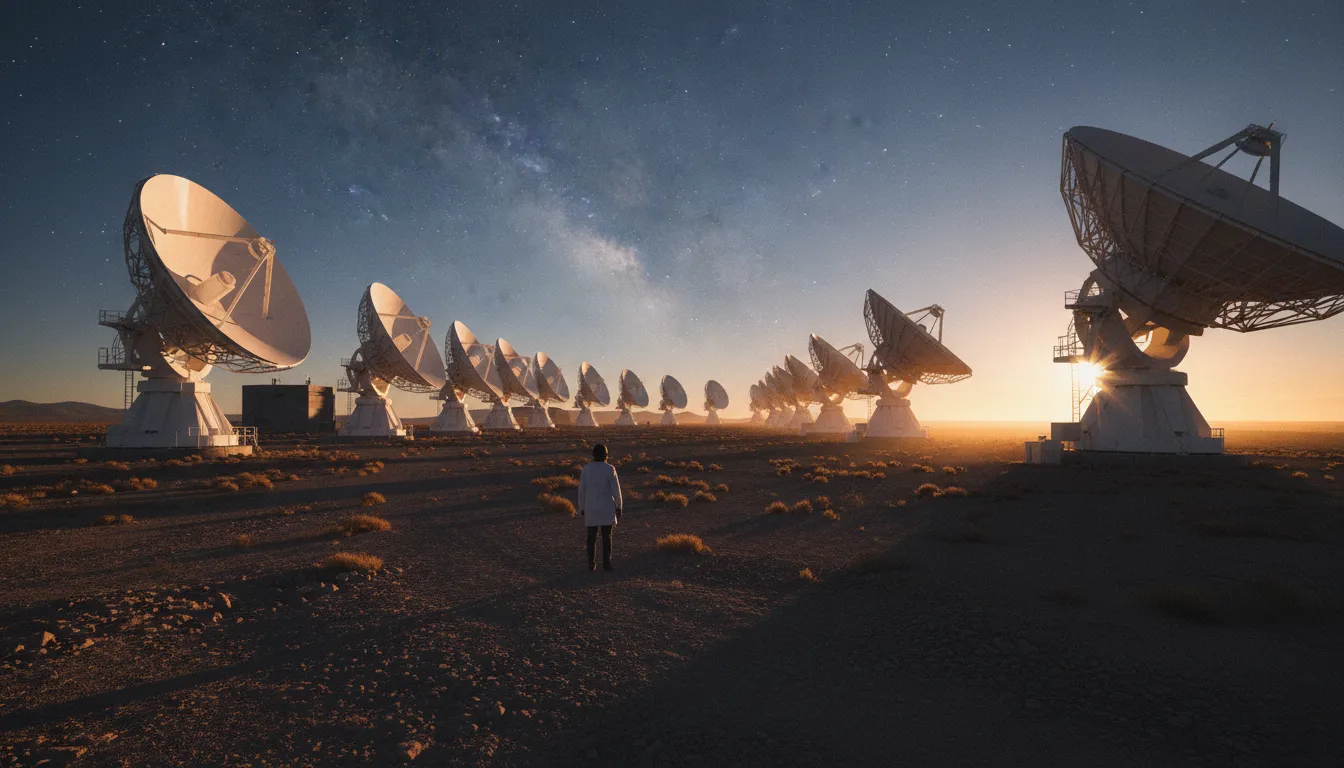
A new generation of instruments is mapping the universe with unprecedented precision. The Dark Energy Survey recently published its final analysis of six years of data collected from a telescope in the Chilean Andes, cataloging 669 million galaxies across 758 nights of observation. Its combined results have doubled the precision of previous constraints on the universe's expansion history.
Meanwhile, DESI continues building the largest three-dimensional map of the cosmos, and the Vera C. Rubin Observatory — expected to begin its decade-long survey soon — will track billions of galaxies to measure how cosmic structures grow under the tug-of-war between gravity and dark energy. The European Space Agency's Euclid mission, launched in 2023, is conducting its own all-sky survey from space.
Together, these projects may finally reveal whether dark energy is Einstein's unchanging constant or something far more dynamic — and, in doing so, tell us how the story of the universe ends.