What Is the Dolomite Problem—Geology's 200-Year Puzzle
Dolomite is one of Earth's most common minerals, yet for two centuries no one could grow it in a lab. Here's how the 'dolomite problem' stumped scientists—and how it was finally cracked.
A Rock That Refused to Cooperate
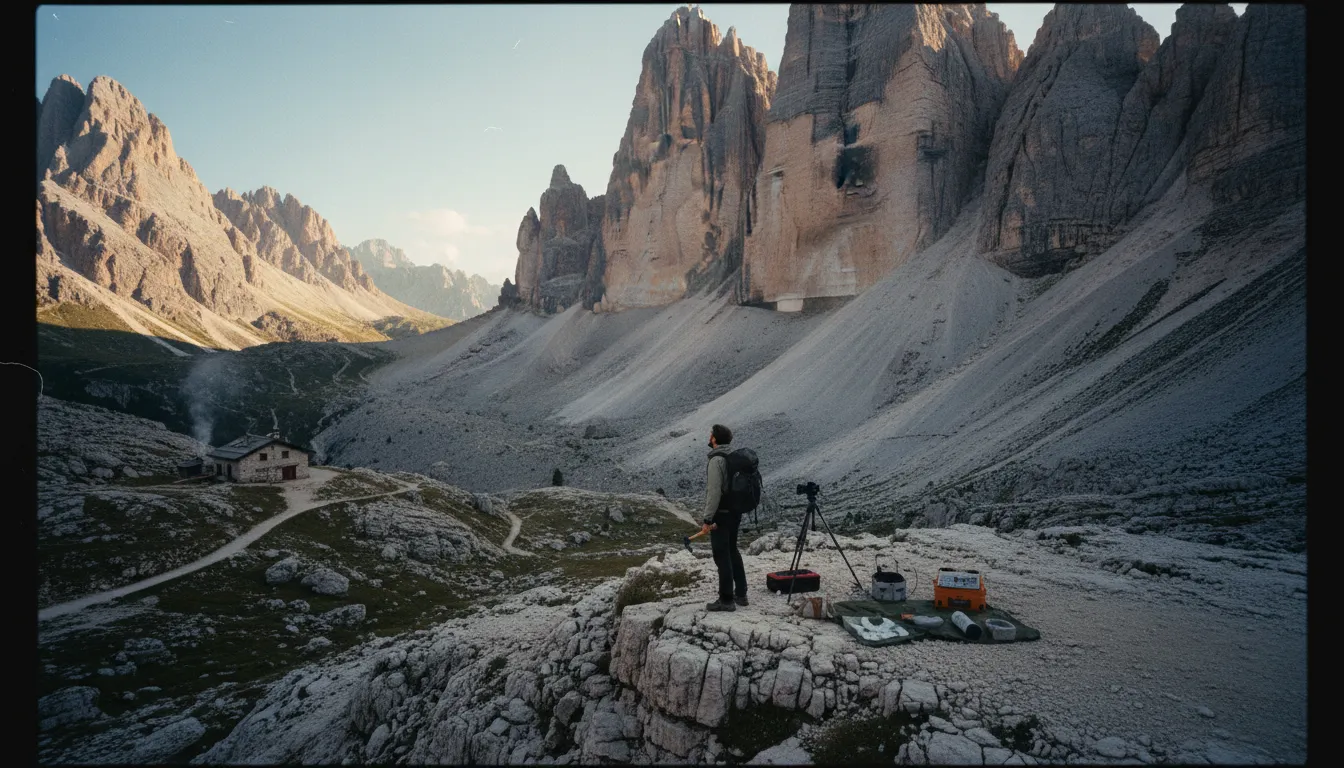
Dolomite is everywhere. It forms the dramatic peaks of Italy's Dolomite mountains, the cliffs of Niagara Falls, and the strange hoodoos of southern Utah. The calcium-magnesium carbonate mineral (CaMg(CO₃)₂) makes up vast stretches of the geological record, particularly in rocks older than 100 million years. Yet for more than two centuries, scientists could not make it grow in a laboratory under the conditions believed to have formed it in nature.
This paradox—a mineral abundant in ancient rocks but stubbornly absent from modern environments and impossible to synthesize at room temperature—became known as the dolomite problem. First identified after French naturalist Déodat de Dolomieu described the mineral in the late 18th century, it has ranked among geology's most persistent unsolved mysteries.
Why Dolomite Refuses to Grow
On paper, dolomite should form easily. Seawater contains plenty of calcium and magnesium, and thermodynamics says the mineral is perfectly stable. The problem lies in how its crystal must assemble.
Dolomite's crystal structure demands strict alternation: a layer of calcium atoms, then a layer of magnesium atoms, then calcium again, in a perfectly ordered sandwich. When the mineral tries to grow in a solution, however, calcium and magnesium ions attach randomly to the crystal's edge. They frequently land in the wrong positions, creating atomic-scale defects. These misplaced atoms block further growth, and the crystal stalls after just a few layers.
Previous laboratory experiments had never produced more than about five layers of new dolomite. The mineral essentially poisons its own growth, which is why scientists call it a fundamental mystery in crystal growth theory.
The Breakthrough: Dissolve to Build
A team from the University of Michigan and Hokkaido University in Japan finally cracked the puzzle using detailed atomic simulations paired with electron microscopy experiments. Their key insight was counterintuitive: to grow dolomite, you must periodically dissolve it.
Because the misplaced atoms are less stable than correctly positioned ones, they are the first to wash away when the crystal is exposed to a slightly undersaturated solution—one with less dissolved mineral than the liquid can hold. This selective dissolution removes the defects while leaving the ordered structure intact. When the solution switches back to supersaturated conditions, new ions can attach in the correct positions. Repeating this cycle—grow, rinse, grow, rinse—allows ordered dolomite to build up layer by layer.
In the laboratory, the researchers pulsed an electron beam roughly 4,000 times over two hours, dissolving defects as they formed. The result was about 300 new layers of dolomite on a seed crystal—a record that dwarfed every previous attempt.
Nature's Secret: Tides, Rain, and Time
The finding explains why dolomite forms readily in certain natural settings. Coastal salt flats, tidal lagoons, and evaporative basins experience natural cycles of flooding and drying. Each cycle alternates between supersaturated and undersaturated conditions—exactly the rinsing mechanism the researchers identified. Over thousands to millions of years, these repeated pulses allow massive dolomite deposits to accumulate.
It also explains the mineral's near-absence from modern deep-ocean sediments, where conditions remain relatively stable and the critical dissolve-and-regrow cycles rarely occur.
Why It Matters Beyond Geology
The dolomite problem is more than an academic curiosity. Dolomite reservoirs trap significant quantities of oil and natural gas, so understanding how they form helps geologists locate energy resources. The mineral also sequesters carbon dioxide on geological timescales, making its formation relevant to long-term climate models.
Perhaps most surprisingly, the "dissolve to grow" principle applies far beyond rocks. The researchers say their theory can help engineers manufacture higher-quality semiconductors, solar panels, and batteries—any technology that depends on growing defect-free crystalline materials. By periodically etching away atomic mistakes during production, manufacturers could produce purer crystals faster and more cheaply.
After 200 years, geology's most stubborn puzzle has yielded not just an answer, but a blueprint for building better materials from the atomic level up.