Afghanistan Strikes Back at Pakistan Along Durand Line
Taliban forces launched large-scale retaliatory attacks on Pakistani military posts on February 26, escalating a border crisis that erupted after Pakistan's airstrikes on Afghan territory days earlier left at least 13 civilians dead.
A Fragile Border Explodes
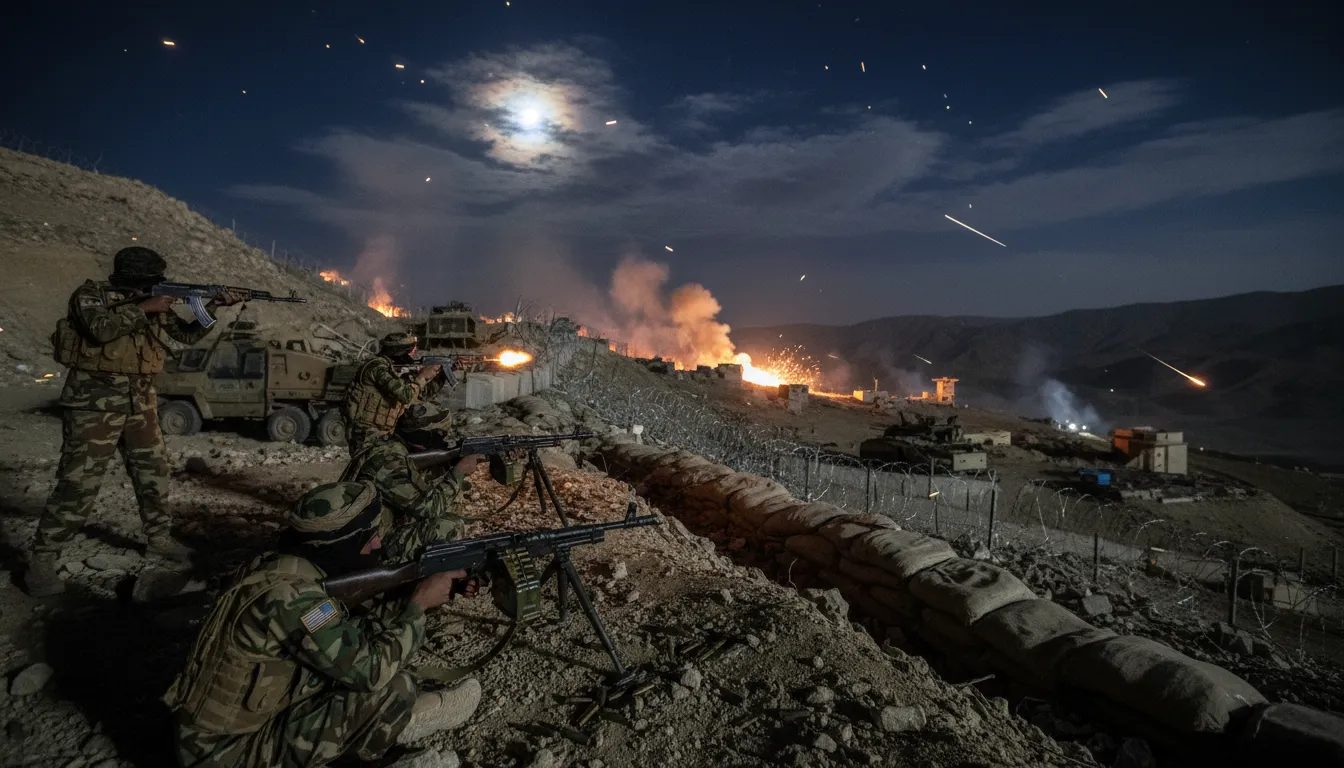
What began as a counterterrorism operation has rapidly spiraled into one of the most serious military confrontations between Afghanistan and Pakistan in years. On Thursday, the Taliban government announced it had launched large-scale offensive operations against Pakistani military positions along the contested Durand Line — the 2,640-kilometre colonial-era border that Kabul has never formally recognised.
Taliban government spokesman Zabihullah Mujahid said the operations were launched "in response to repeated provocations and violations by Pakistani military circles." An Afghan military source told Al Jazeera that at least 10 Pakistani soldiers were killed and 13 to 15 border outposts captured. Pakistan's military denied the extent of the losses, saying it had delivered "immediate and effective" punishment across multiple sectors in Khyber Pakhtunkhwa, with heavy Afghan casualties on its side.
The Spark: Mosque Bombing and Pakistani Airstrikes
The chain of events traces back to February 6, when a suicide bomber struck a Shia mosque in Islamabad during Friday prayers, killing at least 36 worshippers. The Islamic State – Khorasan Province (ISKP) claimed responsibility. Pakistan's military pointed to sanctuaries in eastern Afghanistan and, on February 22, launched coordinated airstrikes on targets in Nangarhar, Paktika, and Khost provinces.
Islamabad claimed the operation destroyed seven TTP (Tehreek-e-Taliban Pakistan) hideouts and killed more than 80 militants. The picture on the ground looked starkly different: the UN mission in Afghanistan reported 13 civilians killed, including women and children, and seven wounded in Behsud district of Nangarhar alone. The Taliban put their civilian death toll at 18.
The TTP Problem at the Core
The fundamental dispute is not new. Pakistan has long accused Afghanistan's Taliban rulers of harbouring the TTP, a separate — though ideologically allied — militant group responsible for thousands of deaths inside Pakistan. The Taliban insists it does not permit its territory to be used for cross-border attacks, a claim Pakistani and Western security officials flatly reject.
"The Afghan Taliban appear unwilling to seriously crack down on the TTP, partly due to prior affinities between the two groups but also out of fear of TTP militants defecting to its main rival, ISKP," one South Asia analyst told Al Jazeera. "In the absence of a serious crackdown, further escalation seems inevitable."
A fragile ceasefire brokered by Qatar in October 2025 had already frayed by early 2026. Low-level cross-border incidents continued even as diplomats tried to restart formal talks, according to Gulf News.
Regional Implications
The crisis arrives at an awkward moment for Pakistan, which is simultaneously managing economic fragility and a tense relationship with India. New Delhi's Foreign Ministry condemned Islamabad's airstrikes, citing civilian deaths during the holy month of Ramadan — a rebuke that underscored how growing India-Taliban diplomatic ties are reshaping the region's strategic geometry and complicating Pakistan's calculations.
On Thursday, fighting was reported across at least six border sectors — Chitral, Khyber, Mohmand, Kurram, and Bajaur — representing a geographic spread that analysts say makes de-escalation harder to engineer. With both sides now claiming military successes and civilian-death narratives running in opposite directions, the Euronews evening bulletin described it as "the most serious exchange of fire between the two countries in over a decade."
No Off-Ramp in Sight
Neither Islamabad nor Kabul has signalled any willingness to stand down. Pakistan frames its actions as legitimate counterterrorism; the Taliban frames its response as defence of national sovereignty. With mediators absent and the Durand Line dispute unresolved for over a century, the border that was never truly settled threatens to become the region's next open wound.