Canada-India Reset: Carney Pursues $2.8B Uranium Deal
Canadian Prime Minister Mark Carney arrived in India on February 27 to cement a dramatic diplomatic reset and unlock a sweeping trade agenda, including a $2.8 billion uranium supply deal, amid shared concerns over U.S. tariffs under Trump.
A Relationship Rebuilt From the Ruins
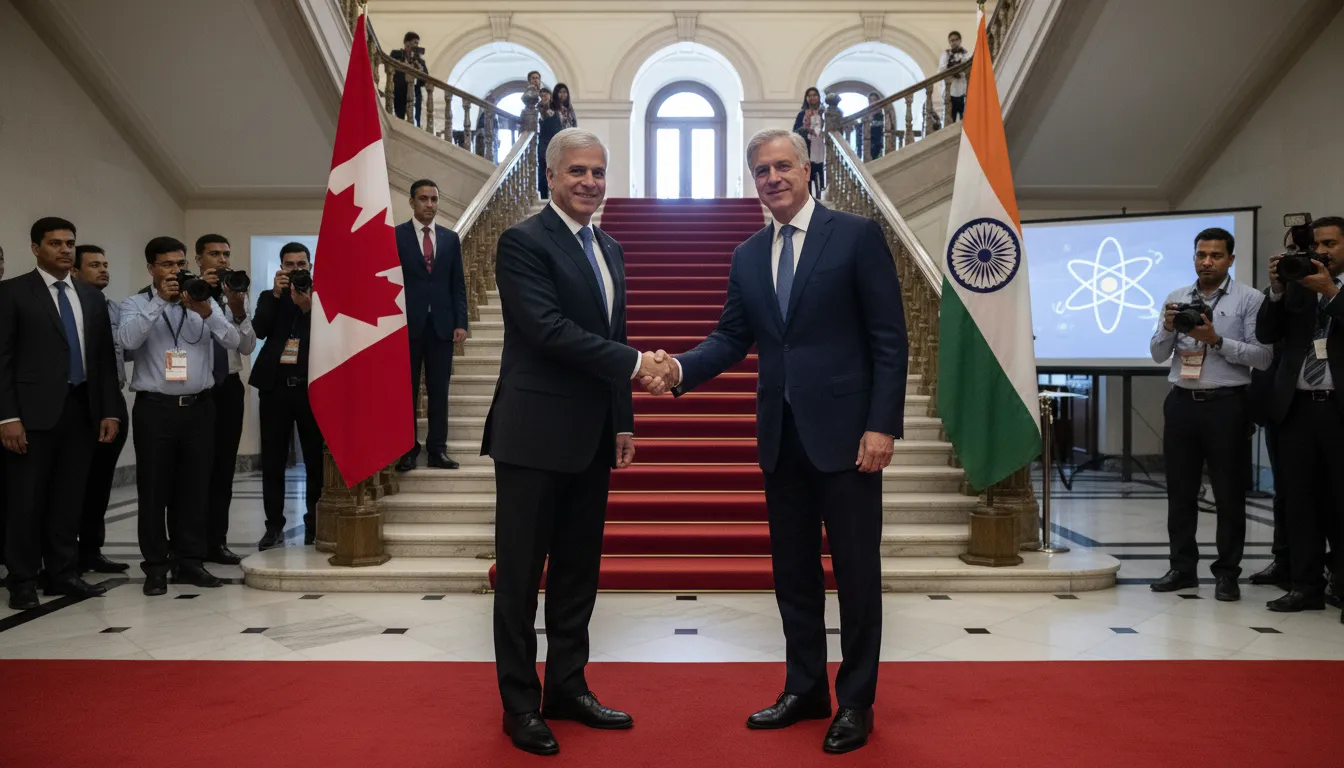
Just sixteen months ago, Canada and India were engaged in one of the most serious diplomatic ruptures between two democracies in recent memory. On Friday, February 27, Canadian Prime Minister Mark Carney landed in Mumbai for a four-day visit that represents the most striking turnaround in the bilateral relationship — an attempt to transform a crisis born of alleged espionage and political murder into a partnership worth tens of billions of dollars.
The rift began in June 2023, when then-Prime Minister Justin Trudeau publicly accused the Indian government of orchestrating the killing of Hardeep Singh Nijjar, a Sikh separatist activist, on Canadian soil in British Columbia. India denied the allegations as "absurd." By October 2024, Canada had expelled India's High Commissioner Sanjay Verma and five other Indian diplomats, citing them as "persons of interest" in RCMP investigations into threats against the Sikh diaspora. India retaliated by expelling 41 Canadian diplomats — gutting both countries' diplomatic infrastructure overnight.
How the Thaw Began
The breakthrough came when Carney — who replaced Trudeau in early 2025 — invited Indian Prime Minister Narendra Modi to the G7 summit in Canada in June 2025. Both sides subsequently appointed new high commissioners, and trade negotiations quietly resumed on the sidelines of the G20 in November. By early 2026, what had been a frozen relationship was thawing fast.
The timing is not accidental. Both leaders are navigating a global trading landscape reshaped by U.S. President Donald Trump's tariff regime. As one expert framing the visit put it, "For India and Canada alike, the big picture is diversification — reducing overreliance on the U.S." Carney's January speech at Davos, where he urged "middle powers" to forge economic independence from American hegemony, set the ideological stage for the visit.
A Sweeping Trade Agenda
The centerpiece deal expected to be announced is a C$2.8 billion, ten-year uranium supply agreement — a significant win for Canada's mining sector and a strategic gain for India, which is aggressively expanding its nuclear power capacity. Beyond uranium, cooperation agreements are expected to cover:
- Oil and natural gas exports
- Critical minerals supply chains
- Artificial intelligence and quantum computing research
- Aerospace and defence cooperation
- Education and academic exchange
The two governments also aim to formally relaunch negotiations toward a comprehensive free-trade agreement, with an ambition to double bilateral trade to $70 billion by 2030 from roughly $10 billion today. A new law enforcement cooperation mechanism is also on the table, designed to address transnational crime — the issue that originally blew the relationship apart.
Geopolitical Stakes
The visit carries weight beyond trade figures. India is the world's most populous country and one of its fastest-growing economies. For Carney, securing meaningful agreements here — before heading on to Australia and Japan — would validate his broader foreign policy pitch: that Canada can thrive as a nimble middle power, connecting energy resources and technology to partners who need them.
Whether the ambitions survive contact with reality remains to be seen. India is a notoriously price-sensitive market, and analysts caution that many of Friday's announcements will be frameworks rather than finalized contracts. But the symbolism alone — a Canadian prime minister standing in Mumbai just sixteen months after the worst diplomatic collapse in the two countries' shared history — signals that pragmatism has decisively overtaken grievance.