Did Mars Have an Ocean? What the Evidence Shows
Scientists have debated whether Mars once held a vast northern ocean for nearly four decades. New geological evidence, including a continental shelf 'bathtub ring,' strengthens the case that a third of the Red Planet was once underwater.
A Decades-Old Question Gets New Answers
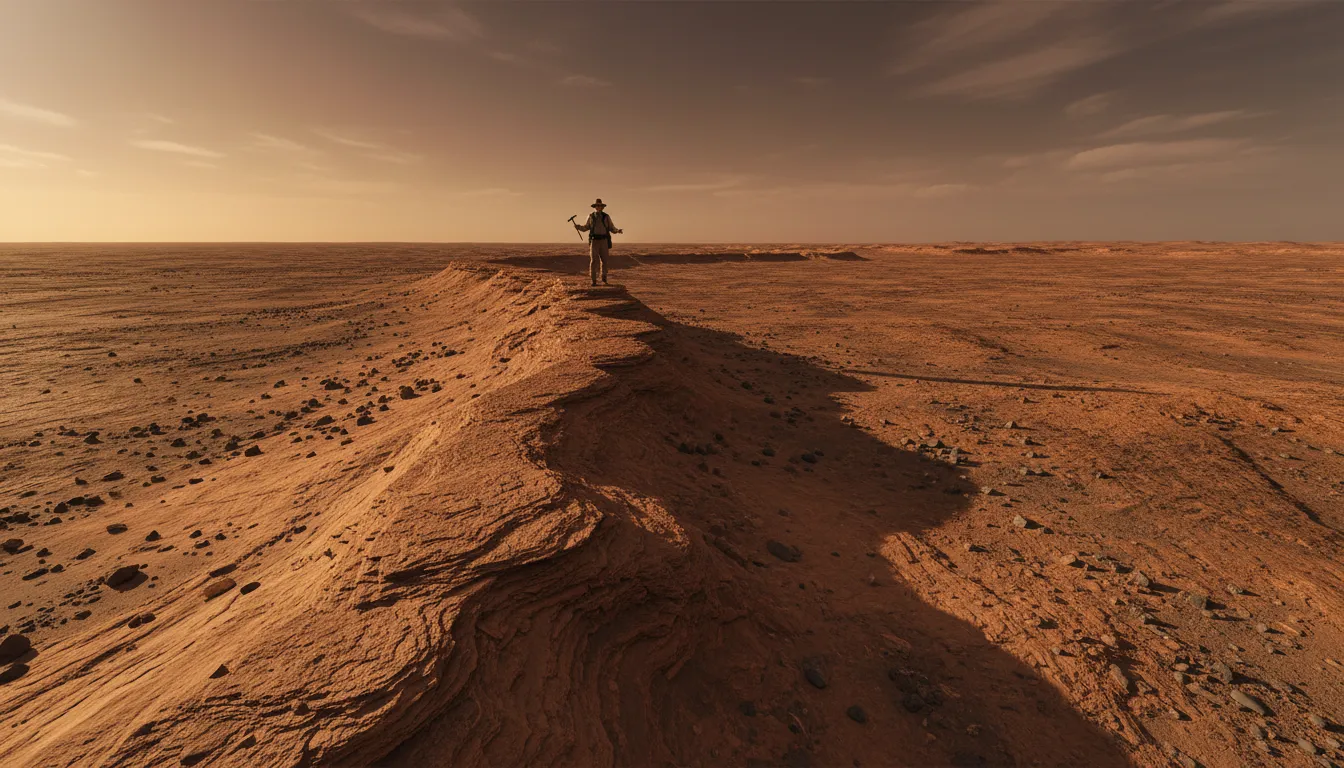
Was the Red Planet once blue? Since 1987, when physicist John E. Brandenburg first proposed that a "Paleo-Ocean" once filled Mars's northern lowlands, scientists have argued over whether liquid water truly pooled on the Martian surface at a planetary scale. The hypothesis, known as the Mars ocean hypothesis, suggests that an ancient body of water called Oceanus Borealis once covered roughly a third of Mars — an area comparable to Earth's Arctic Ocean.
The debate has swung back and forth for decades. But a growing body of evidence — from orbital radar to river delta mapping to a newly discovered "bathtub ring" — is tipping the scales toward a wetter Martian past.
The Continental Shelf That Shouldn't Be There
In April 2026, a team led by geologist Abdallah Zaki and Caltech professor Michael Lamb published a landmark study in Nature describing a geological feature that had never been identified on Mars before: a continental shelf.
On Earth, continental shelves are the gently sloping underwater extensions of coastlines. They take millions of years of stable ocean conditions to form. The researchers first tested their method on Earth by computationally "draining" Earth's oceans to see which geological signatures remained visible. Continental shelves stood out clearly.
When they applied the same analysis to Martian topographic data, they found an analogous flat band — several hundred kilometers wide — wrapping around the northern hemisphere between elevations of −1,800 m and −3,800 m. Within this band, they identified coastal deposits, river deltas, and sedimentary channels, all consistent with a long-lived shoreline.
"The shelf is a new observation that ties together evidence of what the coastal zone would have looked like." — Abdallah Zaki, University of Texas at Austin
Why Shorelines Alone Weren't Enough
Previous attempts to prove the ocean hypothesis relied heavily on identifying ancient shorelines. Scientists found two possible ones — called Arabia and Deuteronilus — stretching thousands of kilometers near the northern lowlands. The problem? Their elevations vary significantly, which critics argued was inconsistent with a single, stable ocean surface.
A continental shelf sidesteps this issue entirely. As Lamb explained, "There is hardly anything on Earth that is that old; anything on Mars from that time has been eroded by billions of years of wind blowing, volcanoes erupting." A shelf is a more robust geological fingerprint than a shoreline — one that persists even after eons of erosion.
Converging Lines of Evidence
The shelf discovery doesn't stand alone. Multiple independent studies have built a compelling circumstantial case:
- River deltas at ocean altitude: A 2010 study found 17 river deltas all terminating at elevations consistent with the proposed ocean level.
- Tsunami deposits: Research from 2016 identified channels and boulder fields consistent with massive tsunami events — which require a large body of water.
- Deuterium ratios: Mars's atmosphere contains eight times more deuterium (heavy hydrogen) than Earth's, suggesting the planet once held far more water that was gradually lost to space.
- Fan deltas in Valles Marineris: A January 2026 study in npj Space Exploration found cone-shaped deposits in Coprates Chasma, all at identical elevations around 3,700 meters, dated to roughly 3.37 billion years ago.
Where Did the Water Go?
If Mars had an ocean covering a third of its surface roughly 4.1 to 3.8 billion years ago, the obvious question is: where did it go? Scientists propose several mechanisms. Much of it likely escaped to space as Mars lost its magnetic field and solar wind stripped away the atmosphere. Some froze into the subsurface cryosphere — layers of ice locked beneath the regolith. Recent studies suggest substantial liquid water may still exist 3 to 5 miles below the surface.
Why It Matters Beyond Mars
A stable, long-lived ocean has profound implications for astrobiology. Coastal sediments on Earth are among the best environments for preserving traces of ancient life. If Mars's continental shelf harbors similar deposits, it could guide where future rovers — and eventually astronauts — search for biosignatures.
The question of whether Mars once had an ocean is no longer fringe speculation. With each new discovery, the case for a once-blue Red Planet grows harder to dismiss.