How the Antikythera Mechanism Works—the First Computer
The Antikythera mechanism, a 2,100-year-old Greek device recovered from a shipwreck, used dozens of interlocking bronze gears to predict eclipses, track planets, and model the cosmos with a precision not matched for over a millennium.
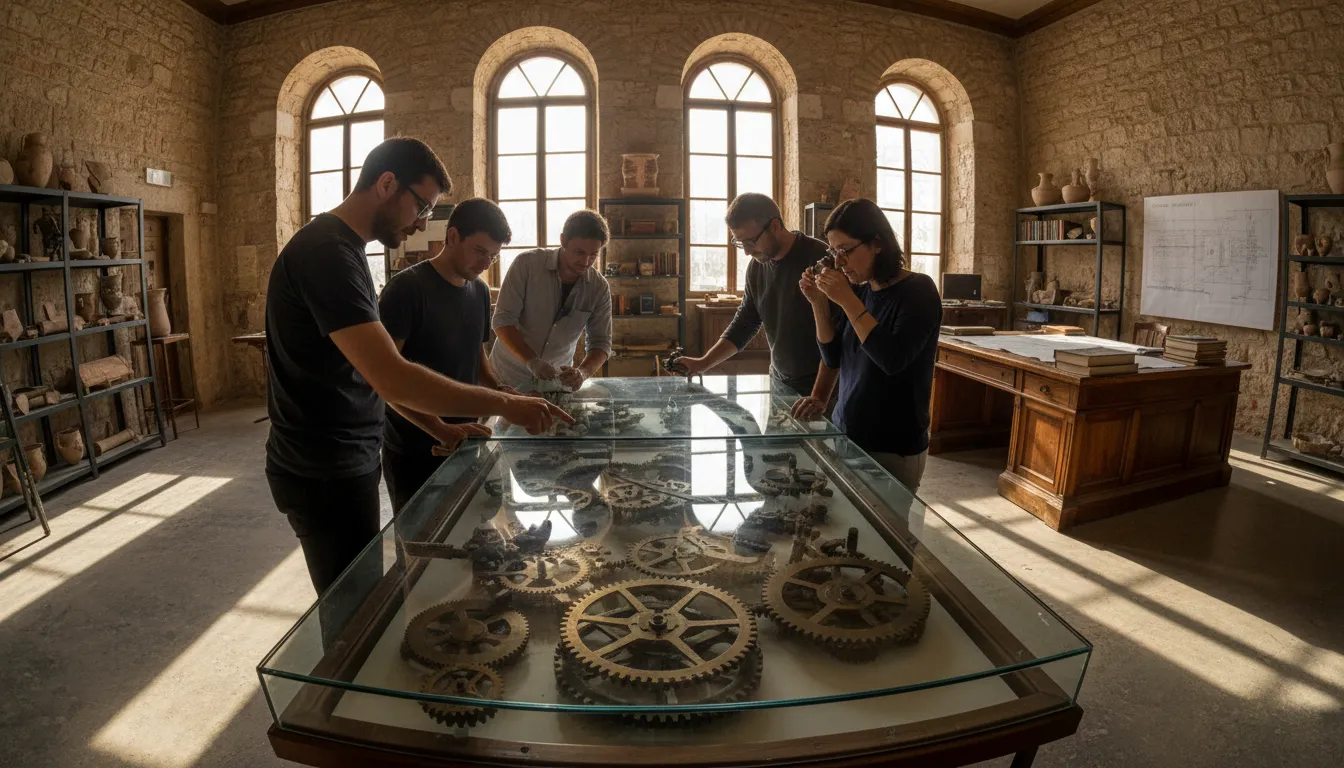
A Shoebox That Mapped the Cosmos
In 1901, sponge divers working off the tiny Greek island of Antikythera hauled corroded bronze lumps from a Roman-era shipwreck resting 45 metres below the Aegean Sea. For decades, nobody understood what the fragments were. Today, scientists recognize them as the remains of the Antikythera mechanism—the oldest known analogue computer, built around 150–100 BCE, and a device so sophisticated that nothing of comparable complexity appeared again until medieval European clockmakers began their work more than a thousand years later.
What the Device Could Do
Housed in a wooden case roughly the size of a shoebox, the mechanism allowed a user to turn a hand crank and instantly see where the Sun, Moon, and the five planets known to the ancient Greeks—Mercury, Venus, Mars, Jupiter, and Saturn—would appear in the sky on any chosen date, past or future. It tracked the Moon's phases, predicted both solar and lunar eclipses using the 223-month Saros cycle borrowed from Babylonian astronomy, and even marked the timing of the Panhellenic games, including the ancient Olympics.
A set of scientific dials on the front and back displayed these readings. The front showed a zodiac dial and a calendar ring; the rear carried the Saros eclipse-prediction dial and a secondary dial for athletic festivals. Inscriptions etched into the bronze, revealed only by modern X-ray CT scanning, described how each celestial body's motion was displayed.
The Gear Train: Ancient Precision Engineering
Of the original device, only about a third survives, split into 82 fragments. Imaging has identified at least 30 bronze gearwheels, 19 shafts and axles, and seven pointer mechanisms—suggesting the complete machine contained around 39 or more gears. The teeth were hand-cut into thin bronze sheet, some barely a millimetre across.
The most ingenious element is the lunar anomaly mechanism. The Moon does not orbit Earth at a constant speed because its orbit is elliptical—a fact the Greeks did not yet understand theoretically. The builders solved the problem mechanically by mounting two gears on slightly offset axes, converting uniform input rotation into the variable output speed that mirrors the Moon's real motion. This use of a pin-and-slot device to model a non-uniform orbit remains one of the most remarkable feats of ancient engineering ever documented.
Planetary motions posed a similar challenge. Viewed from Earth, planets periodically appear to reverse direction—so-called retrograde motion. The Greeks explained this with epicycles, small circles riding on larger orbits. According to researcher Michael Wright, the mechanism modelled these epicycles with trains of small gears riding around larger ones, faithfully reproducing the planets' apparent wandering paths across the sky.
Where the Knowledge Came From
The mechanism draws on multiple intellectual traditions. Its eclipse cycles originate in Babylonian observational records accumulated over centuries. Its geometric models of planetary motion reflect theories taught at Plato's Academy and refined by astronomers such as Hipparchus. The engineering itself—precision metalwork, differential gearing—points to a workshop tradition in the Greek-speaking world, possibly in Rhodes or Syracuse, though the exact origin remains debated.
The Roman statesman Cicero, writing in the first century BCE, described devices that could reproduce the motions of the Sun, Moon, and planets—descriptions long dismissed as literary exaggeration until the Antikythera mechanism proved such machines actually existed.
Modern Research Keeps Revealing Surprises
A landmark 2021 study published in Scientific Reports by a University College London team proposed a new model for the mechanism's front display, showing how all known planetary cycles could fit within the device's surviving gearwork. In 2024, University of Glasgow researchers applied statistical techniques originally developed for gravitational-wave detection to determine that a broken ring on the device most likely contained 354 holes—matching a lunar calendar rather than the 365-day Egyptian calendar previously assumed.
Not all findings are settled. A 2025 analysis questioned whether manufacturing tolerances in the surviving gears were precise enough for the device to have functioned accurately, reigniting debate about whether it was a working instrument or a demonstrative model. Ongoing excavations at the Antikythera shipwreck continue to recover new artefacts, keeping hope alive that additional fragments—or even a second mechanism—may yet surface.
Why It Still Matters
The Antikythera mechanism matters because it rewrites assumptions about ancient technology. It demonstrates that Greek artisans possessed engineering capabilities—differential gearing, miniaturized precision metalwork, complex mechanical computation—that historians once believed emerged only in the Renaissance. It stands as proof that technological progress is not a straight line: knowledge can be gained, lost, and rediscovered across centuries.


