How Lithium Mining Works—From Brine to Battery
Lithium powers every rechargeable device and electric vehicle on the planet, yet most people have no idea how it reaches a battery. This explainer breaks down the three main extraction methods, the geopolitics of supply, and why a new technique could reshape the industry.
The Lightest Metal With the Heaviest Burden
Every smartphone, laptop, and electric vehicle on Earth depends on lithium-ion batteries—and demand is surging. Global lithium-ion battery demand rose 29 percent in 2025 alone, reaching 1.59 terawatt-hours, according to Benchmark Minerals. The International Energy Agency projects lithium demand will grow tenfold by 2050 under its net-zero scenario. Yet extracting this soft, silver-white metal from the Earth is neither simple nor cheap.
Method One: Pumping Brine From Salt Flats
Most of the world's lithium comes from underground brine reservoirs beneath vast salt flats called salars, concentrated in the so-called Lithium Triangle—the border region of Chile, Argentina, and Bolivia. Together these three countries hold roughly 56 percent of known global reserves, according to the US Geological Survey.
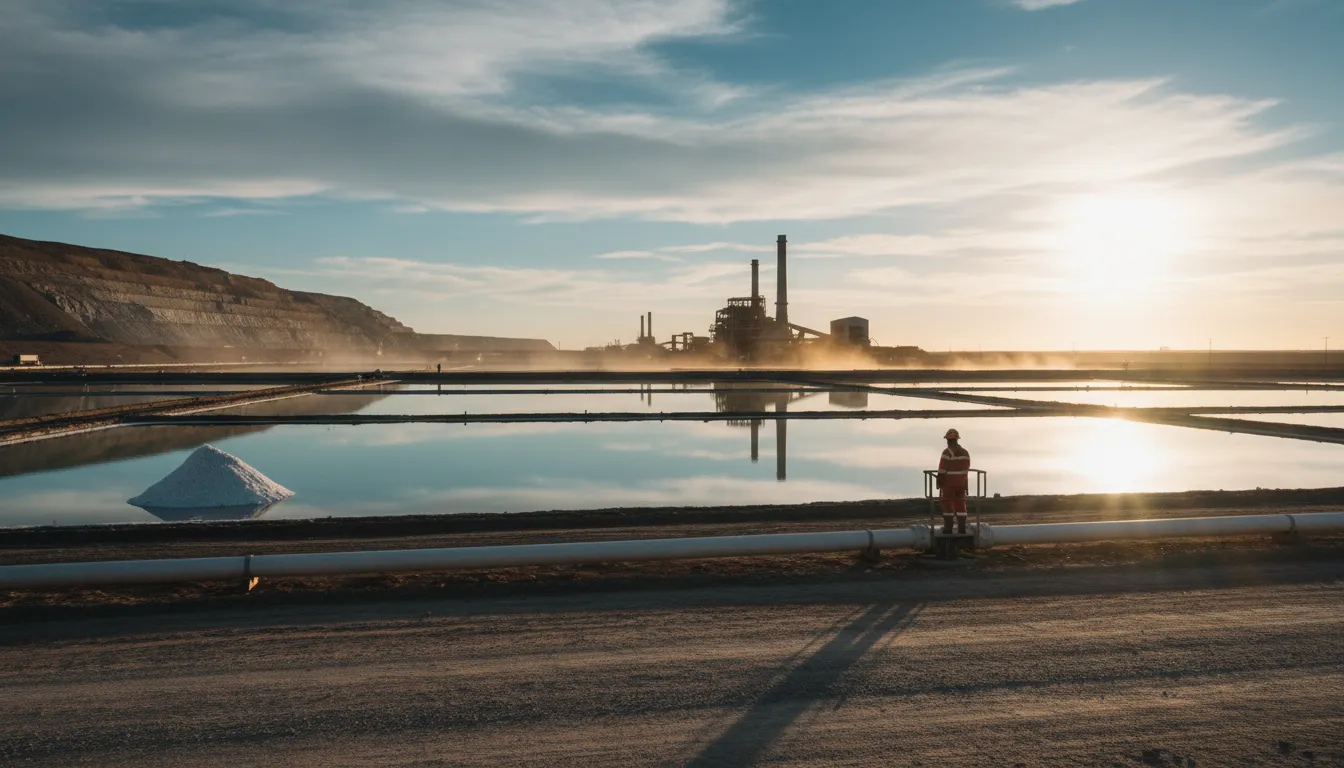
The process is straightforward but slow. Workers drill into subterranean brine pools, pump the mineral-rich water to the surface, and channel it into a series of shallow evaporation ponds. Over 12 to 18 months, the sun does most of the work, gradually concentrating lithium salts as water evaporates. Chemical treatment then converts the residue into battery-grade lithium carbonate or lithium hydroxide.
Brine extraction is the cheapest method, largely because solar energy provides the evaporation. The trade-off is time, enormous land use, and heavy water consumption in some of the driest regions on the planet.
Method Two: Hard-Rock Mining
Australia leads global lithium production not from brines but from spodumene, a lithium-bearing mineral found in hard-rock pegmatite deposits. In 2023, four countries—Australia, Chile, Argentina, and China—supplied 94 percent of the world's lithium, with Australia as the top producer.
Hard-rock mining resembles conventional open-pit operations. Heavy machinery strips away overburden, extracts ore, and trucks it to a processing plant. There the rock is crushed, heated to around 1,100 °C in a rotary kiln, and then mixed with sulfuric acid to leach out lithium. Further refining yields lithium carbonate or hydroxide.
This route is faster than evaporation—weeks rather than months—but roughly twice as expensive, according to MIT's Climate Portal. It also consumes significant energy and generates acid waste that must be carefully managed.
Method Three: Direct Lithium Extraction
A newer approach called Direct Lithium Extraction (DLE) promises to combine the best of both worlds. Instead of waiting for the sun, DLE uses specialized resins, membranes, or solvents to pull lithium directly from brine—or even from oilfield wastewater and geothermal fluids—in a matter of hours.
The technique can recover over 90 percent of available lithium while using a fraction of the water and land that evaporation ponds require. Several pilot plants are already operating: the UK-based Watercycle Technologies facility in Runcorn began producing lithium carbonate equivalent in late 2025, with output expected to scale throughout 2026.
DLE is projected to be the fastest-growing segment of the lithium mining market, with a compound annual growth rate of nearly 20 percent through 2035, according to IDTechEx.
Why Supply Concentration Matters
Lithium's geopolitics mirror those of oil a generation ago. Five upstream producers—SQM, Albemarle, Tianqi, Pilbara Minerals, and Rio Tinto—control nearly 70 percent of global output. Meanwhile, approximately 65 percent of the world's lithium processing capacity sits in China, giving Beijing outsized influence over the battery supply chain.
This concentration has prompted the European Union, the United States, and Canada to classify lithium as a critical mineral and invest in domestic extraction projects. Meeting forecast demand will require an estimated $500–600 billion in new mining investment by 2040, according to the IEA's Global Critical Minerals Outlook.
Unexpected Sources on the Horizon
Researchers are also looking in surprising places. A West Virginia University team recently found significant lithium concentrations hidden inside pyrite—the mineral known as fool's gold—within ancient Appalachian shale rocks. Because pyrite is a common byproduct of oil and gas drilling, the discovery raises the possibility of recovering lithium from existing industrial waste rather than opening new mines.
Between DLE breakthroughs, unconventional sources like pyrite, and massive investment in new capacity, the way lithium reaches your battery is changing fast. The challenge is whether supply can keep pace with a world racing to electrify everything.