How Brain Organoids Work—Mini Brains Grown in a Lab
Brain organoids are pea-sized clusters of human neural tissue grown from stem cells. They mimic early brain development and are transforming research into neurological diseases—but they also raise profound ethical questions.
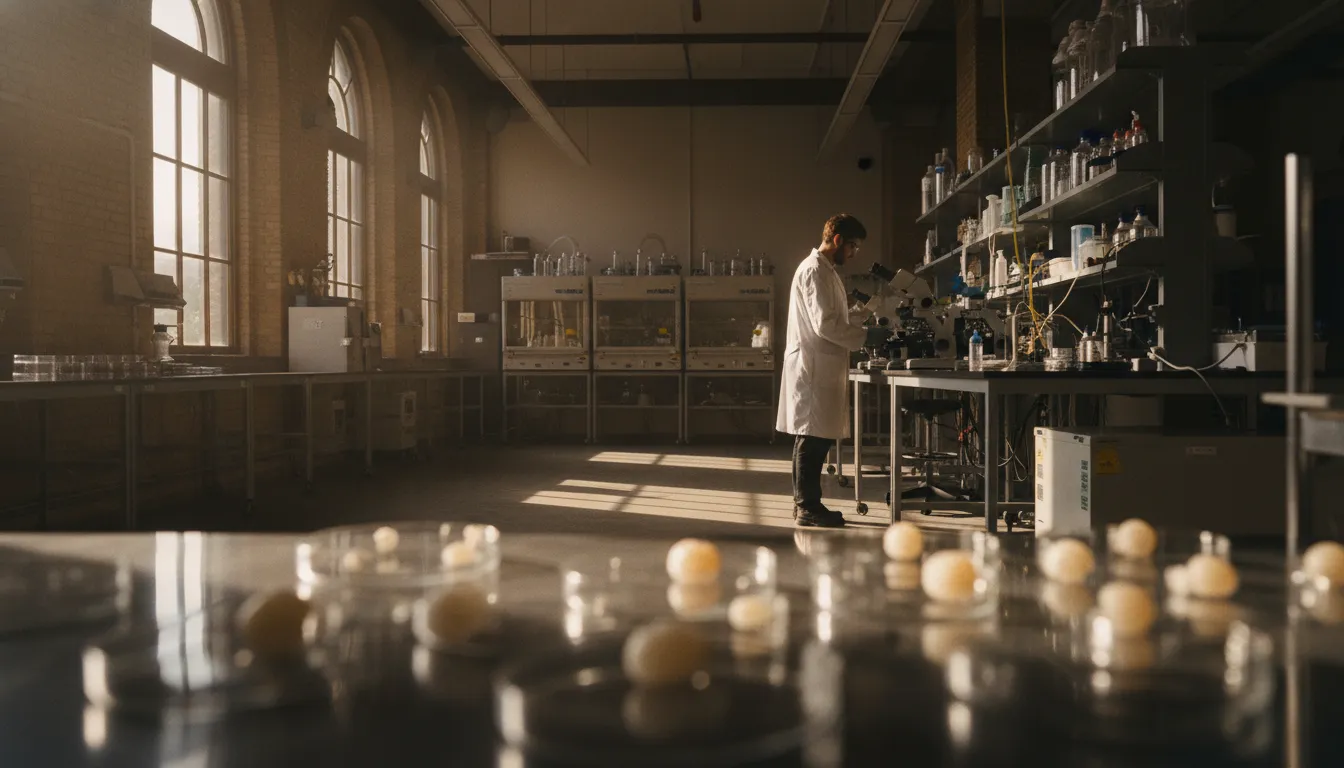
What Is a Brain Organoid?
A brain organoid is a three-dimensional cluster of human cells, roughly the size of a pea, that self-organizes to mimic the architecture of a developing human brain. Grown from human pluripotent stem cells in laboratory dishes, these structures contain neurons, glia, and other cell types arranged in layers that resemble the cortex of an embryonic brain. Scientists sometimes call them "mini brains," though the name is misleading—they lack blood vessels, sensory input, and the full complexity of a real organ.
First created in 2013 by Madeline Lancaster and Jürgen Knoblich at the Austrian Academy of Sciences, brain organoids have since become one of the most powerful tools in neuroscience. They bridge a critical gap: animal brains differ too much from human brains to model many diseases accurately, and flat cell cultures in petri dishes cannot replicate the brain's three-dimensional structure.
How Scientists Grow Them
The process begins with pluripotent stem cells—either reprogrammed from a patient's skin or blood cells, or derived from embryonic sources. Researchers coax these cells into forming a small ball called an embryoid body, then apply chemical signals that push the outer layer (ectoderm) to differentiate into neural tissue.
Over weeks, the ball develops distinct brain-like regions. Neurons begin firing electrical signals and forming synaptic connections. Some organoids can be maintained for months or even years, growing to several millimeters across. Researchers can steer development toward specific brain regions—midbrain organoids for studying Parkinson's disease, for instance, or cortical organoids for investigating autism.
Why They Matter for Medicine
Brain organoids have already yielded insights that would have been impossible with older methods:
- Microcephaly and Zika virus: Organoids grown from patients with microcephaly revealed that the condition stems from neural progenitor cells developing too quickly and then stalling. During the Zika epidemic, researchers used organoids to show exactly how the virus attacks fetal brain cells.
- Alzheimer's and Parkinson's disease: Organoids can replicate beta-amyloid plaques, tau tangles, and dopaminergic neuron degeneration—hallmarks of neurodegenerative diseases that are difficult to reproduce in mice.
- Drug screening: Patient-derived organoids allow researchers to test compounds on tissue that carries the patient's own genetic mutations, opening a path toward personalized medicine for brain disorders.
- Brain tumors: Scientists have modeled glioblastoma inside organoids, creating a platform to study how the deadliest brain cancer grows and responds to treatment.
The Ethical Frontier
As organoids grow more sophisticated, they raise questions unlike any other laboratory tool. The human brain is the seat of consciousness, personality, and selfhood—so what happens when a clump of neurons in a dish starts generating coordinated electrical activity?
"We are talking about an organ that is at the seat of human consciousness," bioethicist Insoo Hyun told NPR. "It's reasonable to be especially careful with the kind of experiments we're doing."
Current organoids are far too simple to be conscious. But researchers have already transplanted human organoids into rat brains, where the human cells integrated and influenced the animals' behavior. A Nature commentary published in April 2026 called for international regulation, noting that no governing body currently oversees the creation of brain organoids or sets limits on how complex they can become.
Key unresolved questions include: Who owns an organoid grown from a patient's cells? Should there be a size or complexity limit? And at what point, if ever, would an organoid deserve moral consideration?
What Comes Next
The field is advancing rapidly. Researchers are now building assembloids—fused organoids from different brain regions that form functional circuits. Others are connecting organoids to computer chips, exploring whether biological neural networks can process information alongside silicon. Meanwhile, the push for standardized protocols and ethical frameworks is accelerating as the technology outpaces existing regulation.
Brain organoids will not replace the human brain in a dish. But they are already transforming how scientists study the most complex organ in the known universe—and forcing society to grapple with what it means to grow human neural tissue in a lab.