How Scientists Recreate Star Explosions on Earth
Inside the world's most powerful rare-isotope accelerator, physicists smash atomic nuclei at half the speed of light to understand how stars forge the elements that make up everything around us.
Forging Elements in a Lab
Every atom of calcium in your bones, every trace of selenium in your diet, was forged inside a star or its violent death. For decades, scientists understood the broad strokes of stellar nucleosynthesis — the process by which stars build heavier elements from lighter ones. But a stubborn mystery remained: roughly 35 rare, proton-rich isotopes, called p-nuclei, could not be explained by the standard processes. To crack the puzzle, physicists needed to recreate the conditions of exploding stars — not in space, but in a laboratory in Michigan.
The Machine: FRIB
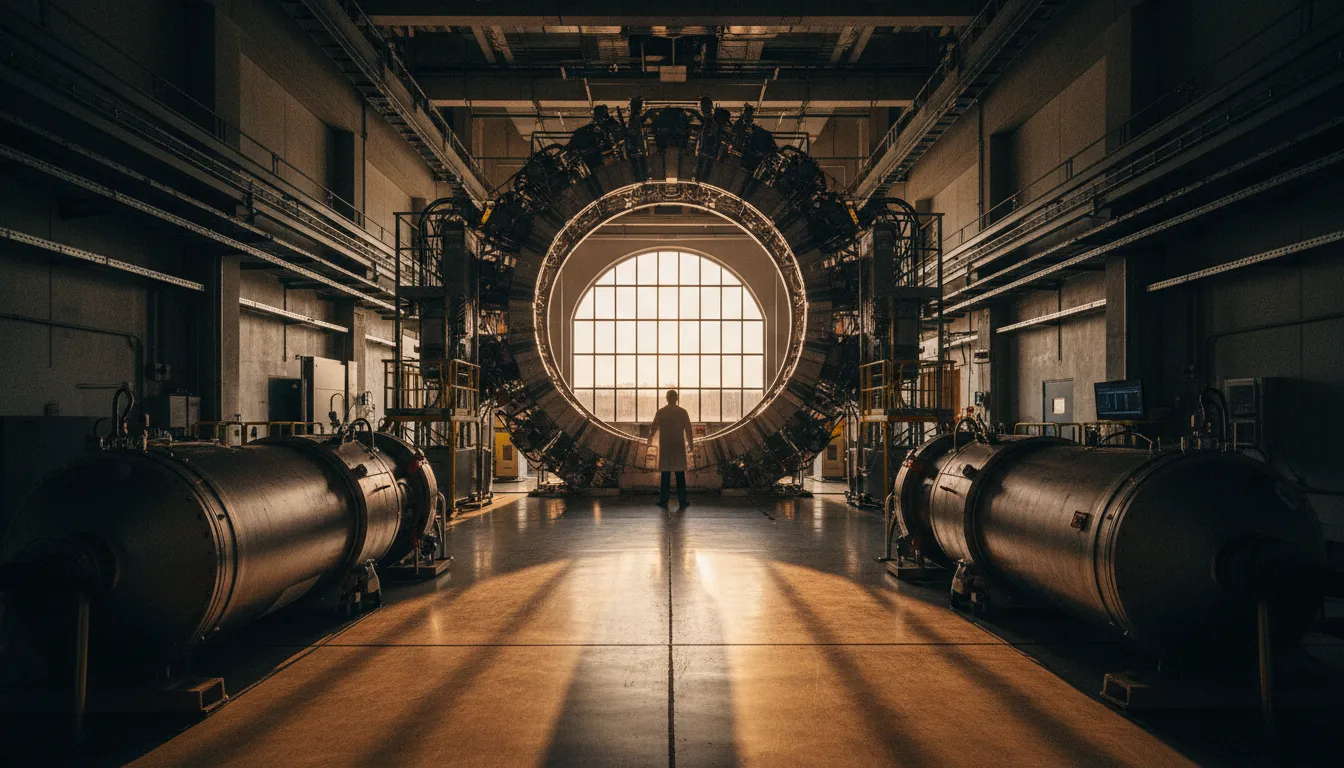
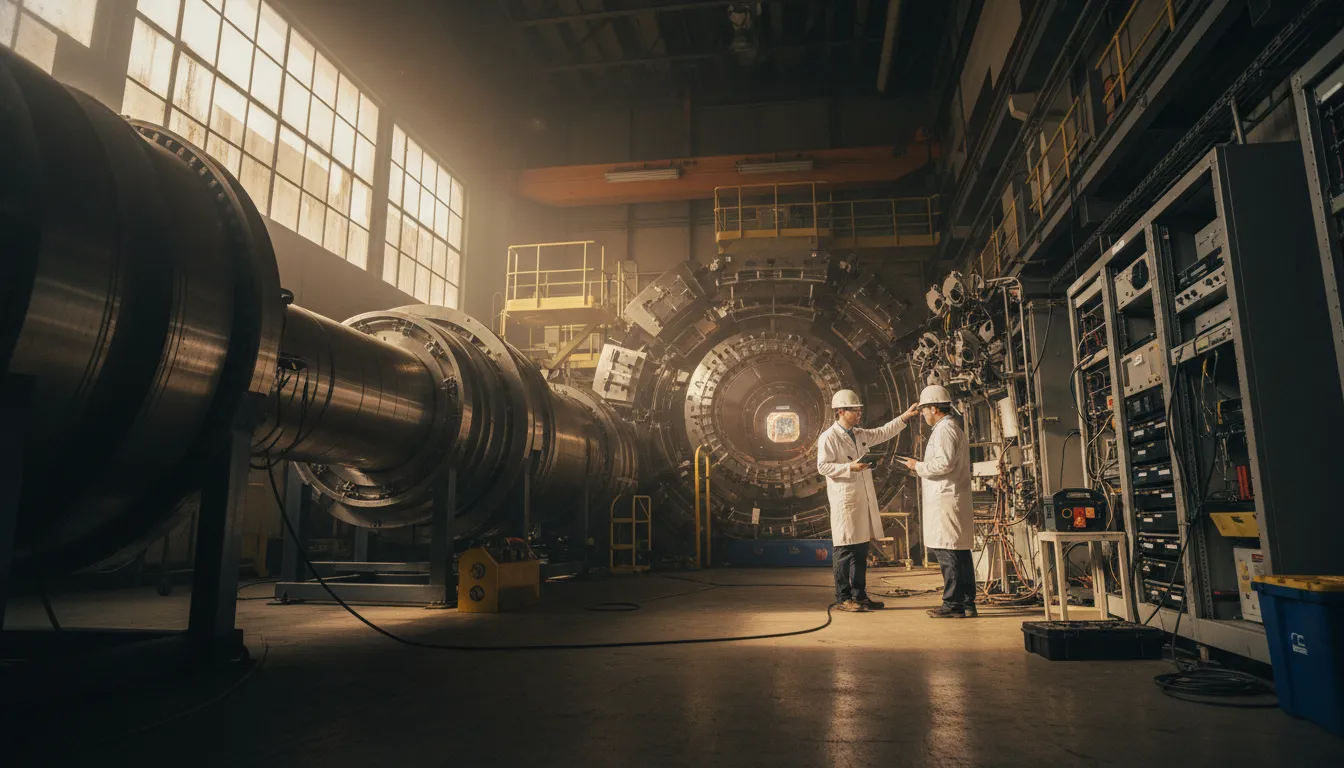
The Facility for Rare Isotope Beams (FRIB), operated by Michigan State University for the U.S. Department of Energy, is the world's most powerful rare-isotope accelerator. Its superconducting linear accelerator — a chain of nearly 50,000 superconducting components cooled to near absolute zero — accelerates ions of any element, from hydrogen to uranium, to more than half the speed of light.
The accelerated beam then slams into a target. The collision shatters heavy nuclei into exotic, short-lived isotopes that do not normally exist on Earth. Giant magnets sort through the debris, selecting the isotopes scientists want and steering them into experimental halls for study. In essence, FRIB recreates on a tabletop what supernovae accomplish in seconds across light-years of space.
Why It Matters: The Missing Elements
Most heavy elements are built through two well-understood pathways. The s-process (slow neutron capture) operates inside aging giant stars, building elements step by step over thousands of years. The r-process (rapid neutron capture) occurs in cataclysmic events like neutron-star mergers, producing elements in seconds. Together, they account for the vast majority of isotopes heavier than iron.
But about 35 naturally occurring isotopes — the p-nuclei — are proton-rich, meaning they carry more protons than either the s- or r-process can produce. These isotopes, ranging from selenium-74 to mercury-196, are extremely rare, typically 10 to 1,000 times less abundant than their neighbors on the periodic table. The leading theory, called the gamma process, holds that they form when intense gamma-ray radiation inside supernovae strips neutrons from heavier nuclei. But until recently, key reactions in this chain had never been measured directly.
A First-of-Its-Kind Measurement
In a landmark experiment, a team led by physicist Artemis Tsantiri used FRIB to produce a beam of arsenic-73 — a radioactive isotope that decays in just 80 days. By firing this beam at a hydrogen target, they directly measured the rate at which arsenic-73 captures a proton to become selenium-74, the lightest known p-nucleus. It was the first time this reaction had ever been observed using a rare isotope beam.
The results cut the uncertainty in models of selenium-74 production by half, providing the tightest constraints yet on how this element forms and is destroyed inside supernovae. The measurement confirmed that the gamma process can account for selenium-74's cosmic abundance — a critical piece of a decades-old puzzle.
Beyond Astrophysics
FRIB's reach extends well beyond the stars. The exotic isotopes it produces serve as tools in nuclear medicine, where new radioisotopes could enable more targeted diagnostics and cancer therapies. The facility also contributes to homeland security applications and fundamental physics research, testing symmetries of nature that could reveal physics beyond the Standard Model.
With the accelerator now routinely producing uranium beams at 20 kilowatts of power — double its previous record — FRIB is poised to discover hundreds of new isotopes in the coming years. Each one is a data point that helps scientists map the boundaries of nuclear existence and understand the violent cosmic forges that built the periodic table.
The Bigger Picture
Understanding where elements come from is more than an academic exercise. The calcium in bones, the iodine in thyroid glands, the selenium in enzymes — all were synthesized in stellar processes billions of years ago. Facilities like FRIB let scientists reverse-engineer those processes, testing astrophysical models with laboratory precision. One beam of exotic nuclei at a time, they are filling in the origin story of matter itself.