EU Freezes US Trade Deal as Trump Raises Tariffs to 15%
The European Parliament has halted ratification of a landmark US-EU trade agreement after President Trump imposed sweeping new 15% global tariffs, raising fears the deal is dead before it takes effect.
A Hard-Won Deal on Ice
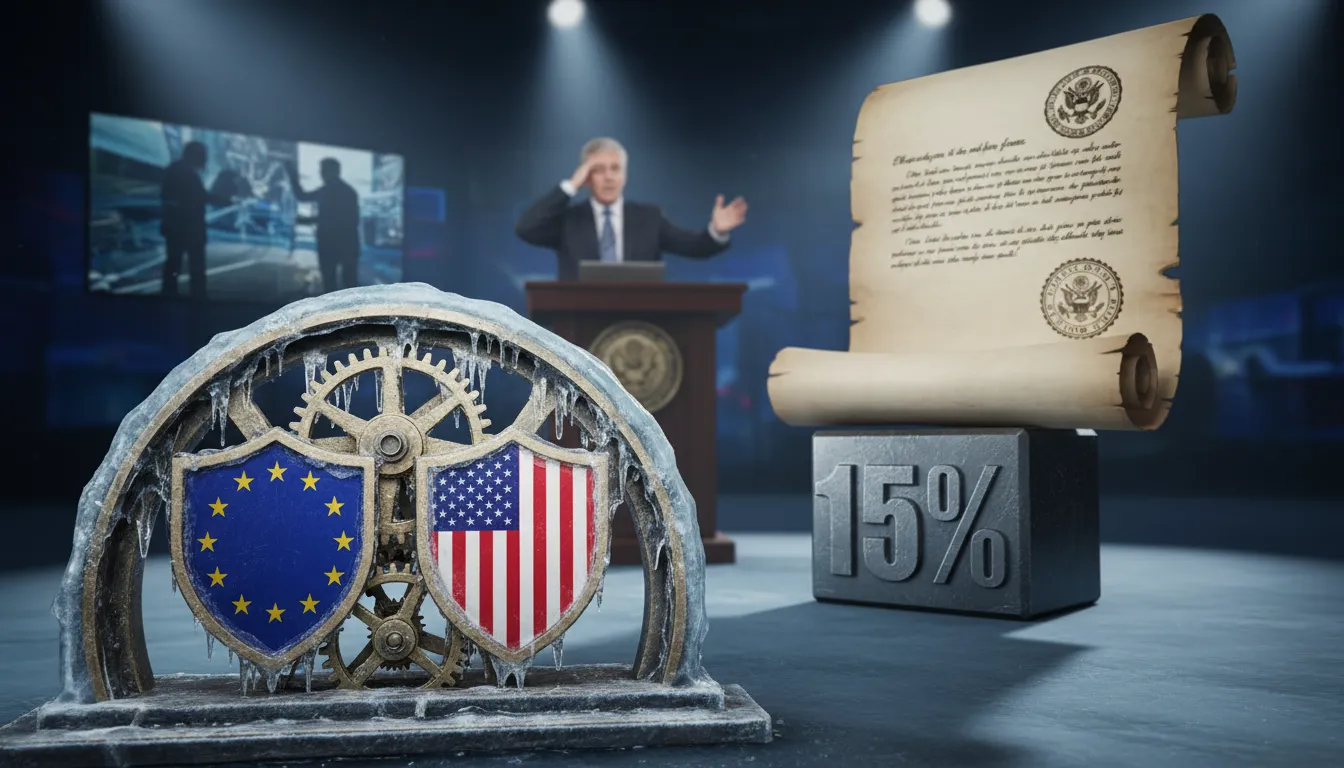
A trade agreement hailed last summer as a breakthrough in transatlantic relations has been thrown into deep uncertainty. The European Parliament voted Monday to suspend ratification of the so-called Turnberry deal — a sweeping US-EU accord struck at a Scottish golf resort last July — after President Donald Trump moved to impose a new round of sweeping global tariffs, threatening to blow past the limits the two sides had agreed.
The deal, which would have capped most US tariffs on EU imports at 15% and eliminated duties entirely on aircraft, generic drugs, semiconductors, and critical raw materials, now faces an unclear future as both sides trade accusations of bad faith.
What Triggered the Freeze
The crisis was set off by a US Supreme Court ruling late last week that struck down most of Trump's earlier global tariff regime as legally overreaching. Rather than accept the court's limits, the president pivoted swiftly. By Friday he had signed an executive order imposing a 10% universal tariff under Section 122 of the Trade Act of 1974 — a different legal basis designed to withstand judicial scrutiny. By Saturday, that rate had climbed to 15%, with Trump warning that countries "playing games" with the Supreme Court decision would face "much higher" duties still.
For Brussels, the escalation was the final straw. Bernd Lange, chair of the European Parliament's trade committee, said the new tariffs "run counter to the stability and predictability we sought to achieve with the Turnberry deal" and that nobody could say whether Washington would honour its side of the bargain. The European Commission responded with a terse declaration: "A deal is a deal," adding that it expected the United States to meet its commitments just as the EU intended to meet its own.
Markets Rattle, Allies Reassess
Financial markets reacted sharply. On Wall Street, the Dow Jones fell 1.66%, the S&P 500 dropped 1.04%, and the Nasdaq lost 1.13%. In Europe, the Stoxx 600 retreated 0.4%. The sell-off reflected not only the tariff numbers themselves but the broader uncertainty they generate — a concern European Central Bank President Christine Lagarde had flagged days earlier, warning that unpredictability in trade policy tends to suppress business investment and hiring well beyond what the headline tariff rates alone would suggest.
The fallout spread beyond the Atlantic. China announced it was reviewing the Supreme Court ruling and called on the US to scrap its tariffs entirely. India, in the middle of its own trade negotiations with Washington, canceled a scheduled meeting with American officials, signaling that confidence in US commitments had eroded globally.
What Comes Next
The immediate path forward is murky. The EU has paused, not abandoned, the ratification process, leaving open the possibility of resuming if Washington clarifies its intentions. But senior European legislators are openly questioning whether the Trump administration views trade agreements as durable commitments at all.
For businesses on both sides of the Atlantic that had begun planning around the deal's terms — from pharmaceutical companies expecting tariff-free drug exports to aerospace suppliers betting on duty elimination — the freeze adds a fresh layer of operational uncertainty to an already turbulent environment. With elections looming in several EU member states and US trade envoys making few public statements, analysts say a resolution is unlikely before the second quarter at the earliest.