How Airport Slots Work—and Why They Cost Millions
Airport slots are landing and takeoff rights at congested airports, allocated through a global system of grandfather rights, use-it-or-lose-it rules, and—at some hubs—multimillion-dollar trades. Here's how the system keeps the world's busiest runways from gridlock.
What Is an Airport Slot?
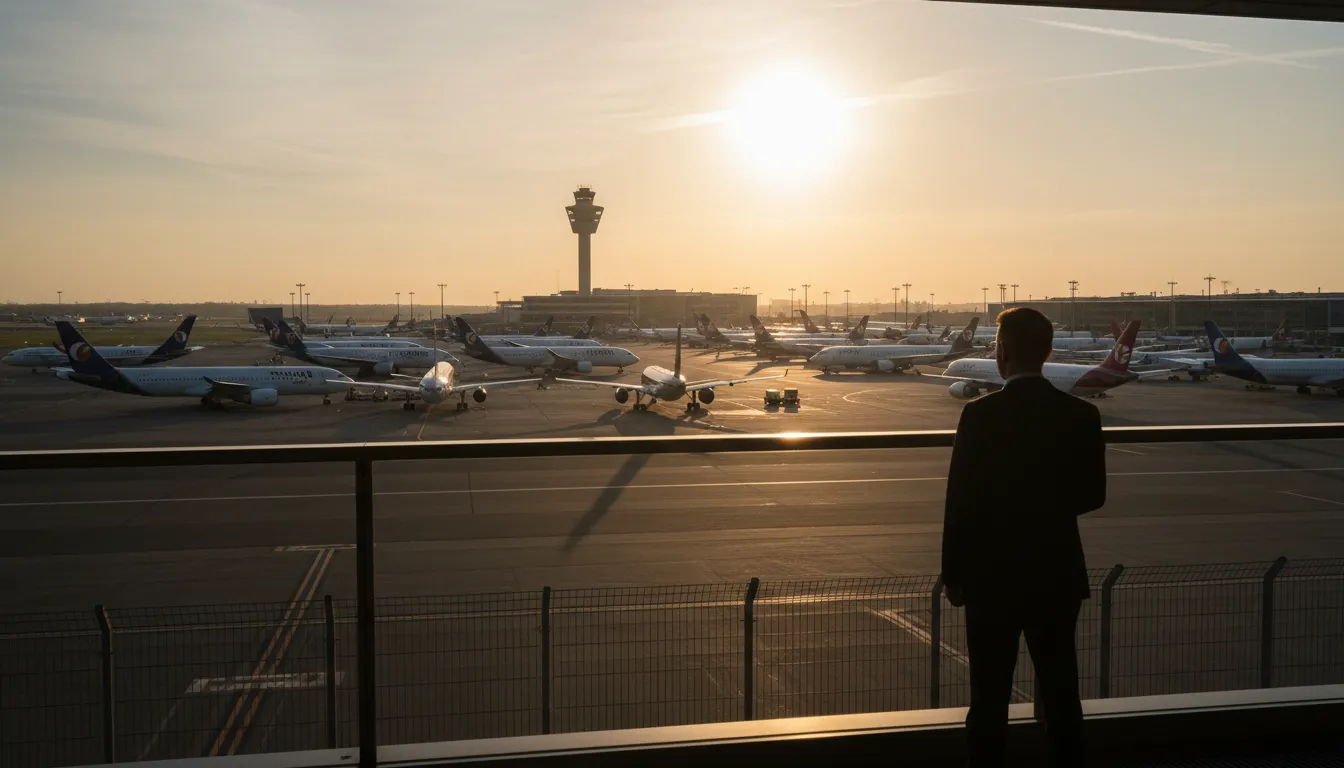
An airport slot is a scheduled permission for an airline to take off or land at a specific airport during a defined time window on a given day. At the world's most congested hubs—London Heathrow, New York JFK, Tokyo Haneda—demand for runway access far exceeds supply. Without a system to manage that gap, airports would face constant gridlock, cascading delays, and safety risks.
That system is slot coordination, and it governs roughly 43 percent of all global air passengers, according to the International Air Transport Association (IATA). It is one of aviation's least visible but most consequential mechanisms.
How Airports Get Classified
IATA and national regulators classify airports into three tiers based on congestion:
- Level 1 — capacity meets demand; airlines schedule freely.
- Level 2 — potentially congested; a schedule facilitator coordinates voluntary adjustments.
- Level 3 — fully congested; an independent slot coordinator must approve every takeoff and landing in advance.
As of 2025, there were 215 Level 3 airports worldwide, with roughly nine new airports added each year. In the United States, the FAA designates JFK, LaGuardia, and Reagan National as slot-controlled, while O'Hare, Newark, LAX, and San Francisco are subject to formal schedule review.
Grandfather Rights: How Airlines Keep Their Slots
The backbone of slot allocation is a principle called grandfather rights. If an airline operated a slot reliably in the previous equivalent season—summer or winter—it retains the right to that slot in the next one. This gives carriers scheduling stability and allows passengers to book flights months in advance.
But grandfather rights come with a catch: the 80/20 rule, also known as "use it or lose it." Airlines must operate at least 80 percent of their allocated slots during a scheduling season. Fall below that threshold, and the underused slots are returned to a common pool for reallocation—potentially to a competitor.
Ghost Flights and Slot Hoarding
The 80/20 rule creates a perverse incentive. Rather than surrender a valuable slot, some airlines have resorted to operating near-empty "ghost flights"—flights with few or no passengers flown solely to meet the usage threshold. During the COVID-19 pandemic, regulators temporarily waived the rule to prevent airlines from burning fuel on pointless trips. Research published in Transportation Research Part D has documented how this slot-hoarding behavior can increase emissions without delivering any consumer benefit.
When Slots Are Worth More Than the Planes
At the most constrained airports, slots are extraordinarily valuable commodities. London Heathrow, capped at roughly 10,500 weekly aircraft movements, is the prime example. In 2016, Oman Air paid a reported $75 million for a single pair of Heathrow slots from Air France-KLM—the largest publicly known slot transaction in aviation history. A year earlier, American Airlines had paid $60 million for a slot pair from Scandinavian Airlines.
In Europe, airlines can buy, sell, and lease slots in a secondary market. The United States takes a different approach: slots at controlled airports are generally allocated by the FAA and cannot be formally bought or sold, though airlines use workarounds like swap agreements.
Why Regulators Step In
When airlines schedule more flights than an airport can safely handle, regulators intervene. The FAA recently proposed capping operations at Chicago O'Hare at 2,600 to 2,800 daily takeoffs and landings, down from more than 3,000 that carriers had planned. The agency warned the surge would "stress the runway, terminal, and air traffic control systems." It is a rare but powerful tool: the government effectively telling airlines they cannot fly as much as they want.
Such interventions highlight the fundamental tension in slot policy—balancing airline competition and consumer choice against physical infrastructure limits and safety.
What Comes Next
Critics argue that grandfather rights entrench dominant carriers and block new entrants. Reformers have proposed slot auctions, congestion pricing, or stricter use-it-or-lose-it thresholds. Meanwhile, airport expansion projects move slowly—Heathrow has debated a third runway for decades—so the slots already allocated will only grow more scarce and more valuable.
For travelers, the slot system is invisible. But every time a flight departs on schedule from a crowded hub, it is because somewhere, months earlier, a coordinator approved that precise window—one of aviation's quiet feats of global logistics.