How Atmospheric Reentry Works—and Why Speed Kills
Returning from space means slamming into a wall of air at thousands of kilometers per hour. The physics of atmospheric reentry—from blunt-body aerodynamics to ablative heat shields—explains how spacecraft survive temperatures hotter than lava and why the margin for error is razor-thin.
Every spacecraft that returns to Earth faces the same brutal physics problem: how to shed enormous speed without burning up. At orbital velocity—roughly 28,000 kilometers per hour for low Earth orbit, and up to 40,000 km/h for missions returning from the Moon—a vehicle carries enough kinetic energy to vaporize itself many times over. Converting that energy safely into heat and depositing it into the atmosphere, rather than into the crew cabin, is one of the greatest engineering challenges in spaceflight.
Why Reentry Gets So Hot
A common misconception holds that friction causes the extreme heating during reentry. In reality, most of the heat comes from adiabatic compression—the same principle that warms air inside a bicycle pump, scaled up dramatically. As a spacecraft plunges into denser atmosphere, air molecules in its path cannot move aside fast enough. They pile up and compress into a superheated shock wave in front of the vehicle, reaching temperatures of up to 2,760 degrees Celsius—roughly half the surface temperature of the Sun.
The insight that made survival possible came from H. Julian Allen at NASA's Ames Research Center in the 1950s. His "blunt-body principle" showed that a wide, flat-bottomed shape creates a strong bow shock that pushes the hottest gases away from the vehicle's surface. Counter-intuitively, a blunt shape generates more drag but experiences less heat transfer than a sleek, pointed one, because the superheated air flows around the vehicle rather than hugging it.
Two Ways to Beat the Heat
Engineers have developed two main categories of thermal protection systems, each suited to different missions.
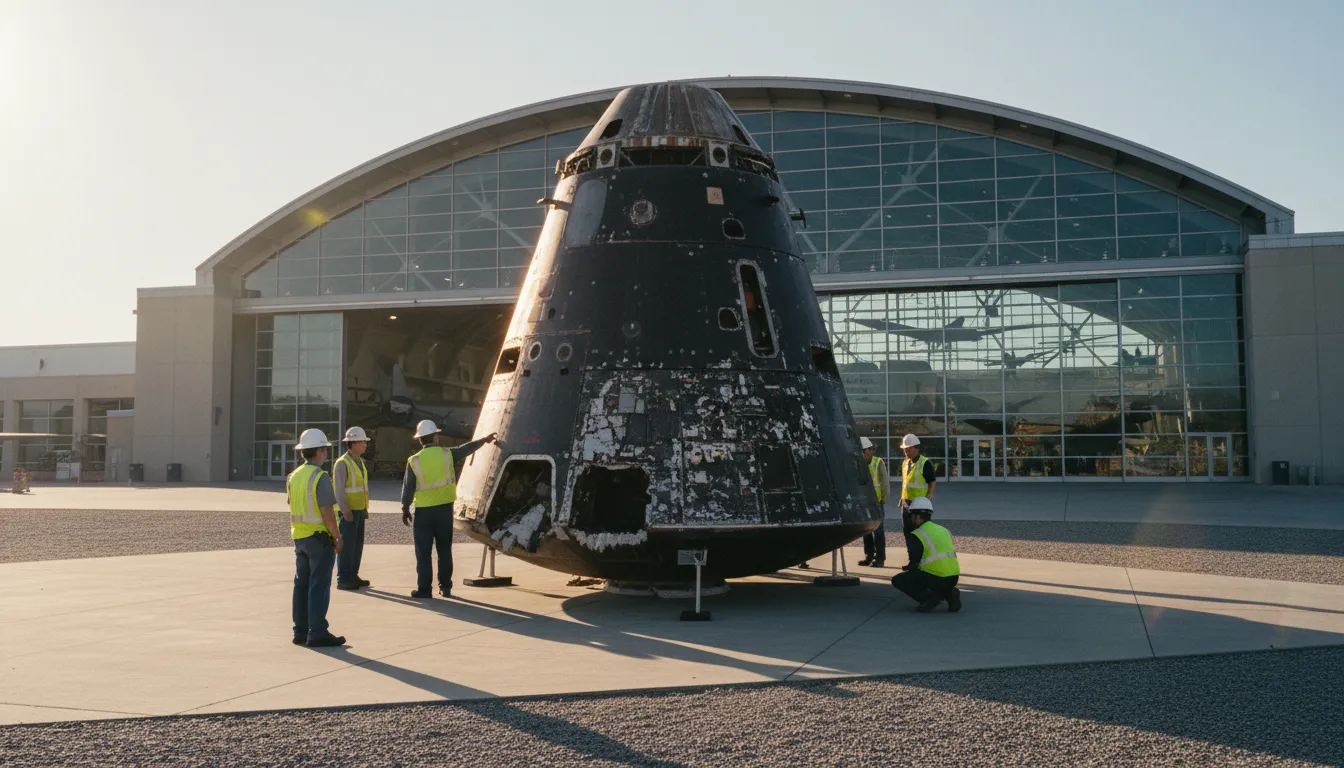
Ablative heat shields are designed to burn away in a controlled manner. As the outer surface chars, it releases gases that push the surrounding superheated air away from the spacecraft, creating an insulating buffer layer. The Apollo program pioneered this approach with AVCOAT, a fiberglass honeycomb filled with epoxy resin applied to the command module. NASA's Orion capsule, built for the Artemis lunar missions, uses an updated version of the same material—a direct descendant of technology first proven during the Moon landings of the 1960s.
Reusable insulating tiles take a different approach. Rather than sacrificing material, they absorb heat on their outer surface and radiate it back into the atmosphere while conducting almost none of it inward. The Space Shuttle's thermal protection system used roughly 24,000 silica tiles, each one capable of being held by its edges moments after removal from a furnace because heat moved through them so slowly. This reusability came at a cost: the tiles were fragile and required extensive inspection between flights.
The Reentry Corridor
Getting the angle right matters as much as the heat shield itself. Spacecraft must thread a narrow "reentry corridor"—typically between about 5.5 and 7.5 degrees for crewed vehicles returning from orbit. Come in too steep, and the deceleration forces crush the crew while heat builds faster than any shield can handle. Come in too shallow, and the vehicle skips off the upper atmosphere like a stone on water, potentially flying back into space on an uncontrolled trajectory with no way to try again.
For missions returning from the Moon, the challenge intensifies. The spacecraft arrives at roughly 40,000 km/h—about 40 percent faster than orbital reentry—which means the energy that must be dissipated scales with the square of the velocity. That speed also tightens the reentry corridor. During the Apollo program, the corridor was barely one degree wide. NASA's Orion capsule uses a "skip reentry" technique, intentionally bouncing off the upper atmosphere once to bleed off speed before making a final descent, giving controllers more flexibility in targeting the landing zone.
Why It Still Pushes Engineering Limits
Despite decades of experience, atmospheric reentry remains one of the most demanding phases of any space mission. The Artemis I test flight in 2022 revealed that Orion's heat shield experienced unexpected cracking and material loss during reentry—a reminder that even well-tested systems can behave unpredictably at these extremes. Engineers adjusted the reentry trajectory for subsequent missions rather than redesigning the shield, demonstrating how even small changes in angle and timing can dramatically alter the thermal environment.
As humanity plans missions to Mars and beyond, the reentry problem only grows. Mars-return vehicles will arrive at Earth even faster than lunar spacecraft, and future Mars landers must survive entry into a thin atmosphere that offers less braking force. Each new destination demands new solutions to the same ancient challenge: how to come home alive through a wall of fire.