How NASA's Orion Spacecraft Works—and Why It Matters
NASA's Orion capsule is the first crewed vehicle designed for deep space since Apollo. Here is how its heat shield, life support, and navigation systems keep astronauts alive far beyond Earth orbit.
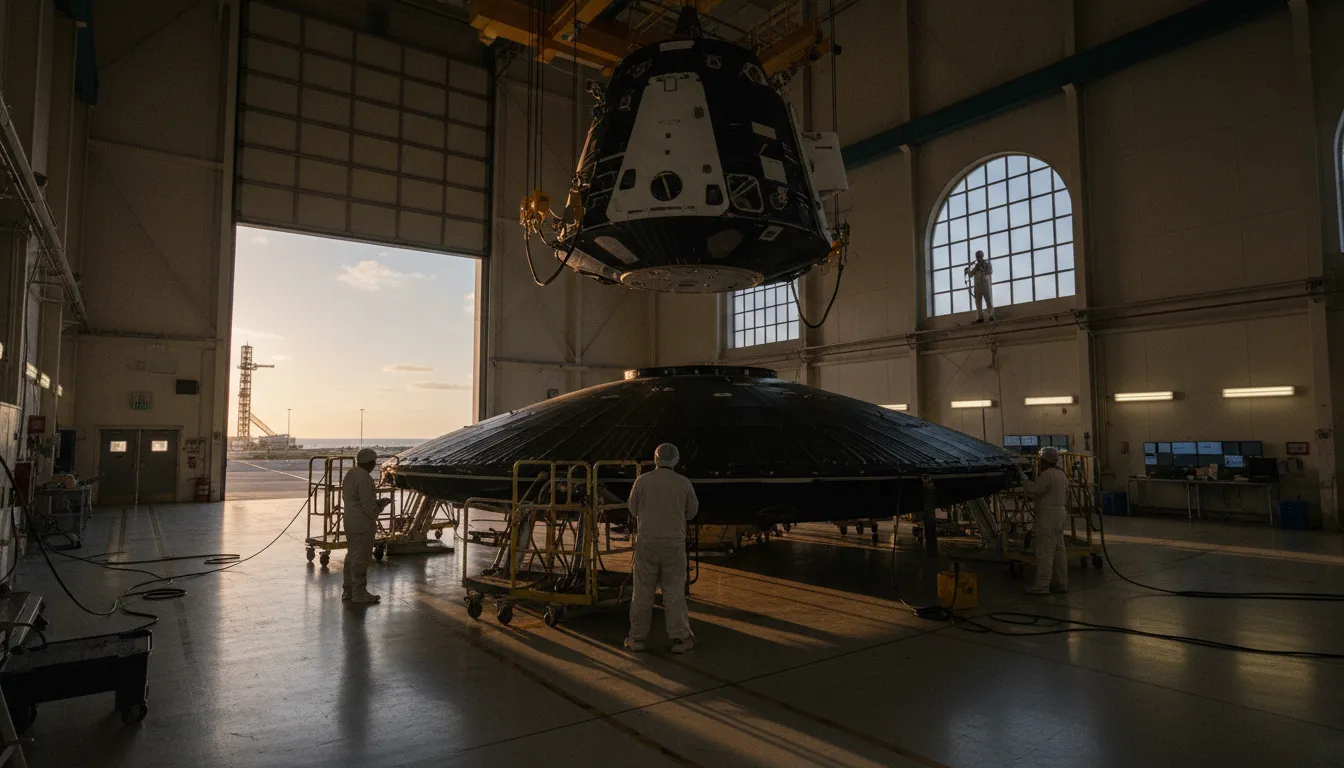
For more than half a century after the last Apollo mission, no spacecraft carried humans beyond low Earth orbit. That gap ended with Orion, a crew capsule built by Lockheed Martin for NASA's Artemis program. Designed to ferry astronauts to the Moon and eventually deeper into the solar system, Orion is the most advanced crewed vehicle ever constructed for deep-space travel.
Anatomy of the Spacecraft
Orion consists of three main sections. The crew module is a cone-shaped pressurised capsule that seats up to four astronauts. Below it sits the service module, built by the European Space Agency, which provides propulsion, electrical power from four solar-array wings, and thermal control. Capping the stack during launch is the launch abort system, a tower of solid-fuel rockets that can pull the crew module to safety within milliseconds if something goes wrong on the pad or during ascent.
Surviving Deep-Space Heat
Returning from the Moon means hitting Earth's atmosphere at roughly 40,000 km/h—far faster than a return from the International Space Station. At that speed, temperatures on the spacecraft's underbelly reach about 2,760 °C. Orion's heat shield, measuring 5 metres across, is the largest ever built for a crewed vehicle. It uses an ablative material called AVCOAT, a silica-fibre-and-resin compound bonded onto a carbon-fibre skin in nearly 200 pre-machined blocks. As the shield heats up, the outer layers char and flake away, carrying energy with them and keeping the cabin cool.
Life Support Far From Home
Orion's environmental control and life-support system (ECLSS) manages air, water, temperature, and humidity for missions lasting up to 21 days with a crew on board. Carbon dioxide is scrubbed from cabin air, oxygen is replenished, and waste heat is radiated into space through fluid loops and external radiators on the service module. Because deep space exposes crews to galactic cosmic rays and unpredictable solar particle events, Orion's structure includes strategically placed polyethylene panels and other shielding materials. During a solar storm, astronauts can shelter behind the densest parts of the spacecraft to reduce their radiation dose.
Navigation Beyond Earth Orbit
In low Earth orbit, spacecraft rely on a dense network of ground stations and GPS satellites for positioning. Orion must navigate where GPS signals do not reach. It carries star trackers—cameras that identify star patterns to determine orientation—and an optical navigation system that photographs the Moon and Earth against the star field to calculate position. These tools, combined with periodic tracking from NASA's Deep Space Network of giant radio antennas, allow mission controllers to pinpoint Orion's location to within a few kilometres even at lunar distance.
Skip Re-Entry: A Controlled Bounce
Unlike Apollo capsules, which plunged straight into the atmosphere, Orion uses a technique called skip re-entry. The capsule dips into the upper atmosphere, bleeds off speed, then skips back up briefly before descending again for a final landing approach. This two-phase method reduces the peak deceleration forces on the crew and, crucially, allows a much more precise splashdown location—within about two kilometres of the target point. Greater precision means recovery ships can be positioned closer, shortening the time astronauts wait in the ocean.
Why Orion Matters Beyond Artemis
Orion is more than a Moon taxi. Its modular design—a reusable crew module paired with a replaceable service module—creates a platform that NASA can adapt for missions to a lunar space station, to asteroids, or eventually toward Mars. Each flight generates engineering data on how hardware and human bodies perform in deep space, data that no other active programme can provide. As commercial partners build landers and habitats, Orion remains the vehicle that carries crews from Earth's surface to the edge of deep space and brings them safely home.