How Dinosaurs Hatched Eggs—With Help From the Sun
Long before modern birds perfected the art of brooding, oviraptor dinosaurs used a remarkable combination of body heat and solar warmth to incubate their eggs—a strategy revealed by scientists who built a life-sized heated dinosaur model to find out.
The Egg Thief That Wasn't
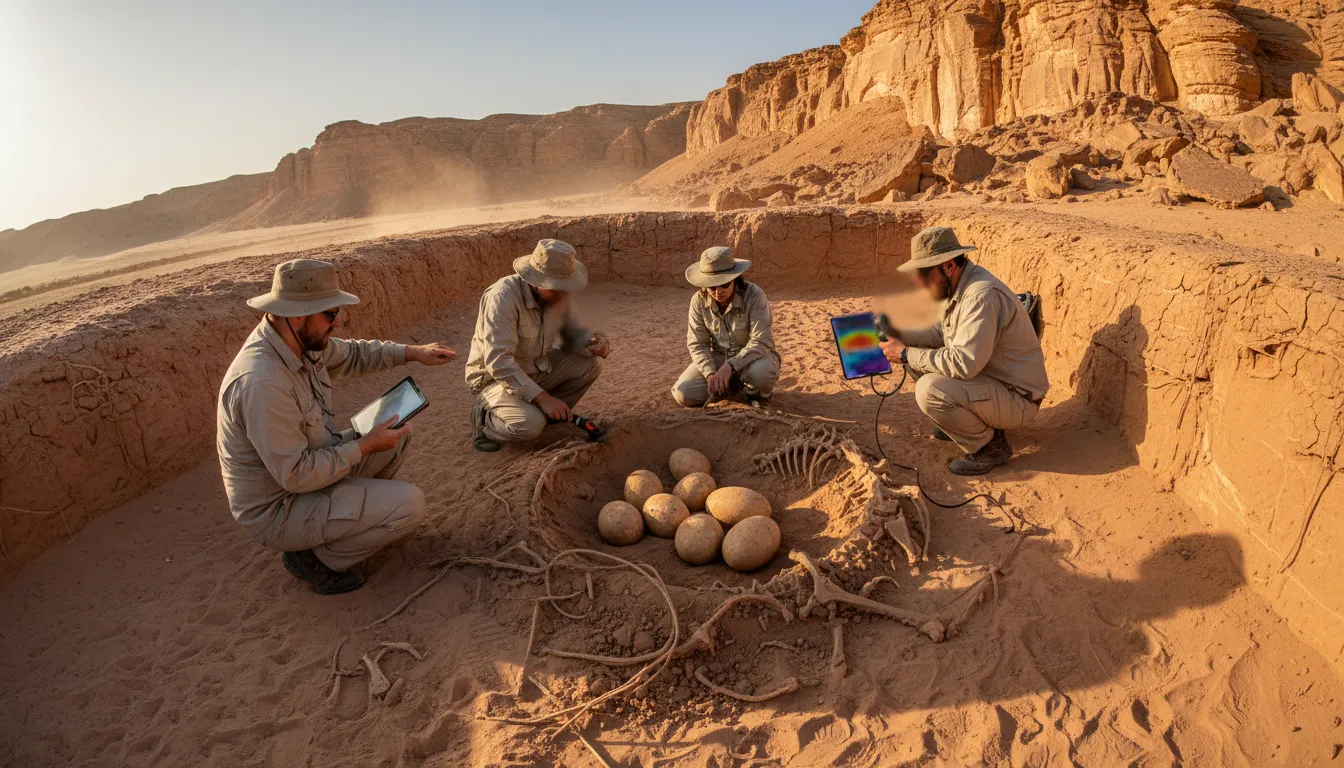
When the first Oviraptor fossil was discovered in Mongolia in 1924, paleontologists made an embarrassing mistake. The creature was found near a clutch of eggs, and scientists assumed it had died stealing them. They named it Oviraptor philoceratops—literally "egg thief that loves horned faces." It took decades of additional fossil finds to reveal the truth: oviraptors weren't robbing nests. They were sitting on their own eggs, brooding them just as birds do today.
That revelation opened one of paleontology's richest puzzles: exactly how did these feathered, bird-like dinosaurs keep their eggs warm? New research using a remarkable experiment—a life-sized, heated robot dinosaur—has finally provided answers, and they upend some of our assumptions about the evolution of parental care.
Brooding, But Not Like a Bird
Modern birds are masterful incubators. A brooding hen presses a bare, blood-vessel-rich patch of skin called the brood patch directly against its eggs, maintaining precise temperatures with remarkable efficiency. Studies show that birds like the common eider achieve around 84% heating efficiency—transferring most of the adult's warmth directly to developing embryos.
Oviraptors couldn't do this. Researchers at National Taiwan University, led by paleontologist Dr. Tzu-Ruei Yang, reconstructed how Heyuannia huangi—an oviraptor species that lived roughly 70 to 66 million years ago in what is now southern China—managed its nests. The animal was about 1.5 meters long and weighed around 20 kilograms, and it laid eggs in large open rings, not compact piles.
The geometry of these nests created a fundamental physical problem. When the adult crouched over the clutch, only around 3% of each egg's surface was in contact with the parent's body—compared to 8–10% in modern chickens. The outer ring of eggs shielded the inner ring from direct contact entirely. No amount of careful positioning could bridge that gap with body heat alone.
The Robot Dinosaur Experiment
To quantify just how inefficient oviraptor brooding was, the Taiwanese team did something unusual: they built a life-sized oviraptor incubator out of foam and wood, fitted with a heating blanket calibrated to approximate dinosaur body temperature. They placed it on a clutch of custom-made resin egg replicas—necessary because oviraptor eggs have no living equivalent—and measured how heat moved through the nest.
The results were striking. In cooler ambient conditions, eggs in the outer ring experienced temperature differences of up to 6°C compared to inner eggs. Such variation would cause asynchronous hatching—different eggs in the same nest breaking open days apart. In warmer, sunnier simulated conditions, that gap shrank to just 0.6°C, with the Sun acting as a powerful equalizer.
Overall, the model oviraptor achieved only 26–65% heating efficiency, well below the 84% of modern birds. Yet Dr. Yang cautions against interpreting this as failure. "Nothing is better or worse. It just depends on the environment," he told researchers. The adult's role may have been less about generating heat and more about regulating extremes—shielding eggs from lethal midday heat and insulating them against cold nights—while the Sun did the heavy lifting during the day.
What This Reveals About Sex Determination
The uneven heating pattern carries a surprising implication. Many reptiles today use temperature-dependent sex determination: the incubation temperature of an egg determines whether the embryo becomes male or female. Crocodiles and many turtles rely on this system.
But if oviraptor eggs varied by up to 6°C within a single clutch, temperature-based sex determination would be disastrous—it could produce entire generations of only one sex, pushing the species toward extinction. The researchers conclude that oviraptors almost certainly used genetic sex determination, the same system employed by modern birds and mammals, where chromosomes—not temperature—decide sex. This suggests that the shift from temperature-based to genetic sex determination happened earlier in dinosaur evolution than previously thought.
A Window Into the Bird–Dinosaur Transition
Oviraptors belong to a group called theropods—the same lineage that gave rise to modern birds. Their fossils, often found in unmistakably bird-like brooding postures crouched over clutches of up to 24 eggs, represent some of the clearest evidence for the deep evolutionary roots of avian parental behavior.
Earlier studies of Troodon, another theropod, estimated incubation periods of around 74 days—squarely between the reptilian average of 107 days and the avian average of 44 days. This intermediate value suggests that fast, efficient incubation was a gradual achievement, refined over millions of years as the theropod lineage evolved toward true birds.
The oviraptor research fits neatly into this picture. These animals had evolved brooding behavior and likely genetic sex determination—key avian traits—but had not yet achieved the tight thermodynamic contact that makes modern birds such efficient parents. They occupied a fascinating middle ground: dinosaurs that brooded like birds but warmed their eggs like the sun-dependent reptiles they partly were.
Why It Matters
Understanding how non-avian dinosaurs reproduced helps scientists trace when and why the traits that define modern birds evolved. Parental investment, efficient incubation, and genetic sex determination are not uniquely avian inventions—they have deep dinosaurian roots. Every time a bird sits on its nest today, it is performing a behavior that began evolving more than 70 million years ago, refined through countless generations of creatures like the egg thief that turned out to be a devoted parent.