How the LHCb Experiment Discovers New Subatomic Particles
CERN's LHCb detector has confirmed dozens of never-before-seen particles, including exotic baryons with two charm quarks. Here is how the machine works, what it is looking for, and why each discovery sharpens our picture of the universe.
A Universe of Hidden Particles
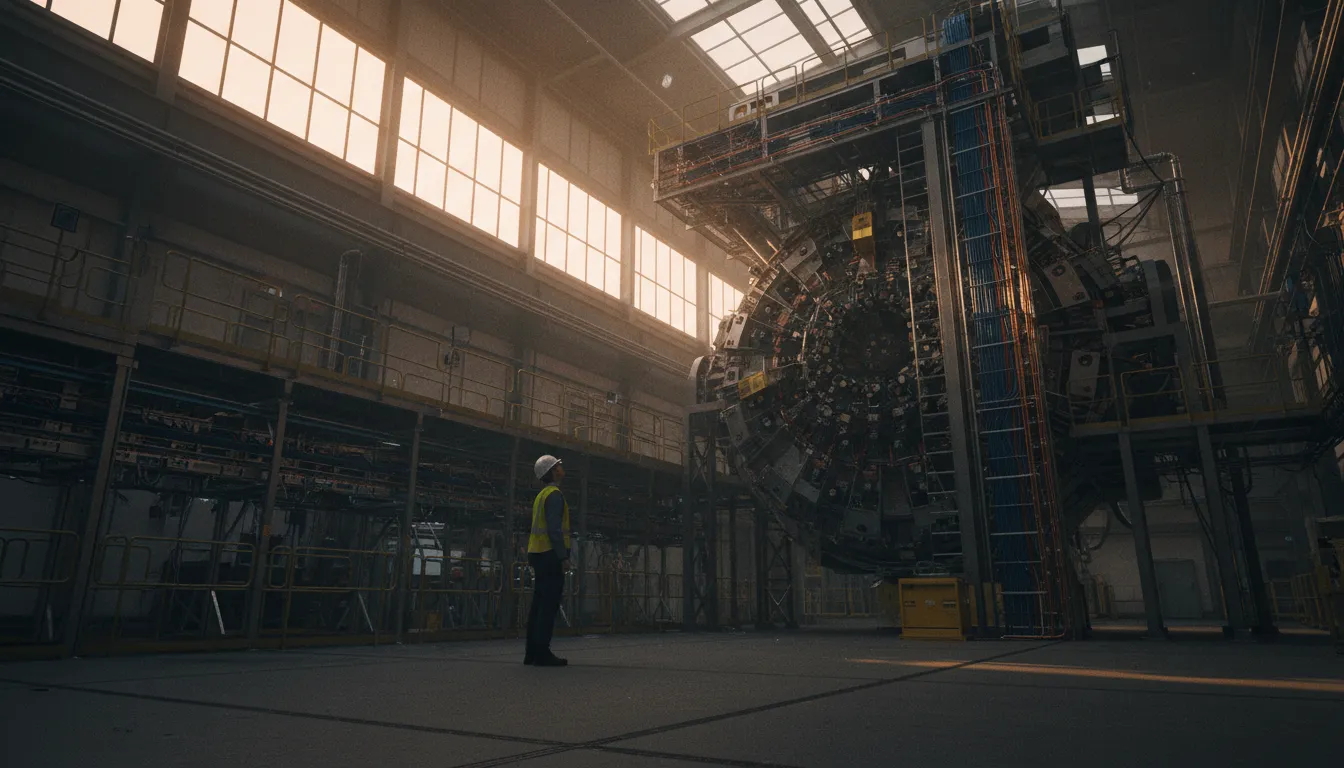
Most people know the proton and neutron as the building blocks of atomic nuclei. Far fewer know that dozens of exotic cousins — particles that exist for only a fraction of a second before decaying — can be coaxed into existence inside a particle accelerator. Since the Large Hadron Collider (LHC) at CERN began operations, its experiments have catalogued more than 60 previously unknown hadrons. The machine responsible for most of those discoveries is a remarkably specialized detector called LHCb — the Large Hadron Collider beauty experiment.
Quarks: The True Building Blocks
To understand what LHCb hunts, you need to know about quarks — the fundamental particles that combine to form hadrons. The Standard Model of particle physics describes six quark "flavors": up, down, strange, charm, bottom, and top. Everyday matter is built almost entirely from up and down quarks. The heavier flavors — charm, strange, bottom, top — appear only under extreme conditions, such as those inside a particle collider.
Baryons are hadrons made of exactly three quarks. The proton (two up quarks plus one down) and neutron (two down plus one up) are the most stable baryons. But theory predicts — and experiment confirms — that many other three-quark combinations can exist, at least briefly. A charmed baryon contains one or more charm quarks alongside lighter partners. A doubly charmed baryon, as its name implies, contains two charm quarks — a configuration so rare that physicists debated for two decades whether it could be observed at all.
How the LHCb Detector Works
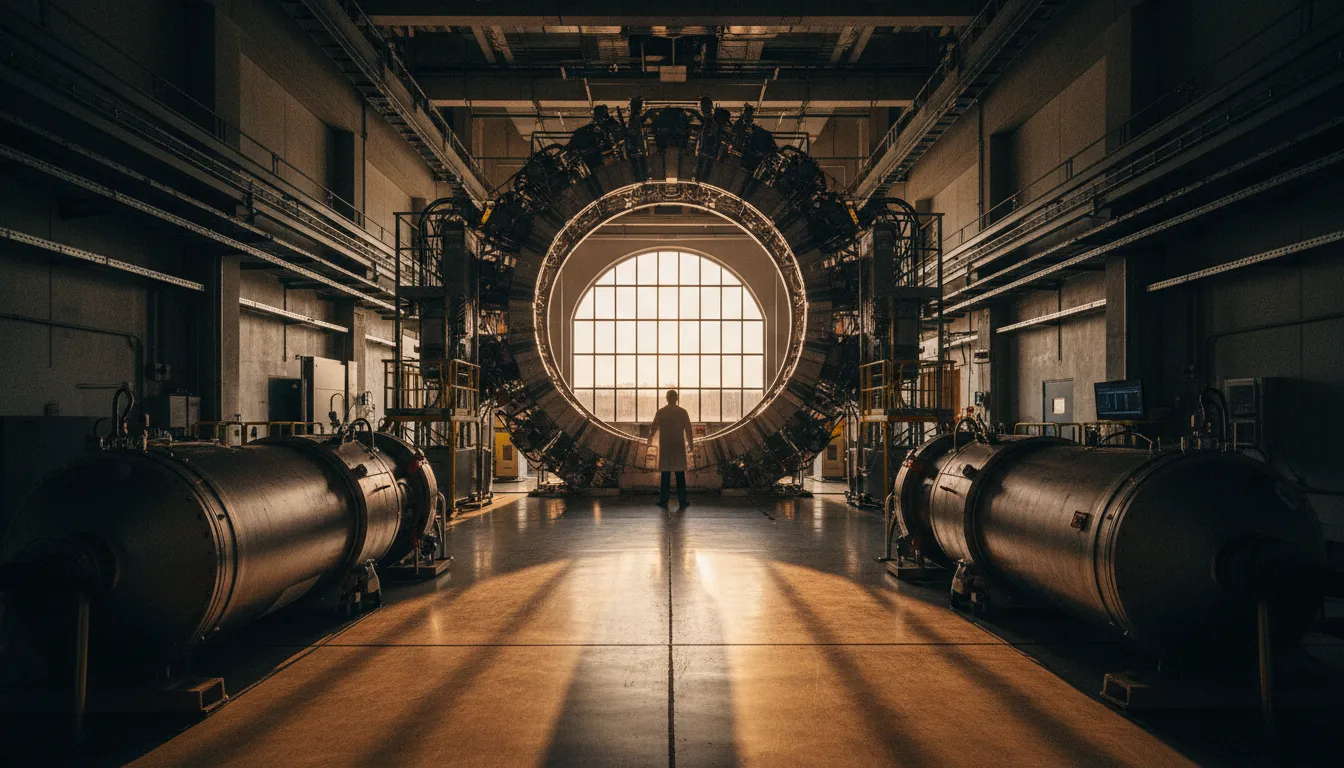
Unlike the cylindrical ATLAS and CMS detectors that surround the collision point in all directions, LHCb is a forward-facing spectrometer. It captures particles that fly in a narrow cone along the beam line rather than spreading out sideways. This geometry is ideal for catching the products of beauty and charm quark decays, which tend to travel in the forward direction.
The detector consists of several distinct layers, each with a specific job:
- VELO (Vertex Locator) — a silicon microstrip detector placed just millimeters from the collision point. It precisely reconstructs where short-lived particles were born and where they decayed, giving physicists a spatial "fingerprint" of the event.
- RICH detectors — Ring-Imaging Cherenkov detectors that identify particle types by measuring the cone of light they emit when traveling through a medium faster than light travels through that medium.
- Calorimeters — absorb electrons, photons, and hadrons to measure their energy.
- Muon stations — detect muons, which penetrate material that stops most other particles.
Together these layers reconstruct the trajectory, identity, and energy of every detectable particle produced in each proton-proton collision. The LHC delivers roughly 30 million collisions per second inside LHCb; powerful trigger systems and algorithms filter the flood down to the tiny fraction worth recording.
From Collision to Discovery
A new particle is never spotted directly — it decays almost instantaneously. Instead, physicists look for its decay products. When they plot the combined mass of those products across millions of events, a genuine new particle appears as a sharp peak rising above a smooth background. The height of that peak, measured in units called sigma (σ), quantifies how unlikely the peak is to be a statistical fluke.
In particle physics, the bar for claiming a discovery is set at five sigma — meaning the chance of seeing such a peak by chance is less than one in 3.5 million. Some discoveries exceed this threshold comfortably: LHCb's 2026 observation of the doubly charmed baryon Ξcc⁺ registered at seven sigma, leaving virtually no doubt about its existence.
Why Doubly Charmed Baryons Matter
Discovering new particles is not just stamp-collecting. Each new hadron is a stress test for Quantum Chromodynamics (QCD), the theory that governs the strong nuclear force binding quarks together. QCD calculations are notoriously difficult because the strong force grows stronger as quarks move apart — the opposite of electromagnetism — making the equations hard to solve exactly.
Doubly charmed baryons offer a rare simplification. Because charm quarks are heavy and sluggish compared with light quarks, two charm quarks sitting close together behave almost like a stationary nucleus while a lighter third quark orbits them — analogous to an electron orbiting a hydrogen nucleus. This cleaner geometry makes QCD predictions more tractable and lets physicists test whether the theory holds under new conditions.
Precise measurements of these exotic particles' masses, lifetimes, and decay modes can reveal whether QCD is complete or whether gaps remain — gaps that might hint at physics beyond the Standard Model.
A Particle Zoo That Keeps Growing
Since LHCb began taking data, it has discovered pentaquarks (five-quark states), tetraquarks (four-quark states), and a growing list of charmed and beauty baryons. The upgraded detector, commissioned in 2023 with improved resolution and a higher collision rate, is expected to push that list further. Each entry in the catalogue is a data point constraining the fundamental equations that describe matter itself — equations physicists are still working to fully solve.