How Earthquake Early Warning Systems Work
Earthquake early warning systems exploit the speed difference between fast but harmless P-waves and slower, destructive S-waves to send alerts seconds before strong shaking arrives — giving people and machines precious time to react.
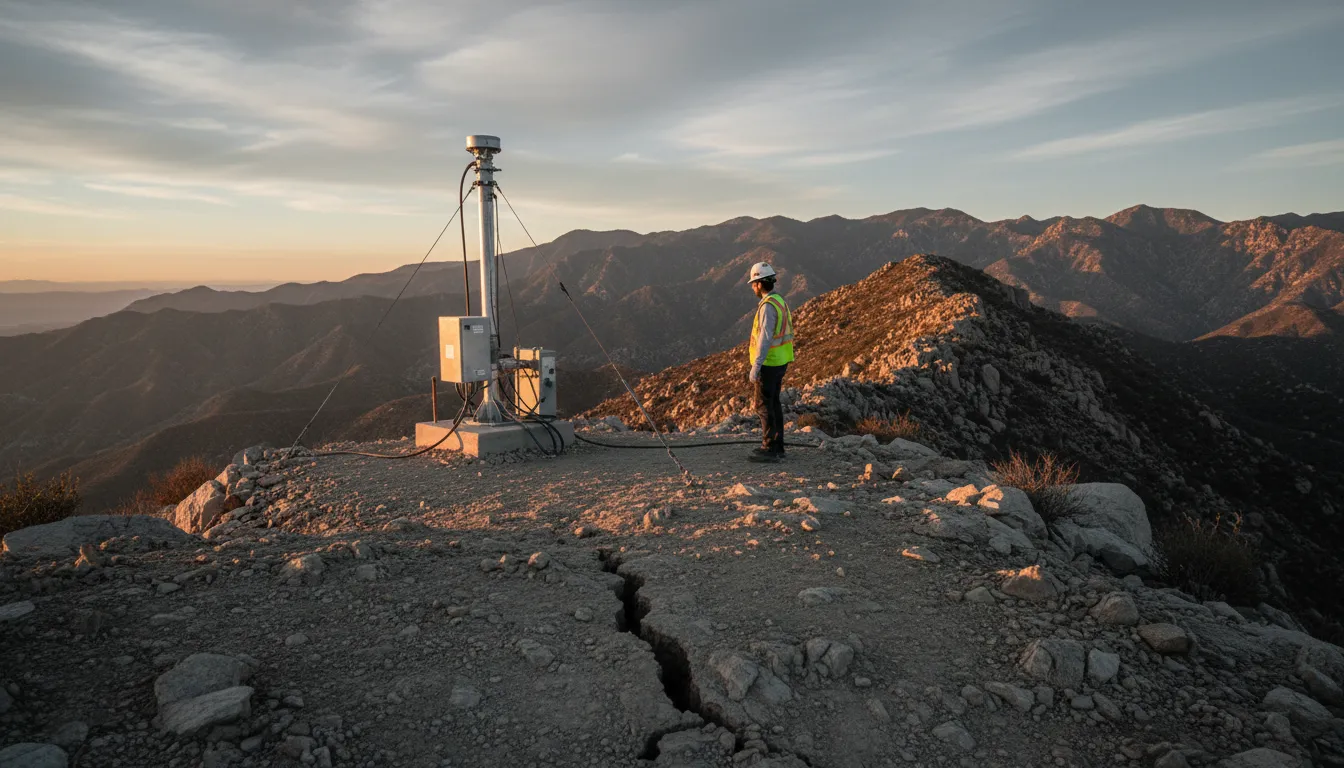
Racing Seismic Waves
Earthquakes cannot be predicted, but they can be detected the instant they begin. Earthquake early warning (EEW) systems exploit a simple fact of physics: seismic waves travel at different speeds. By detecting the first, harmless tremor and transmitting an electronic alert faster than the destructive waves can spread, these systems give people and automated infrastructure precious seconds to react.
The concept dates to 1985, when Caltech seismologist Tom Heaton published the foundational paper arguing that electronic signals could outrun seismic waves. Four decades later, EEW networks protect hundreds of millions of people across Japan, China, Mexico, the United States, South Korea, Taiwan, and Israel.
P-Waves vs. S-Waves: The Core Principle
When rock fractures along a fault, it radiates several types of seismic waves. Primary waves (P-waves) travel fastest — roughly 6 to 8 kilometres per second through the Earth's crust — but cause only mild, back-and-forth compression. Secondary waves (S-waves) follow at about 3 to 5 km/s, shaking the ground violently side to side. It is the S-waves, along with surface waves that arrive even later, that collapse buildings and rupture infrastructure.
The gap between these wave fronts widens with distance. Close to the epicentre, P- and S-waves arrive almost together. But 100 kilometres away, the gap stretches to roughly 15 seconds — enough time for a well-designed system to transmit a warning.
From Sensor to Smartphone
A modern EEW system follows three rapid-fire steps:
- Detection: A dense network of seismometers and accelerometers registers the incoming P-wave. Japan operates over 4,200 seismographic stations; China's network, the world's largest since 2024, deploys about 16,000 monitoring stations.
- Analysis: When two or more sensors detect a P-wave, algorithms instantly estimate the earthquake's location, depth, and magnitude. These estimates refine continuously as more data streams in.
- Alert distribution: If the predicted shaking exceeds a threshold, warnings blast out via cell broadcast, television and radio interrupts, smartphone apps, public address systems, and dedicated receivers in critical facilities.
In California's ShakeAlert system, alerts typically reach users five to eight seconds after an earthquake starts. Data travels from seismic stations through cell towers and a statewide microwave network managed by California's Office of Emergency Services.
What Happens in Those Few Seconds
Even a handful of seconds can save lives. When Japan's EEW fires, bullet trains automatically begin braking, elevators stop at the nearest floor and open their doors, factory assembly lines halt, and gas valves shut. Surgeons can lift scalpels away from patients. Schoolchildren can duck under desks.
Mexico's SASMEX system, operational since 2005, exploits an unusual geographic advantage: the subduction zone earthquakes that threaten Mexico City originate hundreds of kilometres away on the Pacific coast, giving the capital up to 60 seconds of warning — an eternity in seismic terms.
Limitations and Blind Zones
EEW systems have hard physical constraints. People within about 15 kilometres of the epicentre — often where shaking is worst — receive little or no warning because the P- and S-waves arrive nearly simultaneously. The system also cannot warn before an earthquake starts; it reacts to the first detected motion.
Accuracy remains a challenge. During the devastating 2023 Turkey–Syria earthquakes, Google's Android-based EEW algorithm underestimated the 7.8-magnitude event as between 4.5 and 4.9, sending insufficient warnings to vulnerable populations. False alarms, though rare, can erode public trust.
Network density matters enormously. Sparse sensor coverage means slower detection and less precise estimates. This is why wealthier, seismically active nations lead in deployment while many earthquake-prone developing countries remain unprotected.
The Future: Faster, Smarter, Wider
Researchers are now applying deep learning to P-wave detection, training neural networks to identify earthquake signals faster and more accurately than traditional algorithms — even on low-power edge devices. Meanwhile, the expansion of smartphone-based detection, pioneered by Google's Android network, is bringing rudimentary EEW capability to countries that lack dedicated seismometer infrastructure.
An earthquake early warning system cannot stop the ground from shaking. But by converting the physics of wave propagation into a race against time, it turns a few seconds of advance notice into lives saved, infrastructure protected, and communities better prepared for the inevitable next tremor.