How EV Battery Swapping Works—and Why It's Back
Battery swapping lets electric vehicle drivers exchange a depleted battery for a full one in under five minutes. After a spectacular early failure, the technology is surging back in China and expanding worldwide.
The Five-Minute Pit Stop
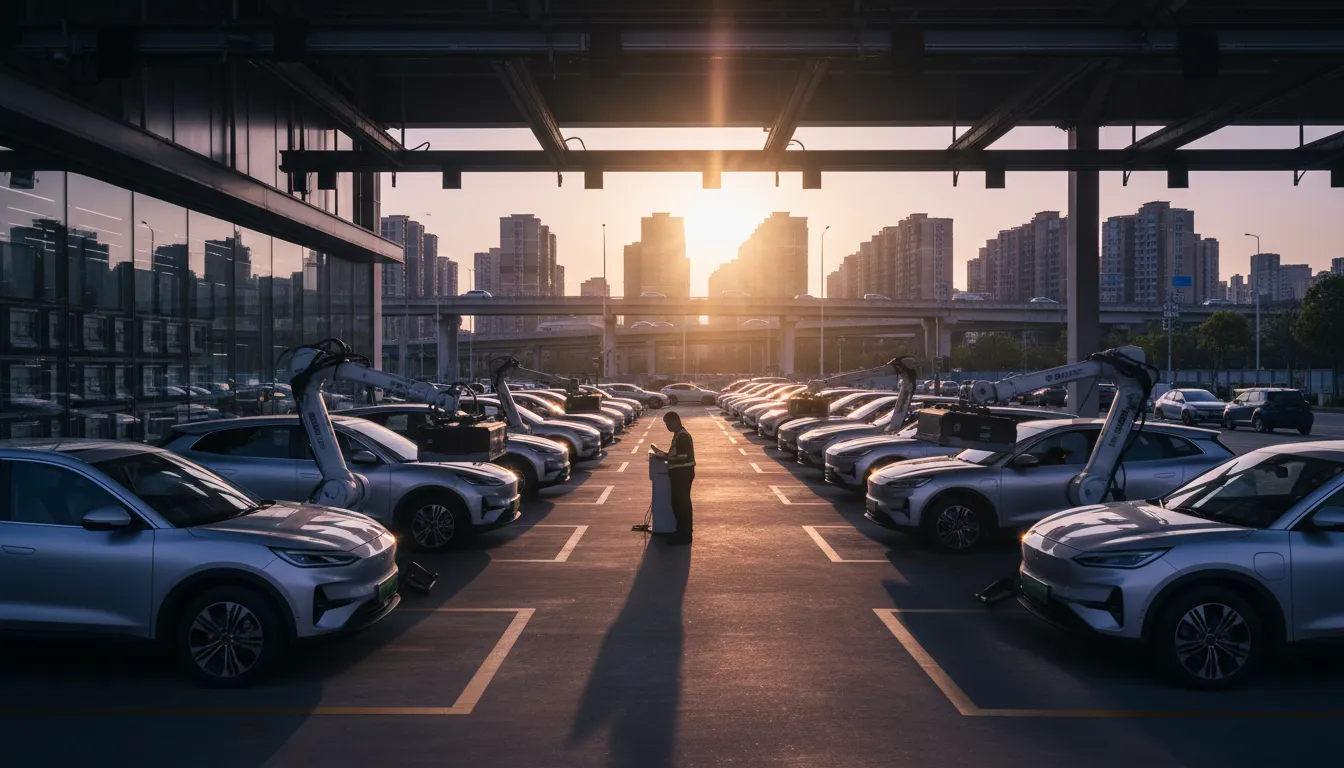
Imagine pulling into a station, parking over a platform, and driving away three minutes later with a fully charged electric vehicle—no cable, no waiting. That is the promise of battery swapping, a technology that replaces a depleted EV battery pack with a freshly charged one using automated robotics. While fast chargers still need 20 to 30 minutes to reach 80 percent, a swap station can return a driver to the road in roughly the time it takes to buy a coffee.
How a Swap Station Works
A driver enters a designated bay and aligns the vehicle on a platform. Sensors verify the car model and battery compatibility. The platform lifts slightly, and a robotic arm beneath the car unlocks the depleted battery pack from the vehicle's underbody, slides it out, and inserts a fully charged replacement. The entire mechanical sequence is fully automated—the driver never leaves the seat.
Behind the scenes, removed batteries enter a climate-controlled charging rack where they recharge at a slower, steadier rate than a public fast charger would demand. This gentler charging cycle extends battery lifespan and reduces stress on the electrical grid, because energy demand is spread evenly rather than concentrated into sharp, high-power bursts.
A Billion-Dollar Failure—and a Comeback
Battery swapping is not a new idea. In 2007, Israeli entrepreneur Shai Agassi founded Better Place, raising roughly $850 million from investors including HSBC, Morgan Stanley, and General Electric. The company built 21 swap stations in Israel and partnered with Renault on a single compatible model, the Fluence Z.E. But fewer than 1,000 cars were ever deployed. Better Place filed for bankruptcy in 2013, undone by massive infrastructure costs, a lack of automaker partners, and a market far smaller than projected.
What changed? China. Government subsidies, national battery-standardization guidelines, and a dense urban population hungry for EVs created the conditions Better Place never had. Today, Chinese companies operate thousands of swap stations—and the numbers are climbing fast.
Who Is Building the Network
NIO, the Chinese luxury EV maker, is the most visible player. By early 2026, NIO had completed 100 million battery swaps across roughly 3,790 stations worldwide, with plans to add another 1,000 stations by year-end and expand into 40 countries. NIO's model separates battery ownership from the car itself through a Battery-as-a-Service subscription, lowering the vehicle's sticker price.
CATL, the world's largest battery manufacturer, launched its own "Choco-SEB" swap network in late 2024. Within a year, the company had surpassed 1,020 stations across 45 Chinese cities and set a target of more than 3,000 stations by the end of 2026. Crucially, CATL is pushing standardized battery packs—the 20# for compact cars and the 25# for midsize sedans—designed to fit multiple automakers' vehicles, attacking the compatibility problem that doomed Better Place.
Swapping vs. Fast Charging
The two technologies are not necessarily rivals; each suits different use cases. Fast charging is universally compatible—any EV with a standard plug can use a public charger—and requires far less infrastructure per site. Battery swapping excels where downtime costs money: taxi fleets, ride-hailing services, and delivery vehicles that cannot afford to sit idle for 20 minutes between runs.
Swapping also decouples the battery from the car, enabling drivers to upgrade to newer battery chemistry without buying a new vehicle. The trade-off is cost: each station must stock multiple charged packs, and the robotic hardware is expensive to install and maintain.
The Standardization Challenge
The biggest obstacle remains battery standardization. Every automaker designs battery packs with different dimensions, voltages, and mounting systems. Without a common standard, a swap station can only serve one brand. China's government has issued national guidelines to encourage uniformity, and CATL's cross-brand packs represent the most ambitious effort yet. Whether the rest of the global auto industry follows remains an open question—but with stations spreading from Beijing to Europe, the swap is no longer a failed experiment. It is a rapidly scaling alternative to the charging cable.