How Heavy Water Reactors Work—and Why They Matter
Heavy water reactors use deuterium oxide instead of ordinary water to moderate nuclear reactions, enabling the use of natural uranium fuel — but also raising serious proliferation concerns that have shaped geopolitics for decades.
A Heavier Kind of Water
In most nuclear power plants, ordinary water does double duty: it cools the reactor core and slows down — or "moderates" — the neutrons that sustain the chain reaction. But a smaller, strategically significant class of reactors relies on something different: heavy water, a molecule in which both hydrogen atoms are replaced by deuterium, a heavier hydrogen isotope carrying an extra neutron. Chemically written as D₂O, heavy water looks and behaves much like the regular kind, but it is roughly 10 percent denser — and, for nuclear engineers, far more useful.
Why Deuterium Changes Everything
The physics comes down to a single property: neutron absorption. When uranium atoms split, they release fast neutrons that must be slowed before they can trigger further fissions. Ordinary ("light") water is a decent moderator, but it also absorbs a significant share of those neutrons, wasting them. Deuterium slows neutrons just as effectively while absorbing far fewer. That superior "neutron economy" means heavy water reactors can sustain a chain reaction using natural uranium — the ore as it comes out of the ground, with only 0.7 percent fissile uranium-235 — instead of the enriched fuel that light water reactors require.
This trade-off is the defining feature of the technology. Heavy water is expensive and difficult to produce, typically separated from ordinary water through energy-intensive distillation or electrolysis. But that cost is offset by eliminating the need for uranium enrichment infrastructure, which is itself technically demanding and tightly controlled.
CANDU: The Workhorse Design
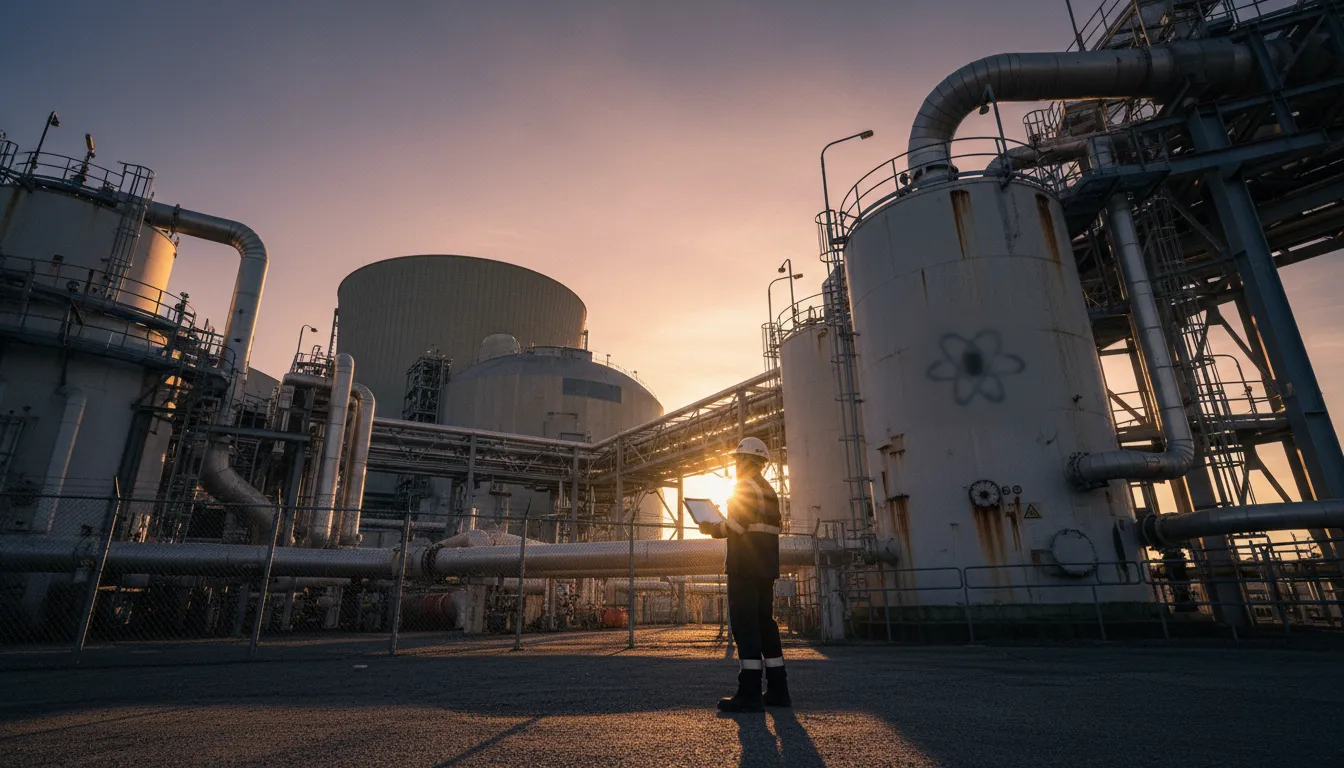
The most successful heavy water reactor is Canada's CANDU (Canada Deuterium Uranium), developed in the 1950s and now operating in seven countries including Argentina, South Korea, Romania, China, and India. CANDU reactors use pressurized heavy water both as moderator and coolant, circulating it through hundreds of horizontal pressure tubes that each hold a bundle of natural uranium fuel.
A distinctive advantage is online refueling: CANDU operators can swap spent fuel bundles for fresh ones without shutting down, boosting availability. The design also accepts a variety of fuel types, including recycled uranium from other reactors and thorium-based fuels — an area of active research in India, which operates the world's largest fleet of indigenous heavy water reactors.
The Proliferation Shadow
The same neutron efficiency that makes heavy water reactors fuel-flexible also creates a weapons risk. When natural uranium absorbs neutrons inside the reactor, some of it converts to plutonium-239 — a fissile material suitable for nuclear weapons. If fuel is removed early and reprocessed, weapons-grade plutonium can be extracted. India demonstrated this starkly in 1974, when it detonated a nuclear device using plutonium produced in a Canadian-supplied research reactor moderated by heavy water provided by the United States.
That history is why the International Atomic Energy Agency (IAEA) applies strict safeguards to heavy water transfers and production technology. Iran's Arak heavy water complex, for instance, became a focal point of the 2015 nuclear deal precisely because its planned 40-megawatt research reactor could have produced enough plutonium for roughly one weapon per year. Under the agreement, Iran agreed to redesign the reactor's core and fill the original with concrete.
A WWII Origin Story
Heavy water's strategic importance was recognized long before the first power reactor. During World War II, Nazi Germany pursued heavy water as a moderator for its own nuclear program, sourcing it from the Norsk Hydro plant at Vemork in occupied Norway — then the world's only industrial producer. In February 1943, nine Norwegian commandos infiltrated the plant in Operation Gunnerside, destroying the heavy water production equipment and over 100 gallons of accumulated product. A follow-up sabotage in 1944 sank a ferry carrying Germany's remaining stocks. Historians credit the raids with significantly delaying the German bomb effort.
Still Relevant Today
Heavy water reactors represent a small fraction of the global nuclear fleet — roughly 50 of the world's approximately 440 operating power reactors. Yet they remain strategically important. Their ability to run on natural uranium appeals to countries without enrichment capabilities. Their flexible fuel cycles support research into next-generation fuels. And their link to plutonium production keeps them at the center of nonproliferation diplomacy, from Iran to South Asia.
Understanding how heavy water reactors work is essential to grasping why certain nuclear facilities attract so much international attention — and why a molecule just 10 percent heavier than ordinary water can shift the balance of global security.