How Ice Cores Work—and What They Reveal About Climate
Ice cores drilled from glaciers and ice sheets preserve up to 1.2 million years of climate history in layers of frozen snow, trapped gas bubbles, and chemical signatures that scientists decode to reconstruct Earth's atmospheric past.
Frozen Time Capsules
Deep beneath the ice sheets of Antarctica and Greenland, and high on mountain glaciers from the Alps to the Andes, lies an extraordinary archive of Earth's climate history. Ice cores—long cylinders of ice extracted by drilling hundreds or thousands of meters into glaciers—offer scientists a direct window into atmospheric conditions stretching back over a million years. Each layer of compacted snow preserves a snapshot of the world as it was when that snow fell, making ice cores one of the most powerful tools in climate science.
How Ice Cores Form and Are Extracted
The process begins with snowfall. Each year, fresh snow accumulates on ice sheets and glaciers, burying previous layers. Over time, the weight of overlying snow compresses deeper layers into dense ice. Winter snow differs from summer snow in texture and chemistry, creating visible annual layers—much like tree rings—that scientists can count to establish a timeline.
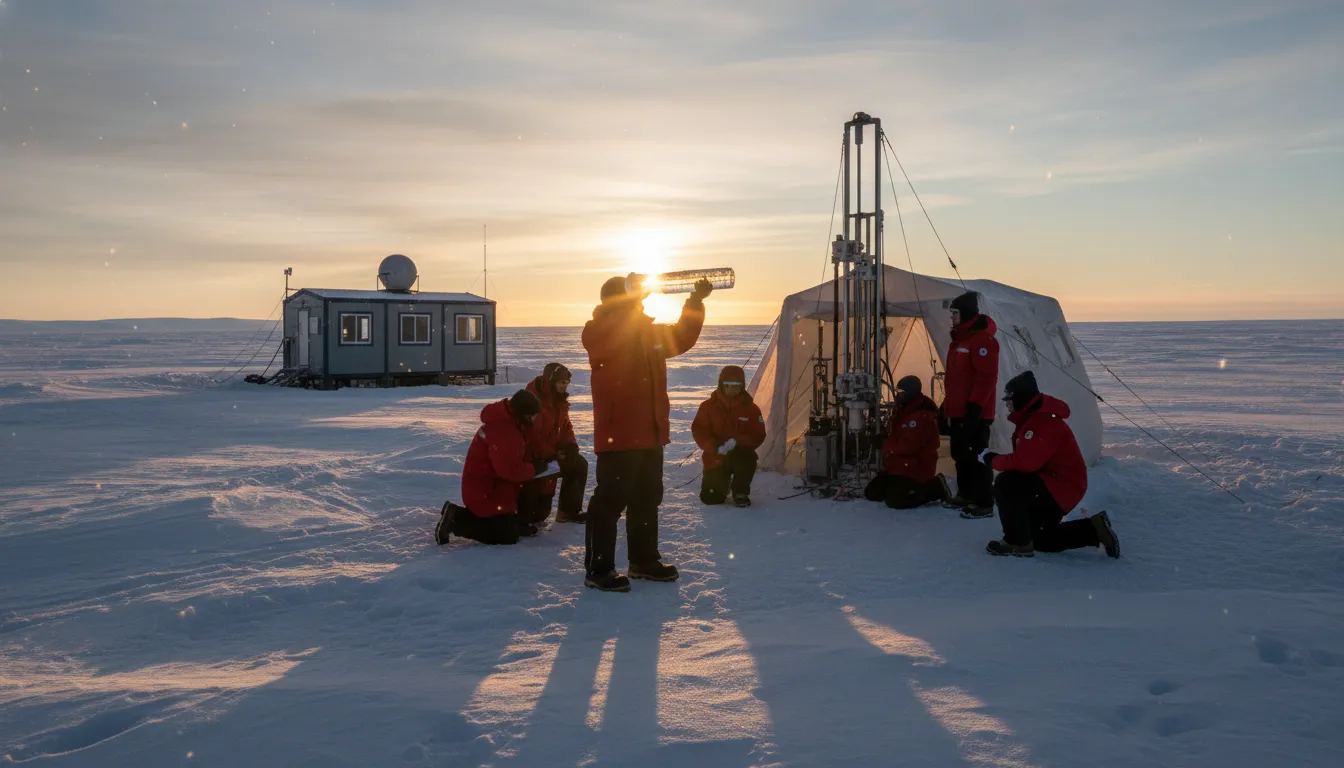
To retrieve these records, researchers use specialized drilling equipment on the ice surface. Powered drills bore downward, extracting a continuous cylinder of ice while leaving the surrounding ice undisturbed. The longest cores exceed 3 kilometers (nearly 2 miles) in length. Once extracted, cores are carefully stored and transported under strict cold-chain conditions to laboratories worldwide.
What's Trapped Inside
Ice cores contain several types of climate evidence. The most valuable are tiny air bubbles sealed within the ice as snow compressed into solid form. These bubbles preserve actual samples of ancient atmosphere, allowing scientists to measure past concentrations of greenhouse gases like carbon dioxide, methane, and nitrous oxide. According to NOAA, this method has produced detailed greenhouse gas records going back over 800,000 years.
The ice itself encodes temperature data through isotope ratios. Water molecules contain different isotopes of oxygen and hydrogen, and the ratio of heavier to lighter isotopes in a given layer reflects the global temperature when that precipitation formed. Colder periods produce ice with a distinct isotopic signature compared to warmer ones.
Beyond gases and isotopes, ice cores also trap volcanic ash, dust, soot, pollen, and sea salt. Layers of volcanic aerosols help scientists date the core by matching them to known eruptions, while dust concentrations reveal past wind patterns and aridity.
What Ice Cores Have Revealed
Ice core data has fundamentally shaped our understanding of Earth's climate system. Cores show that for at least 800,000 years, atmospheric CO₂ fluctuated between 180 and 300 parts per million, rising and falling in sync with glacial and interglacial cycles. Current concentrations, now well above 420 ppm, are far beyond anything recorded in the ice core record—a finding that has become central evidence in climate science.
The original EPICA (European Project for Ice Coring in Antarctica) core, drilled at Dome C, revealed eight complete glacial cycles spanning 740,000 years. In 2025, the Beyond EPICA project achieved a historic milestone by extracting a 2,800-meter core containing ice over 1.2 million years old—the oldest continuous ice core ever recovered.
Racing Against Melting Glaciers
As global temperatures rise, many mountain glaciers that hold irreplaceable climate records are rapidly disappearing. The Ice Memory Foundation has responded by extracting cores from threatened glaciers worldwide and transporting them to a purpose-built sanctuary at Concordia Station in Antarctica. The cave, dug into compact snow at a naturally stable −52°C, is designed to preserve these samples for centuries so future scientists can study them with technologies that do not yet exist.
From the Alps to the Pamir Mountains, from the Andes to the Caucasus, the race is on to save frozen climate archives before they melt away—ensuring that Earth's deep atmospheric history remains accessible for generations to come.