How LEO Satellite Internet Works—and Why It Matters
Low-Earth orbit satellite constellations like Starlink are rewriting the rules of global internet access. Here's how the technology works—from phased-array dishes to laser inter-satellite links—and what the race to connect the planet means for billions of people.
A New Layer in the Sky
For most of the internet era, connecting remote areas to the web meant laying fiber cables or building cell towers—both expensive and time-consuming. Traditional geostationary satellites offered a partial fix, but with a fatal flaw: they orbit 35,786 km above Earth, so far away that every signal takes over half a second to make a round trip. That 600-millisecond delay made video calls jittery and online gaming impossible.
Low-Earth orbit (LEO) satellite internet changes the equation entirely. By positioning satellites just 340–1,200 km above the surface—roughly the distance from London to Paris—these constellations slash latency to 20–50 milliseconds, making them competitive with many ground-based broadband connections. SpaceX's Starlink, the largest LEO network, surpassed 10,000 active satellites in orbit in March 2026, with more than 10 million customers worldwide.
How the Constellation Works
A single LEO satellite covers a footprint of roughly 1,900 km and completes an orbit in about 90 minutes, crossing the sky in just four minutes from a user's perspective. To maintain continuous coverage, operators must deploy hundreds or thousands of satellites arranged in carefully calculated orbital shells at different inclinations—a structure called a mega-constellation.
Data travels a chain: from your home dish, up to an overhead satellite, across to neighboring satellites via high-speed inter-satellite laser links, then down to a ground gateway station connected to the internet backbone. This optical laser mesh—standard on Starlink's newest generation—lets packets hop across the constellation without touching the ground until they're close to their destination, cutting latency further and reducing dependence on ground stations.
The Phased-Array Dish
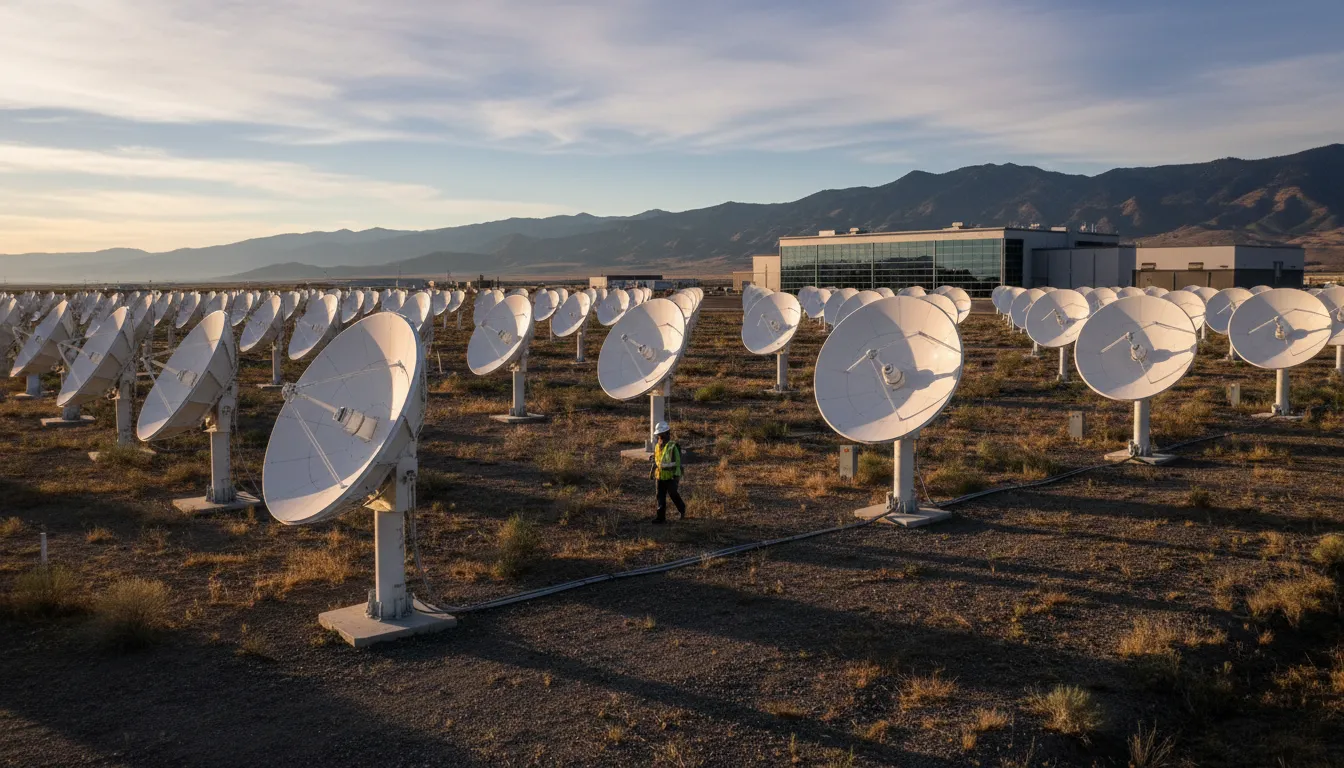
The user terminal—Starlink's flat, pizza-box-sized dish nicknamed "Dishy McFlatface"—is a feat of miniaturized engineering. Unlike a traditional parabolic satellite dish that physically rotates to track a signal, Dishy uses a phased-array antenna: a grid of 1,280 tiny antenna elements that steer beams electronically by adjusting the phase of each element's signal. The result is a dish with no moving parts that can lock onto a fast-moving satellite, hand off to the next one in milliseconds, and maintain 1–3 simultaneous connections at any time. Typical residential users see download speeds of 100–300 Mbps with latency around 25–50 ms.
Why It Matters for Connectivity
The practical implications are profound. Roughly 2.6 billion people still lack reliable internet access—most of them in rural areas, island nations, or conflict zones where laying fiber is economically unviable. LEO internet is already bridging that gap: schools in the Amazon, fishing vessels in the Pacific, and relief workers in disaster zones are all using Starlink or rival networks today.
Low latency also unlocks use cases that older satellite internet could never support: real-time telemedicine, precision agriculture using live drone feeds, and resilient military communications. Ukraine's use of Starlink terminals during the ongoing conflict has demonstrated how LEO networks can sustain critical communications when terrestrial infrastructure is destroyed.
A Crowded Sky—and Growing Risks
Starlink is not alone. Amazon's Amazon Leo (formerly Project Kuiper) is ramping toward a 3,236-satellite network, while the UK-backed OneWeb has deployed over 600 satellites and the EU's IRIS² program is under development. Together, these operators are on track to put tens of thousands of new objects into LEO within the next decade.
That crowding raises a serious concern: the Kessler syndrome. Named after NASA scientist Donald Kessler, the scenario describes a cascade where one collision generates debris that triggers further collisions, exponentially multiplying space junk until certain orbital altitudes become unusable. Starlink's satellites already perform an average of one collision-avoidance maneuver every two minutes across the fleet. Scientists warn that the 520–1,000 km altitude band may already be approaching a critical debris threshold.
To mitigate risks, regulators require new satellites to deorbit within five years of end-of-life—LEO's relatively thick atmosphere naturally pulls satellites down if they do not actively maintain altitude. But with thousands of objects added each year, researchers at Scientific Reports warn that international governance frameworks have not kept pace with the commercial deployment race.
What Comes Next
SpaceX's next-generation Starlink satellites will deliver up to 20 times the capacity of first-generation units, enabling gigabit-level speeds for business customers. Direct-to-cell capability—allowing standard smartphones to connect without a special dish—is already in limited deployment, a development that could eventually eliminate mobile dead zones entirely.
LEO satellite internet is no longer a niche technology for remote adventurers. It is rapidly becoming a mainstream infrastructure layer—one that will shape how billions of people work, learn, and communicate for decades to come, provided the industry can keep the skies from becoming too cluttered to use.