What Is the Status Quo at the Holy Sepulchre?
Six Christian denominations share Christianity's holiest church under a centuries-old Ottoman decree, with two Muslim families holding the key — an arrangement so rigid that even a wooden ladder has stayed in place for over 200 years.
Christianity's Most Contested Building
The Church of the Holy Sepulchre in Jerusalem's Old City stands on the spot where, according to fourth-century tradition, Jesus was crucified, buried, and resurrected. It is the holiest site in Christianity — and one of the most fiercely disputed buildings on Earth. Not because of conflict between religions, but because of conflict within one.
Six Christian denominations share the church under an intricate power-sharing framework known simply as the Status Quo. The arrangement governs every stone, lamp, staircase, and minute of worship inside the building, and any violation can — and regularly does — trigger diplomatic incidents.
How the Status Quo Works
The framework dates to a decree (firman) issued by Ottoman Sultan Osman III in 1757, which froze the division of ownership and responsibilities among the church's Christian communities exactly as they stood at that moment. Further firmans in 1852 and 1853 reaffirmed the principle: no changes may be made without the unanimous consent of all six communities. The Treaty of Paris (1856) gave the arrangement international legal recognition.
The six custodian denominations are the Greek Orthodox, Roman Catholic (Franciscan), Armenian Apostolic, Coptic Orthodox, Syriac Orthodox, and Ethiopian Orthodox churches. Each controls specific chapels, altars, and even individual floor tiles. Worship schedules are timed to the minute. Cleaning duties are ritualized. Even hanging a picture or repositioning a candle without consensus can provoke a standoff.
The Immovable Ladder
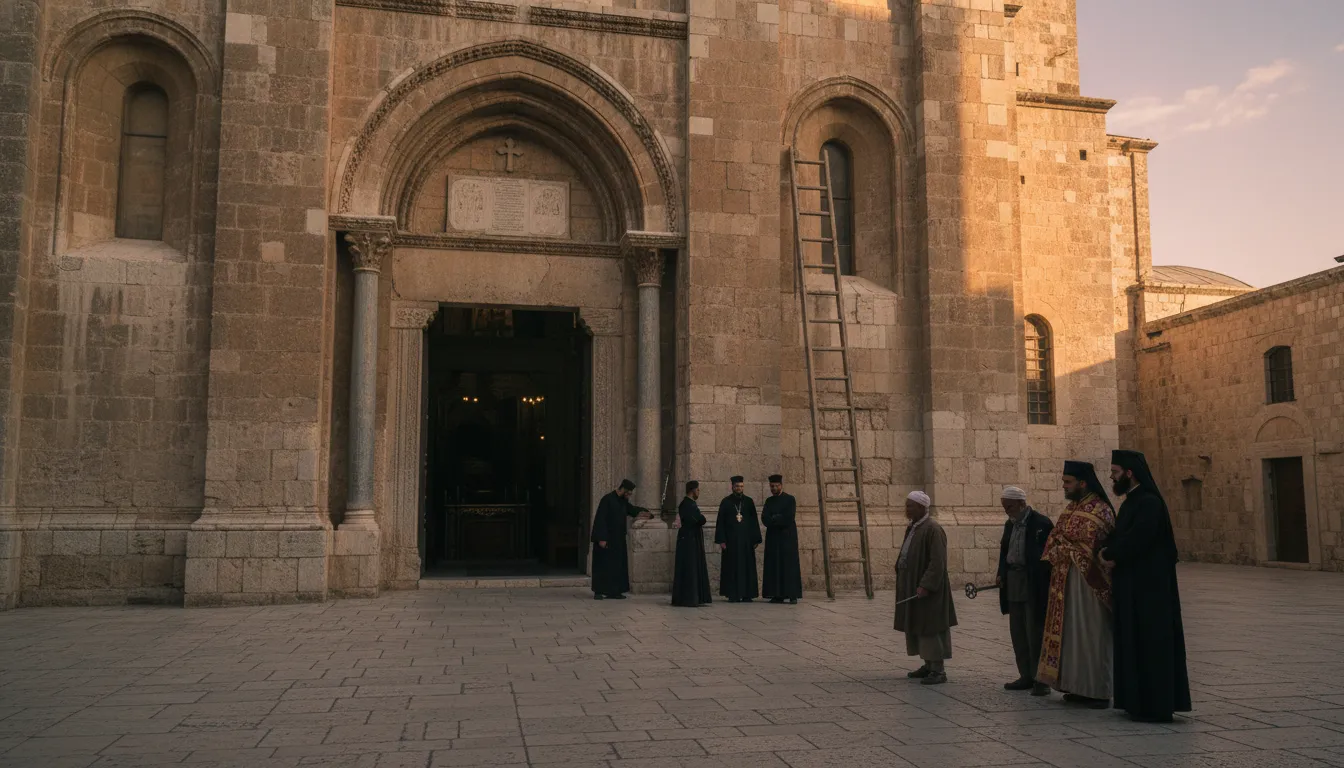
The most famous symbol of the Status Quo is a short wooden ladder resting on a ledge above the church's main entrance. It has been there since at least the early nineteenth century. Because no single denomination has the authority to move it — and all six would need to agree — the ladder has remained in place for over 200 years. It is known as the Immovable Ladder, and it illustrates just how literally the Status Quo is enforced.
Why a Muslim Family Holds the Key
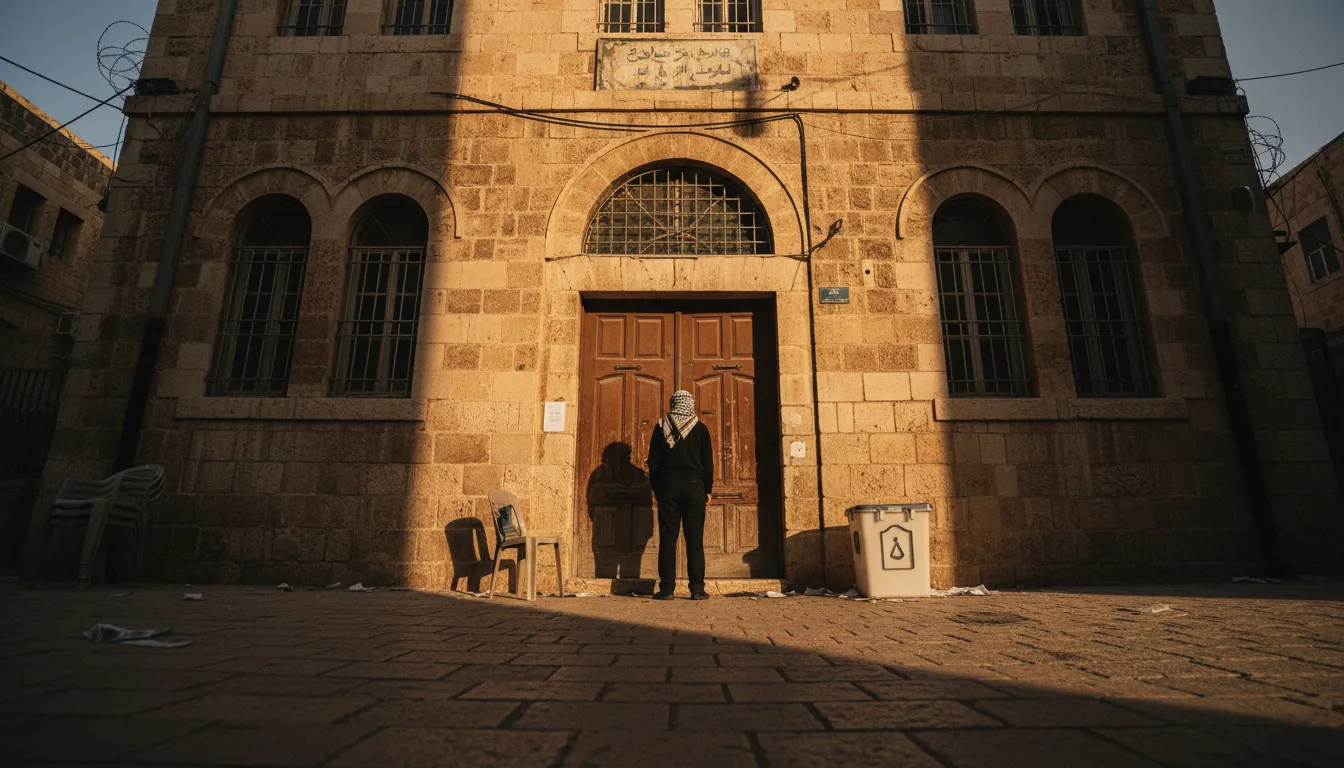
Perhaps the most remarkable detail is that the church's massive iron key is not held by any Christian group. When Sultan Saladin recaptured Jerusalem in 1187, he entrusted the key to two prominent Muslim families — the Joudeh and the Nusseibeh — as neutral custodians. The Joudeh family has kept the physical key ever since, while the Nusseibeh family is responsible for the daily ritual of locking and unlocking the great doors. This arrangement has endured for more than eight centuries, surviving Crusader rule, Ottoman administration, British mandate, Jordanian control, and Israeli sovereignty.
When the Status Quo Breaks Down
The system is remarkably durable, but not immune to crisis. In 2018, all six denominations united to shut the church's doors for three days in protest against Israeli municipal tax measures and a proposed property law. The closure was the first in decades and drew worldwide attention.
Disputes among the denominations themselves can turn physical. Monks have clashed with brooms, chairs, and fists over perceived boundary violations. A Coptic monk once moved his chair from an agreed spot on the roof into a sliver of shade on a hot day — sparking a brawl that sent several clergy to hospital.
In March 2026, Israeli police blocked the Latin Patriarch of Jerusalem from entering the church for Palm Sunday Mass, an act Christian leaders called unprecedented in modern history. Such incidents highlight how external political authority can disrupt even the most deeply rooted religious arrangements.
Why It Still Matters
The Status Quo is more than an ecclesiastical curiosity. It is a living case study in how rival groups can share sacred space without a central authority imposing order. Its strength lies in its rigidity: by freezing rights in place, it removes the temptation to gain advantage. Its weakness is the same — necessary repairs and modernization require consensus that can take decades to achieve.
For diplomats, historians, and anyone interested in how competing claims to holy ground are managed, the Status Quo at the Church of the Holy Sepulchre remains one of the most extraordinary — and fragile — agreements in the world.