How Supershear Earthquakes Work—and Why They Hit Harder
Supershear earthquakes rupture faster than their own seismic waves, creating Mach cone shockwaves analogous to sonic booms. These rare but devastating events can double shaking intensity and strike hundreds of kilometers from the epicenter.
The Seismic Sonic Boom
Most earthquakes are terrifying enough. But a rare class of quake ruptures the ground faster than its own seismic waves can travel—producing a shockwave effect analogous to a jet breaking the sound barrier. These are supershear earthquakes, and seismologists increasingly believe they pose a greater hazard than standard models assume.
In a typical earthquake, the rupture front—the advancing edge of the break along a fault—travels at roughly 80 to 90 percent of the local shear-wave speed, about 3 kilometers per second in Earth's crust. A supershear earthquake exceeds that threshold, sometimes reaching compressional-wave speeds near 5–6 km/s, or roughly 11,000 miles per hour.
How a Mach Cone Forms Underground
When a rupture outruns its own shear waves, something dramatic happens. The seismic energy piles up into a cone-shaped wavefront called a Mach cone—the underground equivalent of a sonic boom. For anyone inside that cone's footprint on the surface, waves from the entire rupture arrive almost simultaneously rather than spreading out over time.
The result is shaking that can be twice as intense as what a sub-shear quake of the same magnitude would produce, focused in a narrow corridor along the fault. Buildings far from the epicenter that would normally escape serious damage can instead experience violent, concentrated ground motion.
Which Faults Go Supershear?
Not every fault can produce this effect. Research published in the Seismological Research Letters shows that supershear ruptures overwhelmingly occur on strike-slip faults—where two blocks of crust slide horizontally past each other. The fault must be long, relatively straight, and "mature," meaning it has accumulated significant stress over many earthquake cycles.
A global survey of large strike-slip earthquakes above magnitude 6.7 found that about 14 percent reached supershear speeds over a 20-year period—far more common than scientists once assumed.
Well-known candidates include:
- The San Andreas Fault in California—the 1906 San Francisco earthquake likely went supershear
- The North Anatolian Fault in Turkey, linked to multiple devastating supershear events
- The Sagaing Fault in Myanmar, where the 2025 magnitude 7.7 earthquake ruptured over 450 km at supershear velocity
Why It Matters for Safety
Current building codes and seismic hazard maps largely assume sub-shear rupture speeds. If supershear events are more common than expected, structures in the Mach cone corridor may face forces they were never designed to withstand.
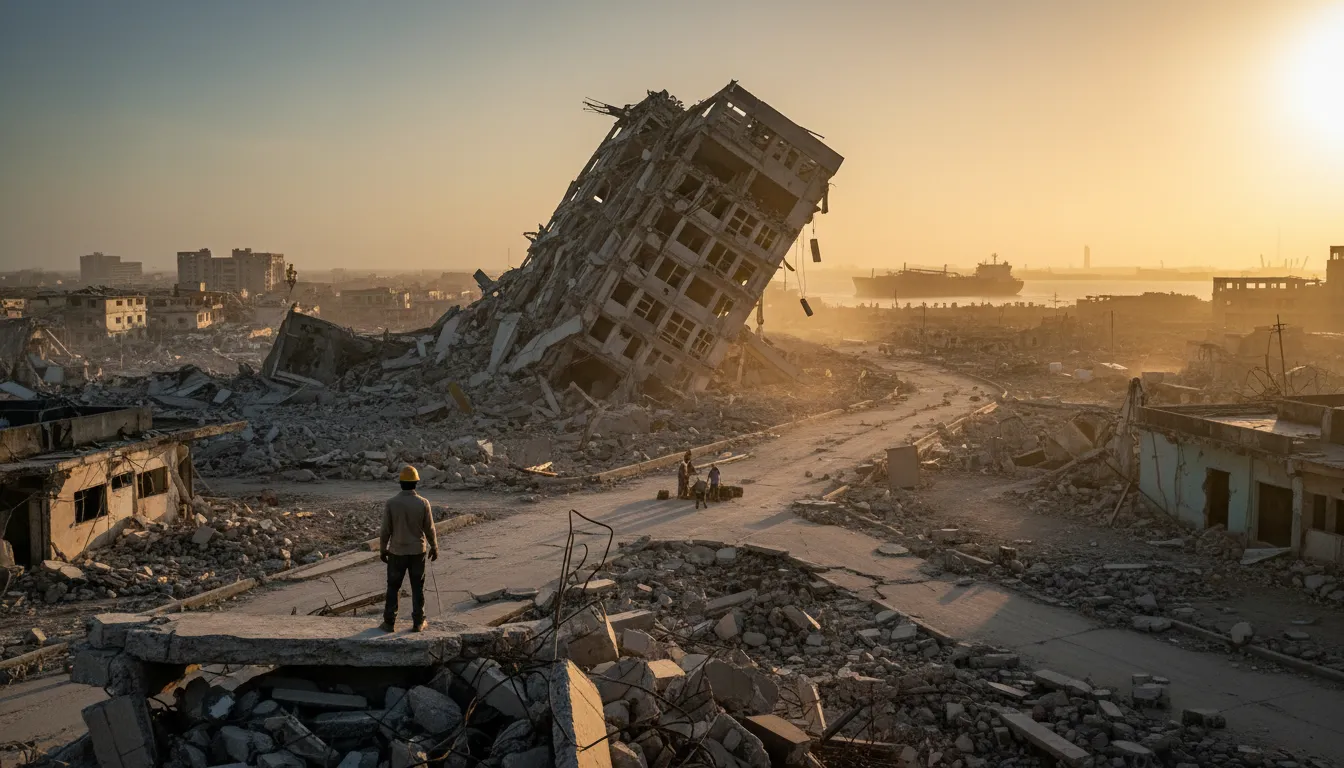
The 2023 Turkey–Syria earthquake sequence, which killed at least 58,000 people, included supershear segments. Research from UCLA on the 2025 Myanmar quake showed three compounding "super factors"—including supershear propagation—that amplified destruction far beyond typical predictions.
Seismologists are now calling for updated building standards that account for supershear shaking, particularly along known fault "superhighways" where conditions are ripe for extreme rupture speeds.
Detecting and Preparing
Identifying supershear earthquakes in real time remains challenging. Scientists rely on dense seismometer networks, satellite radar, and—in one recent breakthrough—even CCTV footage that captured a fault displacing 2.5 meters in 1.3 seconds during the Myanmar event. Advanced simulations now model which fault segments are most likely to go supershear, helping target where reinforced infrastructure is needed most.
As monitoring improves and more supershear events are documented, seismologists hope to build early-warning systems capable of flagging the heightened risk in real time—giving communities in the Mach cone's path precious extra seconds to take cover.