How Meteor Fireballs Work—and Why They Boom
Every day, thousands of fireballs blaze through Earth's atmosphere. Here's the science behind how space rocks become blazing streaks of light—and why some produce window-rattling sonic booms.
A Rock Meets the Atmosphere
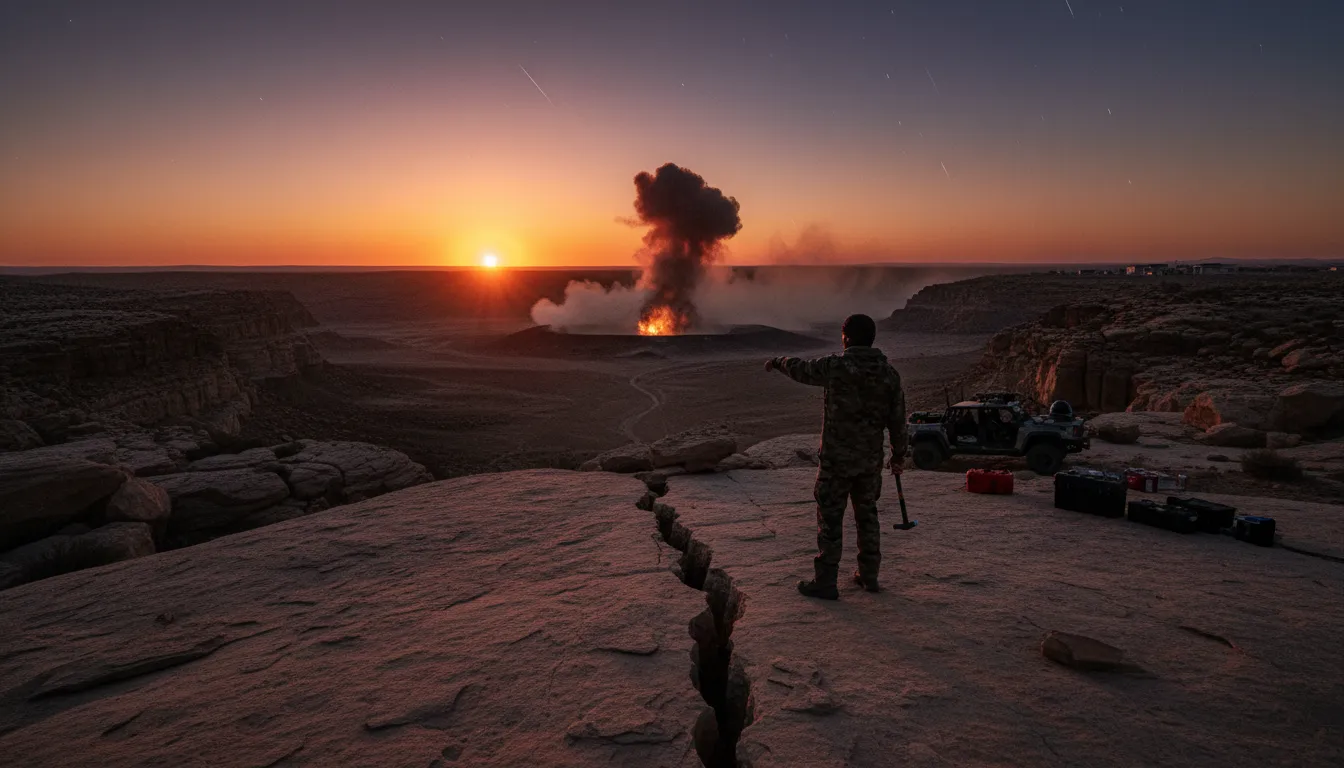
Somewhere above your head, right now, a piece of space debris is burning up. An estimated 25 million meteoroids enter Earth's atmosphere every day, according to NASA. Most are no bigger than a grain of sand and vanish in a blink. But a few are large enough to put on a show—blazing across the sky as fireballs visible in broad daylight and, occasionally, shaking homes with thunderous booms.
Understanding how an ordinary chunk of rock or metal transforms into a brilliant fireball involves some of the most violent physics in the near-Earth environment.
What Makes a Fireball
A fireball is officially defined as any meteor brighter than Venus—roughly visual magnitude −4 or below, according to the American Meteor Society. The objects that produce fireballs are typically meteoroids at least a few centimeters across, entering the atmosphere at speeds between 11 and 72 kilometers per second.
At those velocities, the meteoroid does not burn from friction in the conventional sense. Instead, a bow shock forms ahead of it, compressing and superheating the air to temperatures exceeding 10,000°C. That searing envelope of plasma radiates intense light. About 95 percent of the glowing cloud consists of heated atmospheric gases; only a small fraction comes from vaporized meteoroid material, a process called ablation.
When the stress from deceleration and heating exceeds the meteoroid's structural strength, it fragments—sometimes explosively. A fireball that detonates in a bright terminal flash is called a bolide. NASA's Center for Near-Earth Object Studies (CNEOS) maintains a global database of bolide events, recording each one's altitude, velocity, and estimated energy release.
Why They Produce Sonic Booms
A meteoroid traveling at tens of kilometers per second far exceeds the speed of sound. As it punches through denser layers of the lower atmosphere, compressed air piles up along its path, creating a shock wave that propagates outward as a sonic boom.
Observers on the ground may see the fireball seconds or even a full minute before the boom arrives, because light travels far faster than sound. Larger bolides can release energy equivalent to hundreds of tons of TNT, producing pressure waves strong enough to rattle windows, set off car alarms, and register on seismometers.
From Fireball to Meteorite
Between 90 and 95 percent of meteoroids that enter the atmosphere never reach the ground, according to Live Science. They vaporize completely or shatter into dust. Scientists estimate that about 17 meteorites land on Earth every day—roughly 6,100 per year—but most splash into oceans or fall in remote areas unnoticed.
When fragments do survive, they are traveling far slower than their entry speed. The largest pieces typically land within a strewn field—an elliptical zone stretching several kilometers downrange—and can sometimes be recovered by researchers or lucky homeowners.
How Scientists Study Fireballs
Modern fireball science relies on a combination of ground-based camera networks, satellite sensors, and infrasound stations. The American Meteor Society collects hundreds of eyewitness reports each year, while CNEOS uses U.S. government satellite data to log bolides worldwide.
By analyzing a fireball's light curve—how its brightness changes as it descends—scientists can identify fragmentation events and estimate the object's composition and strength. Iron-rich meteoroids tend to survive longer, while stony or cometary material breaks apart at higher altitudes.
Why Fireballs Matter
Fireballs are more than spectacular sky shows. Each one is a free delivery of extraterrestrial material, offering clues about the composition of asteroids and comets. Recovered meteorites have revealed amino acids, ancient mineral grains, and water-bearing minerals that help explain how the solar system formed.
On a practical level, studying how meteoroids behave in the atmosphere helps scientists calibrate planetary defense models. The 2013 Chelyabinsk bolide—which injured over 1,600 people in Russia—demonstrated that even relatively small objects can cause real damage. Every fireball recorded adds data that sharpens predictions for the next one.