How NASA's Artemis II Mission Works—and Why It Matters
NASA's Artemis II will carry four astronauts around the Moon in 2026—the first crewed deep-space mission in more than 50 years. Here is how the mission works, from the SLS rocket to the free-return trajectory that safely brings the crew home.
Humanity's Return to Deep Space
The last time human beings traveled beyond low Earth orbit was December 1972, when Apollo 17 astronauts Gene Cernan and Harrison Schmitt walked on the Moon. More than half a century later, NASA's Artemis II mission is set to send four astronauts around the Moon—the first crewed deep-space mission since that final Apollo flight. Launching no earlier than April 2026, it marks the beginning of a new era of lunar exploration.
What Is the Artemis Program?
Artemis—named for the twin sister of Apollo in Greek mythology—is NASA's flagship program to return humans to the Moon and eventually send them to Mars. Formally established under Space Policy Directive-1 in 2017, the program aims to go to the Moon and stay there, building a long-term human presence rather than planting a flag and leaving.
The program advances in steps. Artemis I (2022) flew an uncrewed Orion capsule around the Moon, validating the hardware in deep space. Artemis II repeats the journey—this time with a crew aboard. Later missions plan to land astronauts on the lunar surface for the first time since 1972, with Artemis III targeting a landing near the Moon's south pole.
The Rocket: Space Launch System
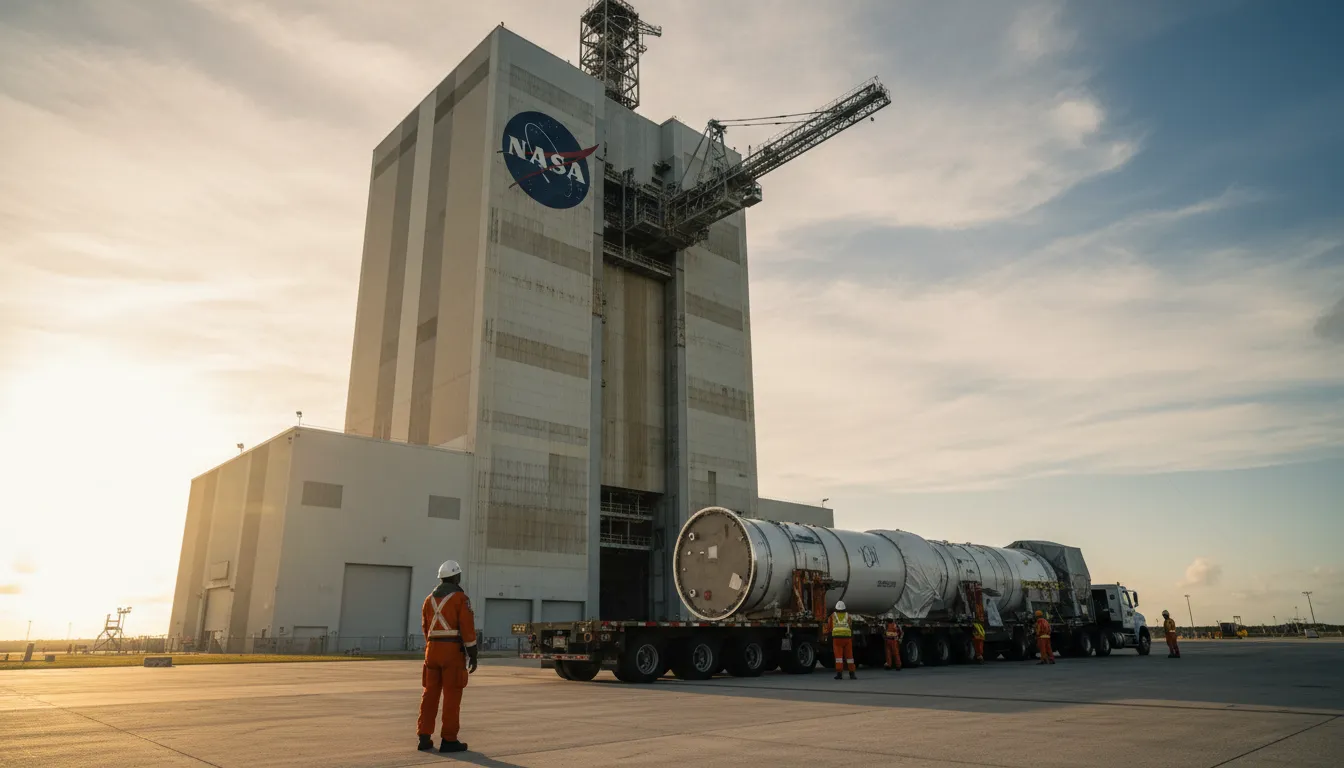
Artemis II lifts off on the Space Launch System (SLS), one of the most powerful rockets ever built. Its core stage—flanked by two solid rocket boosters—generates more than 8.8 million pounds of thrust at liftoff, roughly 15 percent more than the Saturn V that carried Apollo astronauts to the Moon.
The launch sequence is carefully choreographed: the four RS-25 core engines ignite seven seconds before liftoff, and the solid boosters ignite at the moment of launch. The boosters burn out and separate just two minutes after liftoff at an altitude of about 48 kilometers. Eight minutes after launch, the core stage separates, and a smaller upper stage—the Interim Cryogenic Propulsion Stage—fires to send Orion on its way to the Moon.
The Spacecraft: Orion
The Orion spacecraft has three main parts. The crew module is the pressurized capsule where astronauts live and work during the mission; it is built to survive the intense heat of re-entry into Earth's atmosphere at speeds exceeding 40,000 kilometers per hour. The service module, provided by the European Space Agency (ESA), supplies power, propulsion, and life support systems including air and water. A launch abort system sits atop the stack and can yank Orion away from the rocket in milliseconds if anything goes wrong during ascent.
Orion is designed for deep-space conditions that low-Earth-orbit vehicles like the International Space Station never face: higher radiation doses, greater temperature extremes, and the need for a more robust heat shield on return.
The Trajectory: A Gravity-Assisted Free Return
Artemis II does not fly straight to the Moon. Instead, it follows a hybrid free-return trajectory—an elegant solution that uses the Earth-Moon gravity field as a safety net. After completing two orbits around Earth to verify all systems, Orion performs a trans-lunar injection burn that sets it on a figure-eight path toward the Moon.
The key feature of this trajectory is that it is self-correcting: if Orion's engine fails at almost any point, the combined gravity of Earth and Moon will naturally pull the spacecraft back to Earth without any additional propulsion. The crew will fly roughly 8,000 kilometers beyond the far side of the Moon—farther into space than any human being has ever traveled—before Earth's gravity draws them home. The total mission lasts about 10 days.
Who Is Flying?
The four-person crew makes history in multiple ways. Commander Reid Wiseman and mission specialist Christina Koch represent NASA; pilot Victor Glover will become the first person of color to reach deep space; and Canadian Space Agency astronaut Jeremy Hansen will be the first non-American to travel beyond Earth orbit.
Why Artemis II Matters Beyond the Mission Itself
Artemis II is above all a test flight—its core job is to certify every Orion system with humans aboard in the actual environment of deep space, from life support to communications to the heat shield. A successful flight clears the path for lunar landings and, ultimately, human missions to Mars. It also signals renewed international collaboration: ESA built Orion's service module, Canada contributed the CanadaArm3 for the future lunar Gateway station, and more than a dozen countries have signed the Artemis Accords committing to peaceful lunar exploration.
After five decades of absence, humanity is heading back to the Moon—not for a brief visit, but to learn how to live and work there.