How the Right to Protest Works in America
The First Amendment protects peaceful protest on public property, but courts allow governments to impose content-neutral time, place, and manner restrictions—here is how the legal framework actually works.
A Constitutional Bedrock
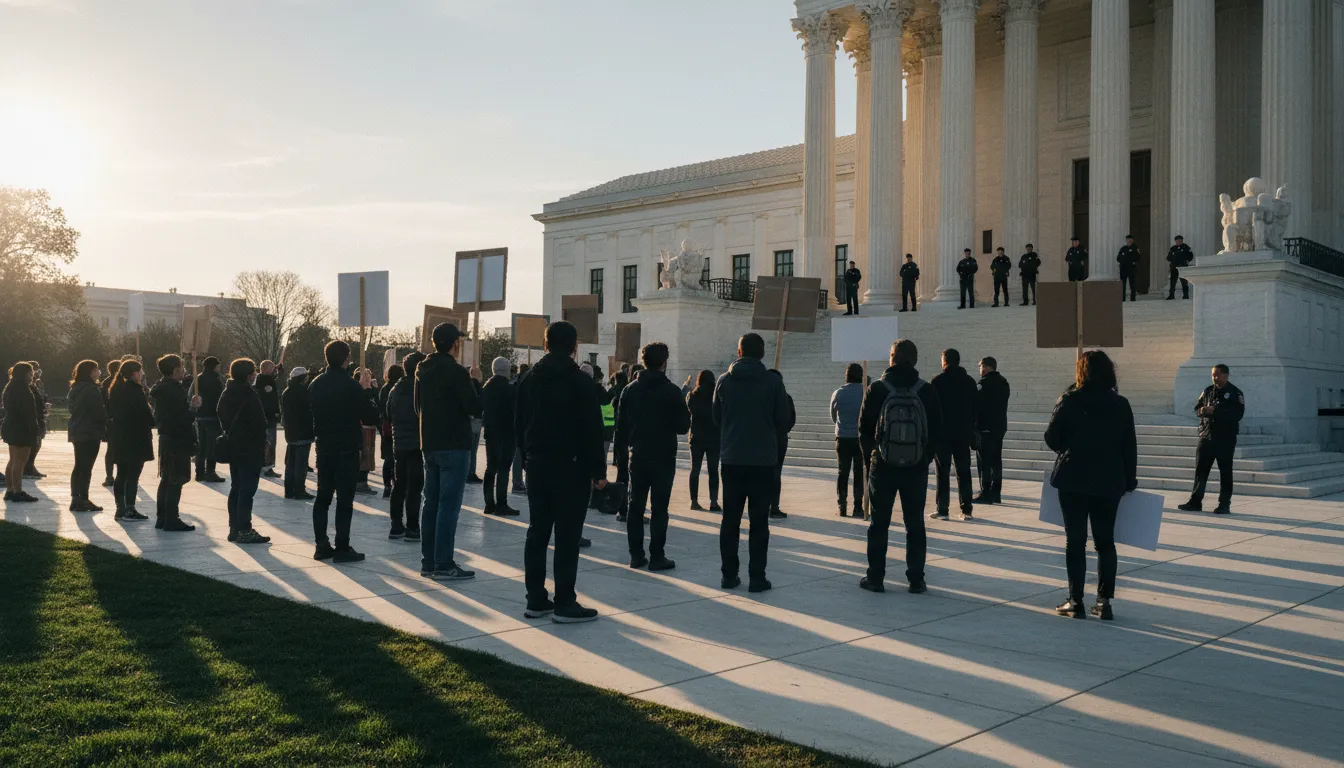
The United States was born from protest, and the Constitution enshrines that tradition in its very first amendment. The relevant clause is deceptively short: Congress shall make no law abridging "the right of the people peaceably to assemble, and to petition the Government for a redress of grievances." Those 20 words have fueled movements from abolition to civil rights to modern-day mass demonstrations—yet the legal framework surrounding them is far more nuanced than most Americans realize.
What the First Amendment Actually Protects
Courts have consistently held that the First Amendment shields a broad range of protest activities on public property—streets, sidewalks, parks, and plazas traditionally open to public expression. You may hand out leaflets, carry signs, chant slogans, and march without prior permission in most everyday scenarios. The right extends to speech that many find offensive or provocative; the Supreme Court ruled in Texas v. Johnson (1989) that even flag burning qualifies as protected expression.
Crucially, the amendment restrains only the government. Private employers, businesses, and property owners can set their own rules about protest on their premises. A shopping mall can eject demonstrators; the First Amendment does not apply.
Time, Place, and Manner: The Legal Balancing Act
While the right to protest is fundamental, it is not absolute. The Supreme Court has long recognized that governments may impose "time, place, and manner" restrictions—provided those rules meet three tests:
- They must be content-neutral, meaning they cannot target a protest because of its message.
- They must be narrowly tailored to serve a significant government interest, such as traffic safety or preventing noise disturbances.
- They must leave open ample alternative channels for communication.
In practice, this means a city can bar bullhorn use in a residential neighborhood at 2 a.m. or require a parade permit when marchers plan to block streets. It cannot, however, charge higher permit fees to groups whose views are controversial—a principle the Court affirmed in Forsyth County v. Nationalist Movement (1992), striking down an ordinance that let officials raise fees based on anticipated counter-protest costs.
When Permits Are—and Aren't—Required
Permit requirements generally apply to large, organized events that need street closures, traffic management, or dedicated public spaces. A handful of people picketing on a sidewalk typically need no permit at all. The ACLU notes that permits should never be required for small or spontaneous gatherings, and any permitting process must not give officials unchecked discretion to deny applications.
Spontaneous protests—those triggered by breaking news or sudden government action—receive special protection. Courts recognize that requiring advance permits for every impromptu gathering would effectively silence the most urgent forms of civic expression.
Landmark Cases That Shaped Protest Law
Several Supreme Court decisions form the backbone of modern protest rights. In De Jonge v. Oregon (1937), the Court unanimously extended the right of assembly to cover state and local government actions, calling it "cognate to those of free speech and free press and equally fundamental." During the civil rights era, Edwards v. South Carolina (1963) reversed the convictions of peaceful demonstrators, and Shuttlesworth v. Birmingham (1969) struck down a permit scheme that had been used to block protest marches led by Rev. Fred Shuttlesworth.
More recently, NAACP v. Claiborne Hardware Co. (1982) protected organized boycotts as a form of assembly, establishing that nonviolent picketing and the association behind it enjoy full constitutional shelter.
Where the Protection Ends
The word "peaceably" in the First Amendment is doing significant work. Violence, vandalism, and direct incitement to imminent lawless action fall outside constitutional protection. Police may lawfully disperse a crowd that turns destructive, and participants who commit crimes can be prosecuted regardless of the cause they champion.
Authorities cannot, however, shut down an entire protest because of the actions of a few. The Freedom Forum emphasizes that police must distinguish between lawful demonstrators and lawbreakers rather than treating a crowd as a monolith.
Why It Still Matters
From the 20 million who turned out for the first Earth Day in 1970 to the millions who have marched in recent years, mass protest remains one of the most visible exercises of American democracy. Understanding the legal architecture behind it—what is protected, what is restricted, and where the lines fall—is essential for anyone who plans to exercise that right or wishes to understand the civic traditions that continue to shape the country.