President Nawrocki Grants Amnesty to Poles Fighting in Ukraine
President Karol Nawrocki has signed a law granting amnesty to Polish citizens who have fought in the ranks of the Ukrainian armed forces since 2014. The law affects an estimated several hundred volunteers and enjoys rare cross-party support.
President Signs Landmark Law
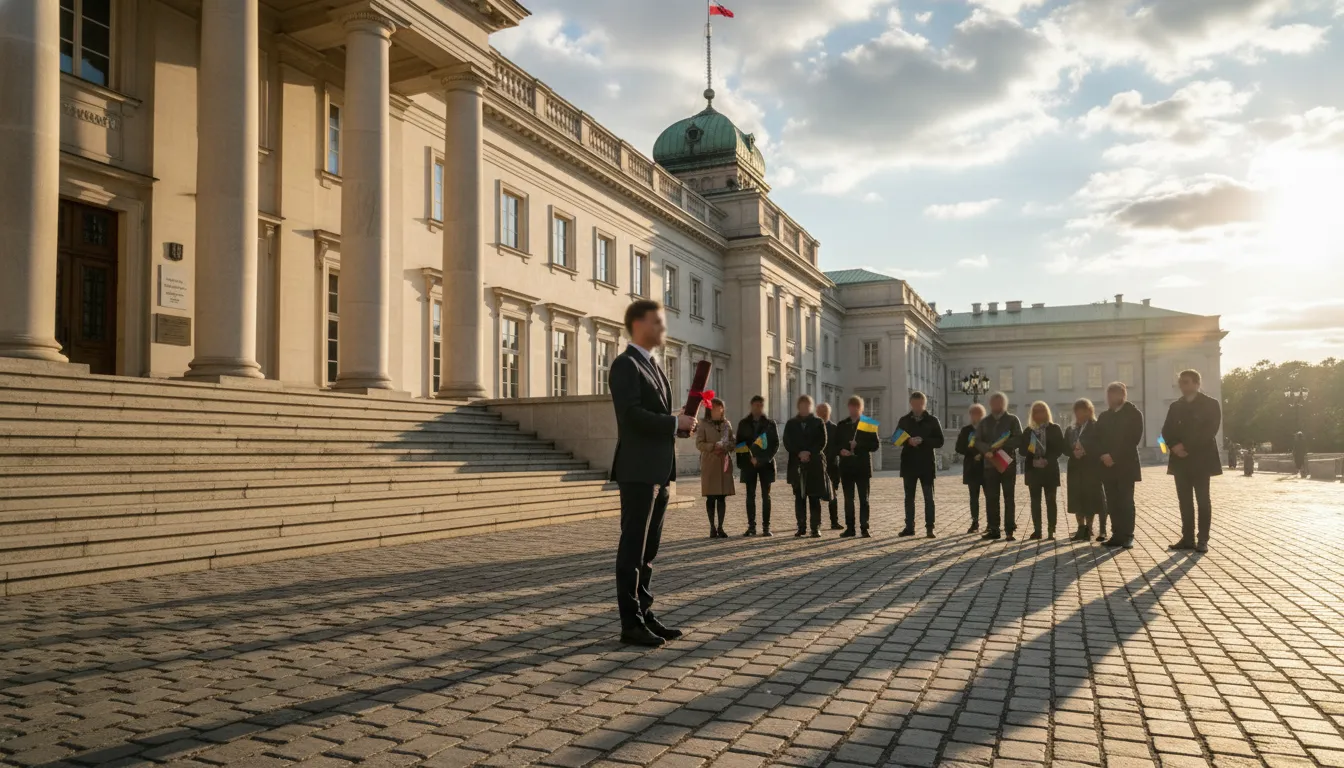
President Karol Nawrocki signed a law on March 27, 2026, guaranteeing amnesty and absolution for Polish citizens who enlisted in the Armed Forces of Ukraine without the required consent of the Ministry of National Defence. The regulations cover the period from April 6, 2014 — the date of the annexation of Crimea — until the law comes into force, i.e., three months after its publication.
Polish criminal law prohibits citizens from serving in foreign armed forces without prior state consent. Violation of this prohibition is punishable by imprisonment from three months to five years. The new law "forgives and forgets" these acts, also covering persons already convicted of such crimes.
Cross-Party Support in the Sejm
The draft law was submitted in December 2024 by deputies of the Civic Coalition (KO), the main ruling party. In the voting in February and March 2026, the law gained rare cross-party support — both the ruling coalition and the opposition Law and Justice (PiS) supported the project. Only deputies from the far-right Confederation abstained or voted against — this group has long taken a critical stance towards support for Ukraine.
The authors of the law argued that "in the existing international context, the participation of a Polish citizen in Ukraine's fight against Russian aggression cannot be seen as a violation of constitutional obligations."
Who Do the New Regulations Affect?
It is estimated that since 2014, several hundred Poles have fought as volunteers on the Ukrainian side — first in the Donbas, and then in subsequent phases of the conflict after Russia's full-scale invasion in February 2022. Exact figures are not known, but 23 deaths of Polish citizens serving in the Ukrainian army have been confirmed.
The law requires returning volunteers to submit a written statement to the Minister of National Defence, containing the date and place of commencement and termination of service. They have six months from their return to Poland to meet this requirement. The statements are subject to the protection of classified information.
Limits of Amnesty and Controversies
The regulations explicitly exclude mercenary activity, which is prohibited by international law. The amnesty only covers service in recognized units of the Armed Forces of Ukraine. KO deputies emphasized that the law "does not encourage" citizens to fight abroad, nor does it constitute an incentive — it only removes criminal liability for actions already taken.
Spokesman for the Polish Legion, Andrzej Podgórski, pointed out the practical dimension of the law: "It is important to provide them with this peace of mind," he said of the volunteers who feared legal consequences upon returning to their homeland.
Critics, however, warn against a dangerous precedent. Legalizing the participation of citizens in foreign armed conflicts — even retroactively — may make it difficult to enforce the prohibition of service in foreign armies in the future. There are also concerns that Russia will use the law for propaganda purposes as evidence of "Poland's direct involvement in the conflict."
Broader Context of Defence Policy
The signing of the law is in line with the consistent Polish policy of support for Ukraine. Warsaw is one of the largest suppliers of military aid to Kyiv in Europe, and the new regulations are another step towards the legal regulation of Polish-Ukrainian relations in the context of the ongoing conflict with Russia. President Nawrocki signed the law along with four other legal acts, including those concerning the removal of the effects of floods and the simplification of procedures for entrepreneurs.