How Nanolasers Work—and Why They Could Halve Computing Energy
Nanolasers use light-trapping nanocavities to replace electrical signals with photons inside microchips, promising to cut computer energy consumption by up to half while dramatically boosting data transfer speeds.
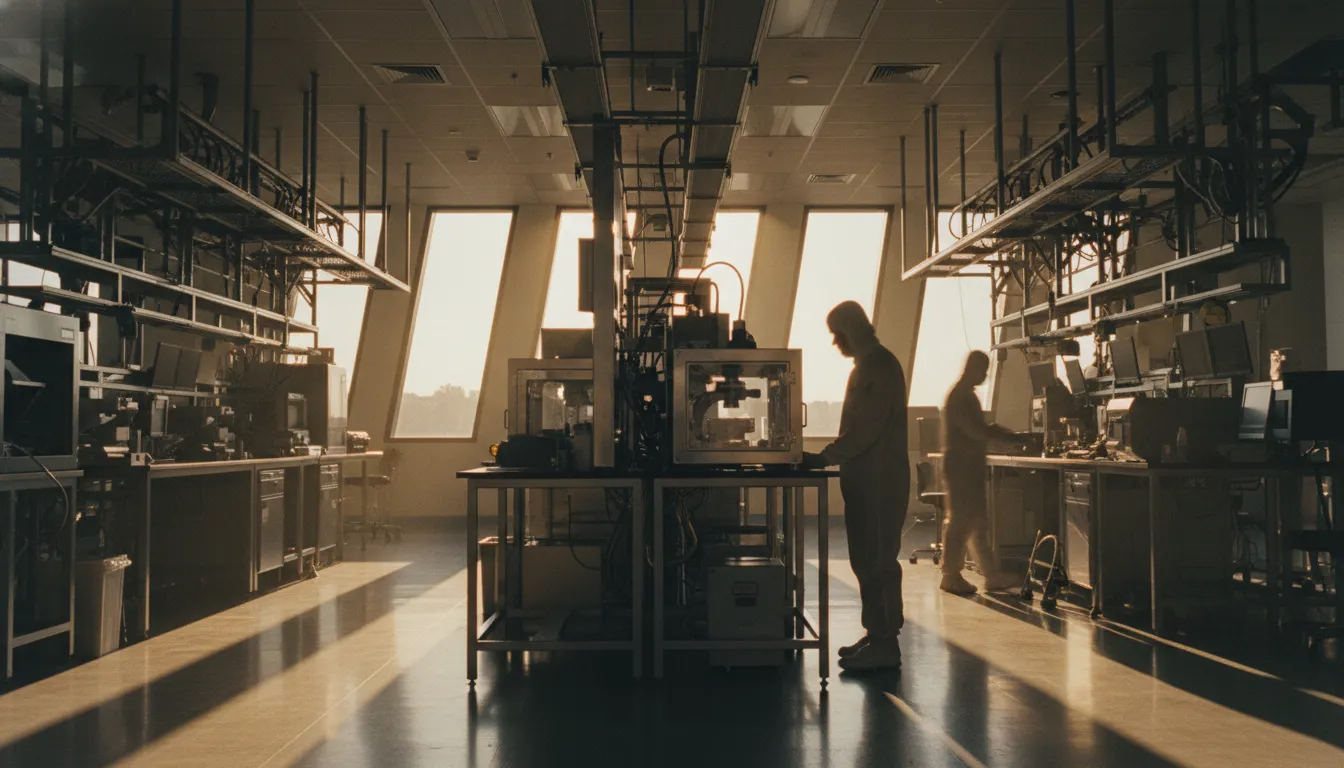
The Bottleneck Inside Every Chip
Modern computers have a hidden energy problem. While processors have grown exponentially faster, the tiny electrical wires that shuttle data between components have not kept pace. These copper interconnects generate heat, waste power on signal amplification, and create bottlenecks that limit how quickly information can move inside a chip. By some estimates, interconnects account for nearly 30% of total data center energy consumption.
The solution, physicists believe, is replacing electrons with photons—particles of light that travel faster, generate less heat, and carry more data. The missing piece has been a laser small and efficient enough to embed directly onto a microchip. That is where nanolasers come in.
What Is a Nanolaser?
A nanolaser is a light source shrunk to dimensions smaller than the wavelength of the light it emits—typically just a few hundred nanometers across. Unlike the lasers used in fiber-optic cables, which are far too large and power-hungry for on-chip use, nanolasers are designed to be integrated by the thousands onto a single piece of silicon.
The core of a nanolaser is a structure called a nanocavity—an engineered trap that confines photons to an extraordinarily small volume. When a semiconductor material inside the cavity is excited ("pumped") with energy, electrons release photons. The nanocavity bounces these photons back and forth, amplifying them through stimulated emission—the same principle behind all lasers—until a coherent beam of light emerges.
The DTU Breakthrough
In research published in Science Advances, a team at the Technical University of Denmark (DTU) demonstrated a nanolaser that achieves what was previously thought impossible: continuous-wave lasing at room temperature from a purely dielectric nanocavity.
Led by Professor Jesper Mørk, the team used topology optimization—a computational technique that systematically searches millions of possible geometries—to design a nanocavity in an indium phosphide semiconductor membrane. The result concentrates both electrons and photons into an ultra-small region, creating what the researchers call a "blue shadow" zone of extreme electromagnetic confinement.
"Our work lays a fundamental building block for the photonic chips of tomorrow, where speed and energy efficiency converge," said Prof. Mørk.
Previous nanolaser designs relied on metallic (plasmonic) cavities, which absorb light and waste energy. The DTU approach uses only dielectric materials, dramatically reducing optical losses and enabling lasing at remarkably low pump powers—roughly 1,000 times lower than commercial semiconductor lasers.
Why It Matters for Computing
The implications extend far beyond the laboratory. Data centers powering artificial intelligence already consume staggering amounts of electricity, and Goldman Sachs projects a 160% increase in data center power demand by 2030. Replacing electrical interconnects with optical ones could slash energy consumption per bit by over 60%, according to industry analysis published in npj Nanophotonics.
Prof. Mørk estimates that nanolaser-based photonic interconnects could halve total computer energy consumption by eliminating the resistive heating that plagues copper wires. Beyond energy savings, photonic data transfer promises higher bandwidth density—moving more data through less physical space.
Applications stretch beyond data centers. Nanolasers could enable ultra-sensitive biomedical sensors, high-resolution imaging systems, and new forms of quantum sensing and optical spectroscopy.
What Still Needs to Happen
The DTU nanolaser is currently optically pumped—it needs an external light source to operate. For practical chip integration, it must be driven electrically, just like a transistor. This remains the key engineering hurdle. The team estimates that electrically pumped nanolasers could emerge within five to ten years, contingent on advances in nanoscale fabrication and carrier localization techniques.
Major players are already betting on the broader photonics trend. NVIDIA and TSMC have announced partnerships to integrate optical interconnects into next-generation AI chips, and the European Union is funding photonics research specifically to address data center energy challenges.
If researchers crack the electrical pumping problem, nanolasers could become as fundamental to future computers as transistors are today—tiny engines of light powering a faster, cooler digital world.