How Papal Apostolic Journeys Work—and Why
From diplomatic invitations to popemobile routes, papal foreign trips are massive logistical operations involving months of planning, multi-layered security, and careful Vatican diplomacy.
A Modern Tradition With Ancient Roots
When a pope boards a plane for a foreign country, it sets in motion one of the most complex diplomatic and logistical operations on Earth. Yet voluntary papal travel beyond Rome is a remarkably recent phenomenon. For the first five centuries of the papacy, popes rarely left the city. It was not until Pope Paul VI in the 1960s that a pontiff left Europe, flew on an airplane, or visited continents like Africa, Asia, and the Americas.
His successor, John Paul II, transformed papal travel into a defining feature of the office, logging roughly 721,000 miles across 104 international trips—the equivalent of circling the Earth 31 times. Since then, apostolic journeys have become one of the Vatican's most powerful tools of diplomacy, evangelization, and public engagement.
How a Papal Trip Begins
Every apostolic journey starts with a formal invitation, typically issued jointly by a country's government and its bishops' conference. The Vatican confirms a trip only after diplomatic protocols, security arrangements, and local logistics have been settled—a process that can take many months or even years.
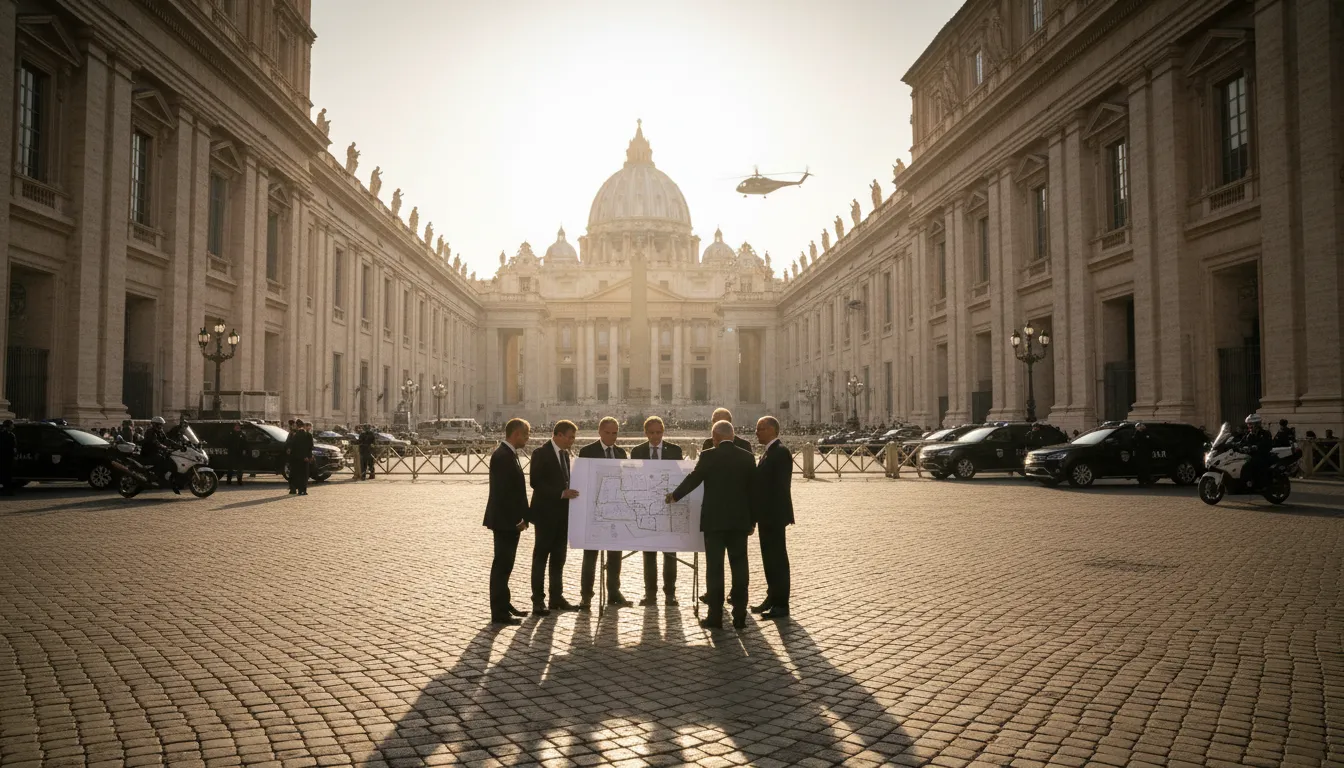
Once the pope accepts, a Vatican advance team travels to the host country for preliminary talks. Led by a senior Vatican official, this team reviews proposed events, transportation, and lodging for the pope, his entourage, and the traveling press corps. The advance team typically returns two or three more times before the papal arrival, fine-tuning every detail—from whether the pope will ride in a closed car or the open-air popemobile, to how many steps he must walk at each venue.
Layers of Security
Protecting the pope abroad requires coordination between multiple forces. The Vatican Gendarmerie, a roughly 130-member police corps, travels with the Holy Father on every trip. They work alongside the host nation's security services under a unified command structure, typically coordinated through the country's interior ministry.
Plainclothes members of the Swiss Guard, the Vatican's 500-year-old military corps, also accompany the pope. The popemobile driver is always a police officer bound by strict secrecy protocols. Security planners assess crowd sizes, route vulnerabilities, and emergency evacuation procedures for every public appearance.
Who Pays the Bill
The Vatican itself does not cover the cost of apostolic journeys. Instead, expenses are shared among several parties. Local Catholic dioceses bear much of the burden, raising funds through donations from corporations, individuals, and the work of thousands of volunteers. Host governments cover security costs—often the single largest expense—though these figures are frequently kept from public view.
Even journalists contribute: media organizations pay steep fees for seats on the papal plane and accommodations arranged by the Vatican press office. Those costs have risen so sharply that some news agencies now skip certain trips. Total expenses for a single papal visit can range from €15 to €30 million, with visits to large Western cities sometimes far exceeding that. Pope Francis's 2015 stop in Philadelphia alone was estimated at $48 million.
Diplomacy in the Air and on the Ground
Apostolic journeys serve a dual purpose: pastoral outreach and soft-power diplomacy. By protocol, political leaders and civil authorities are always the first to receive the pope at the start of a visit. Speeches to government officials set the diplomatic tone, while masses, interfaith meetings, and visits to hospitals or refugee camps deliver the pastoral message.
Popes routinely use these trips to spotlight issues the Vatican considers urgent—religious freedom, poverty, conflict resolution, or interfaith dialogue. A pope's choice of destination itself sends a political signal: visiting a Muslim-majority country, a conflict zone, or a nation with a tiny Catholic minority can carry enormous symbolic weight.
The Press Conference at 30,000 Feet
One unique tradition of modern papal travel is the in-flight press conference. On the return leg of most trips, the pope walks to the back of the chartered aircraft to take questions from journalists. These unscripted sessions have produced some of the most headline-grabbing papal statements in recent decades, from remarks on doctrine to off-the-cuff comments on world affairs. The airborne setting, far from Vatican handlers, gives these exchanges an unusual candor.
From advance teams crisscrossing host cities to popemobile routes planned down to the meter, apostolic journeys represent a uniquely Vatican blend of ancient spiritual mission and modern logistical precision—one that continues to evolve with each new pontificate.