How a Papal Conclave Works—From Lock-In to White Smoke
A papal conclave is the centuries-old secret process by which Catholic cardinals elect a new pope, locked inside the Sistine Chapel until white smoke signals their choice to the world.
Locked Away Until They Decide
When a pope dies or resigns, the Catholic Church activates one of the oldest electoral systems still in use: the papal conclave. The word itself comes from the Latin cum clave—"with a key"—because the cardinal electors are literally locked inside the Sistine Chapel until they choose a new leader for the world's 1.4 billion Catholics.
The tradition dates to a crisis. In 1268, cardinals meeting in the Italian town of Viterbo took nearly three years to elect a successor to Pope Clement IV. Frustrated townspeople reportedly tore the roof off the building and put the cardinals on a bread-and-water diet. The eventual winner, Gregory X, vowed it would never happen again. His 1274 papal bull Ubi periculum established the conclave system, mandating seclusion until a decision was reached.
Who Votes—and Who Cannot
Only cardinals under the age of 80 may serve as electors. Pope Paul VI introduced this age limit in 1970. For the 2025 conclave that elected Pope Leo XIV, 133 of the 135 eligible cardinal electors participated—one of the largest elector pools in history.
No campaigning is formally permitted. Cardinals may discuss candidates informally during the period between a pope's death and the conclave's start, but once inside the Sistine Chapel, strict secrecy rules apply. All electronic devices are banned, the chapel is swept for listening equipment, and every participant swears an oath of silence under penalty of excommunication.
The Voting Process
Voting follows a precise ritual. Each cardinal receives a ballot printed with the Latin phrase Eligo in Summum Pontificem—"I elect as Supreme Pontiff." They write their chosen candidate's name, fold the ballot, and approach the altar one by one to place it in a chalice.
Three scrutineers (vote counters), three infirmarii (who collect votes from ill cardinals), and three revisers (who verify the count) are chosen by lot before each session. Cardinals hold up to four ballots per day—two in the morning, two in the afternoon.
A candidate must win a two-thirds supermajority to become pope. This threshold, established by Gregory XV in 1621, ensures broad consensus. If no winner emerges after roughly 30 ballots, voting narrows to the top two candidates—but still requires two-thirds support.
Black Smoke, White Smoke
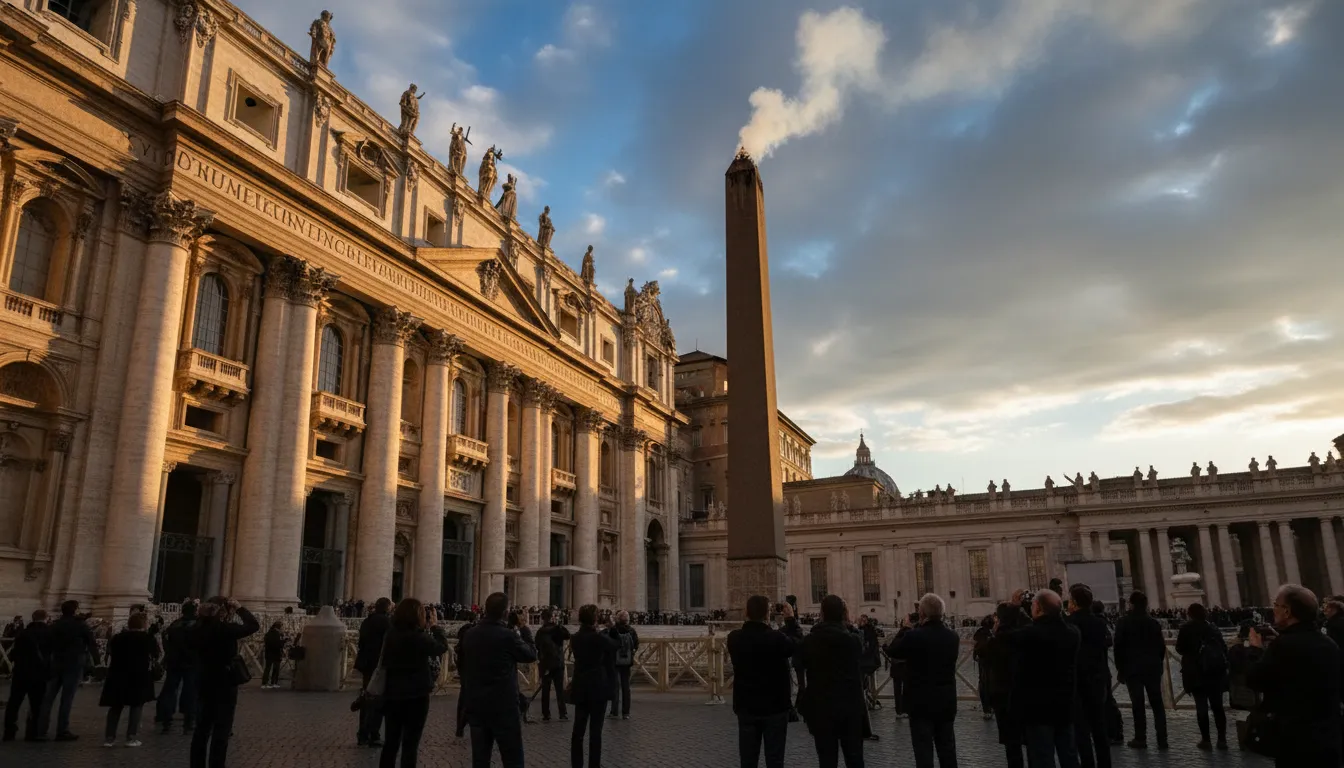
The world learns the outcome through one of the most recognizable signals in global culture: smoke rising from the Sistine Chapel chimney. Black smoke (fumata nera) means no pope has been elected. White smoke (fumata bianca) means the Church has a new leader.
This tradition, traced to around 1914, relies on modern chemistry. When no pope is chosen, ballots are burned with cartridges containing potassium perchlorate, anthracene, and sulfur to produce unmistakable black smoke. For a successful election, potassium chlorate, lactose, and pine rosin generate bright white smoke. Since 2005, the Vatican has also rung the bells of St. Peter's Basilica alongside white smoke to eliminate any confusion.
Acceptance and the New Name
Once the two-thirds threshold is reached, the Dean of the College of Cardinals approaches the winner and asks: "Do you accept your canonical election as Supreme Pontiff?" The cardinal may decline—though none has in modern history. If he accepts, he immediately chooses a papal name, a tradition dating to the sixth century when a pope born Mercurius thought a pagan god's name unsuitable for a pontiff.
The new pope is then dressed in white vestments—three sizes are prepared in advance—and proceeds to the central balcony of St. Peter's Basilica. The senior cardinal deacon announces to the waiting crowd: "Habemus Papam"—"We have a pope."
From Three Years to Two Days
Modern conclaves are dramatically shorter than their medieval predecessors. The 1268 Viterbo election lasted 1,006 days. By contrast, Pope Benedict XVI was elected in 2005 after just four ballots over two days. Pope Francis required five ballots in 2013. Pope Leo XIV's 2025 election also concluded in two days—making it one of the fastest in recent history.
The shortest conclave on record belongs to 1503, when cardinals elected Pope Julius II in mere hours. Whether the process takes hours or days, the conclave remains a striking blend of ancient ritual and calculated consensus-building—a system designed eight centuries ago that still determines who leads the world's largest religious institution.