How Glacier Surges Work—and Why They Threaten Millions
Surging glaciers can accelerate to 100 times their normal speed, damming rivers, triggering catastrophic floods, and destroying infrastructure. Here is how the phenomenon works and why climate change is rewriting the rules.
A Glacier That Moves Like a Freight Train
Most glaciers creep forward at a pace measured in centimeters per day. But roughly one percent of the world's glaciers behave very differently. These so-called surge-type glaciers can suddenly accelerate to speeds of up to five meters per hour—100 times faster than normal—before slowing back down for decades. The cycle can dam rivers, unleash catastrophic floods, and bury communities with little warning.
A comprehensive 2026 review in Nature Reviews Earth & Environment identified approximately 3,100 surge-type glaciers worldwide. Though they represent just one percent of all glaciers, they cover nearly one-fifth of total glacier area and pose outsized risks to the roughly one million people living within ten kilometers of glacial lakes in High Mountain Asia alone.
The Surge Cycle: Build-Up and Release
Every surge-type glacier follows a two-phase cycle. During the quiescent phase, which can last anywhere from five to more than 100 years, snow and ice accumulate in the glacier's upper reaches. The glacier's flow velocity during this period is lower than the rate needed to keep it in balance, so ice steadily builds up in a reservoir zone.
When the accumulated mass becomes large enough, the gravitational driving force exceeds friction at the glacier's base. The result is dramatic: ice begins to slide rapidly downhill, transferring mass from the upper to the lower glacier. The front may advance by several kilometers in a matter of months. Eventually friction reasserts itself, the surge terminates, and the quiescent phase begins again.
Two Flavors of Surge
Scientists recognize two primary surge mechanisms, each named after the region where it was first studied:
- Alaskan-type surges are hydrologically controlled. They begin abruptly, reach extreme speeds of tens of meters per day, and end just as suddenly—often accompanied by a massive release of stored meltwater from beneath the glacier.
- Svalbard-type surges are thermally controlled. They accelerate more gradually, peak at slower speeds (up to four or five meters per day), and taper off over several years as the glacier's base slowly refreezes.
In both cases, water is the key player. Meltwater infiltrates the glacier through surface crevasses, reaches the base, and lubricates the contact between ice and bedrock. Changes in the subglacial drainage system—whether the water flows through efficient channels or spreads into a slippery film—ultimately determine when a surge starts and stops.
Where Surges Strike
Surge-type glaciers cluster in two main regions: the Arctic and Subarctic (about 48 percent), including Alaska, Svalbard, Iceland, and the Canadian Arctic; and High Mountain Asia (about 51 percent), particularly the Karakoram and Pamir mountains of Pakistan, China, and Tajikistan.
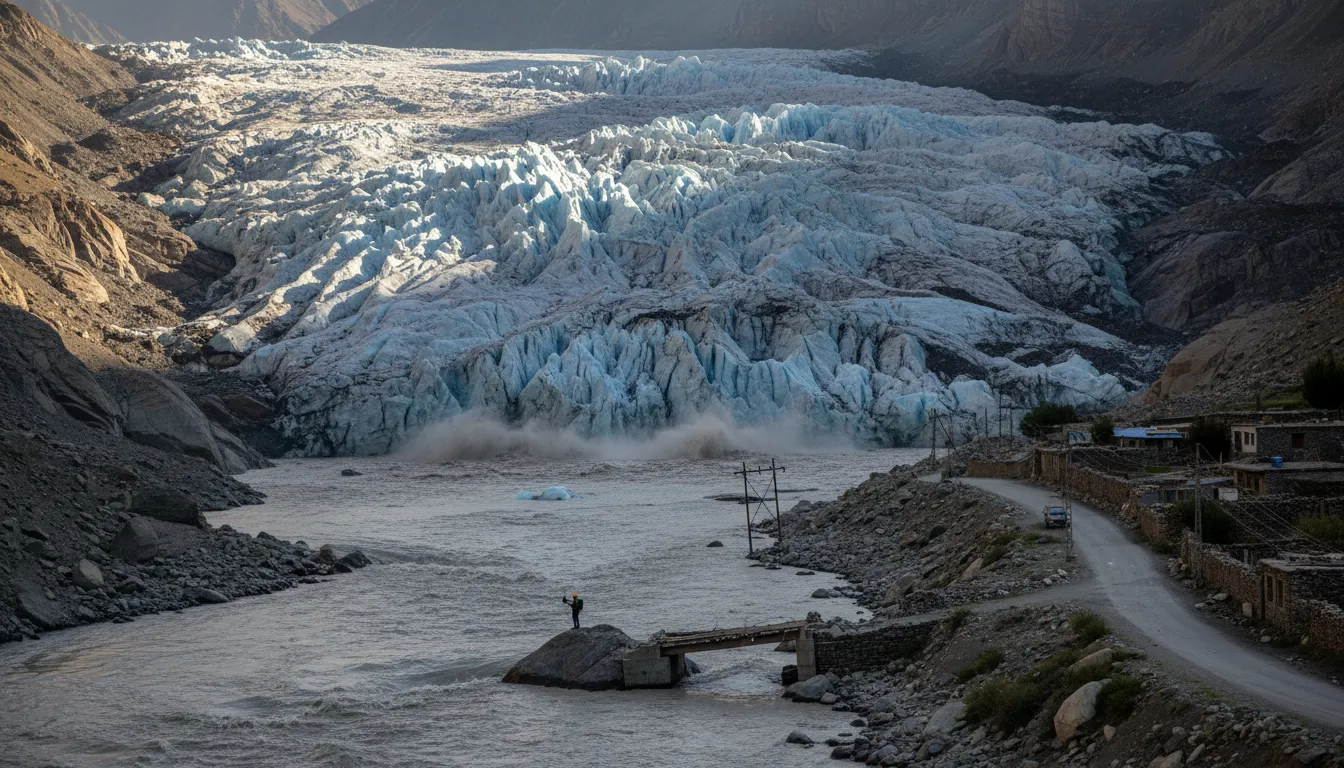
The Karakoram is especially dangerous because populated valleys and critical infrastructure sit directly below surging glaciers. In 2018, Pakistan's Shisper Glacier began surging, blocking a river and forming an ice-dammed lake. Over the next four years the lake filled and drained six times. A glacial lake outburst flood (GLOF) in May 2022 destroyed the Hassanabad Bridge on the Karakoram Highway—a lifeline connecting Pakistan and China—along with homes and hydropower stations downstream.
Climate Change Is Rewriting the Rules
Warming temperatures are altering glacier behavior in ways scientists are still working to understand. More meltwater means more lubrication at glacier bases, potentially changing surge frequency and intensity. The number of glacial lake outburst floods in the Himalayas is now nearly five times higher per decade than it was before 1950, driven largely by expanding glacial lakes and increasing triggers such as avalanches and ice collapses.
A 2023 study in Nature Communications found that 15 million people globally are exposed to potential GLOF impacts. At least 81 surge-type glaciers have been directly linked to hazardous events. As glaciers continue to retreat and meltwater volumes increase, the risks are expected to grow—particularly in regions where monitoring infrastructure remains limited.
A Threat That Demands Attention
Predicting when a glacier will surge remains one of glaciology's hardest problems. Satellite monitoring has improved detection, but many surging glaciers in remote mountain ranges still go unobserved until disaster strikes. For the millions of people living in their shadow, understanding this phenomenon is not academic—it is a matter of survival.