How Ravens Memorize Wolf Kill Sites to Find Food
Ravens don't simply follow wolves to scavenge meals. New research reveals they memorize landscape-scale hunting hotspots and fly directly to likely kill sites, showcasing remarkable spatial intelligence.
The Myth of the Follower
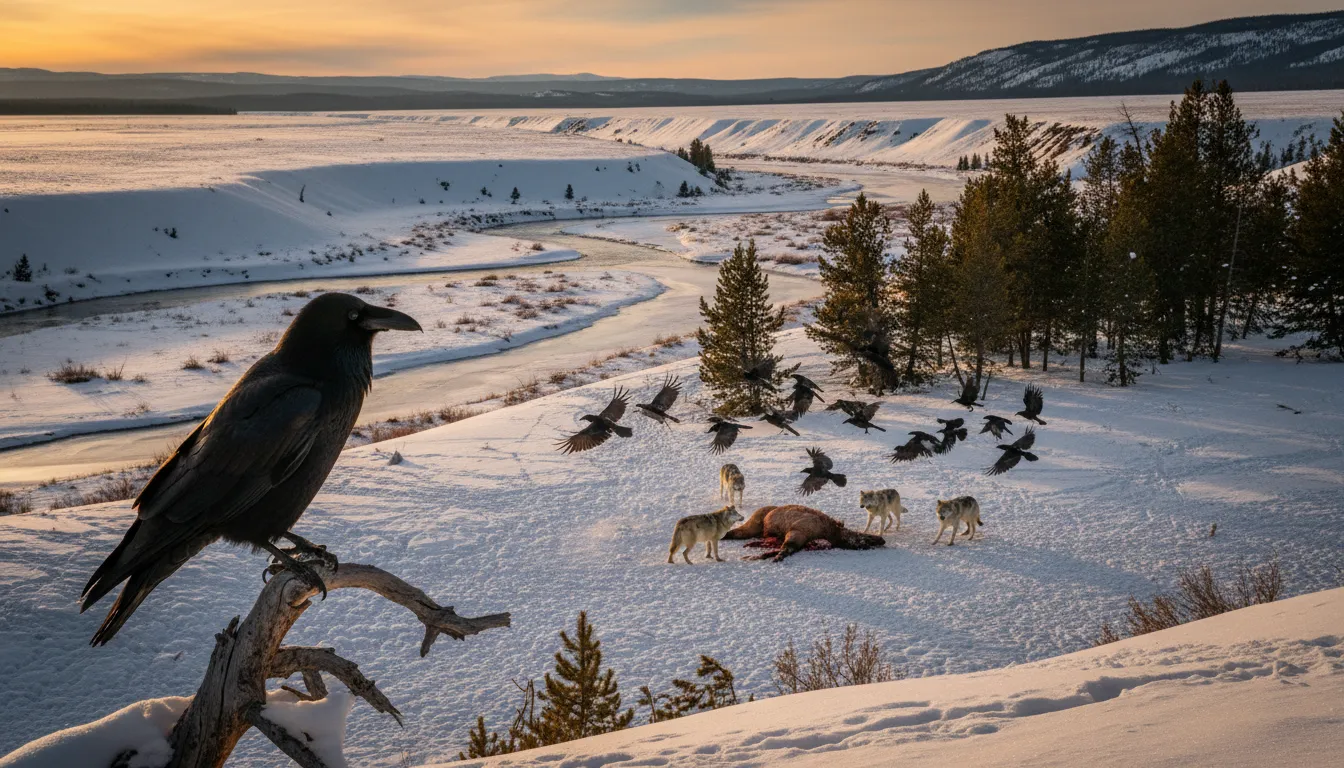
For decades, wildlife biologists assumed ravens relied on a simple trick: follow a wolf pack, wait for a kill, then swoop in for scraps. The image of black birds trailing grey predators across snowy valleys became one of ecology's most familiar stories. But research published in the journal Science has upended that narrative. Ravens, it turns out, are not passive followers. They are strategic planners with extraordinary spatial memory.
What the Yellowstone Study Found
Researchers from the University of Washington, the Max Planck Institute, and Yellowstone National Park fitted 69 ravens and 20 wolves with GPS trackers and monitored their movements for two and a half years. The goal was to test whether ravens actually shadow wolves in real time.
The answer was a resounding no. Over the entire study period, scientists documented only a single instance of a raven following a wolf for an extended distance. Yet ravens consistently showed up at fresh kill sites, often within hours. The explanation lies not in pursuit but in memory.
Wolf kills are not random. They cluster in predictable landscape features—flat valley bottoms, river bends, and open meadows where ungulates are easier to ambush. Ravens learn these hotspots and revisit them regularly, sometimes flying more than 150 kilometres in a single day in direct, purposeful routes toward areas where a carcass is statistically likely to appear.
Spatial Memory: A Corvid Superpower
The raven's navigational feat makes more sense in the context of corvid cognition. The corvid family—ravens, crows, jays, and magpies—possesses some of the most powerful brains in the animal kingdom relative to body size. A corvid brain packs twice as many neurons as a primate brain of equal mass, concentrated in a dense forebrain region called the nidopallium caudolaterale (NCL), which functions much like the mammalian prefrontal cortex.
This neural density supports what scientists call episodic-like memory—the ability to recall what happened, where it happened, and when. Clark's nutcrackers, close relatives of ravens, cache over 30,000 seeds across thousands of sites and retrieve them months later. Ravens apply the same cognitive toolkit on a grander, more dynamic scale: instead of remembering where they hid food, they remember where wolves produce it.
Memory First, Cues Second
The Yellowstone data suggest a two-tier foraging system. At a broad landscape scale, ravens use spatial memory to decide which region to visit. Once in the area, they switch to short-range cues—watching wolf movements, listening for howls, or spotting circling birds—to pinpoint the exact location of a fresh carcass.
Crucially, the study found that ravens are not loyal to any single wolf pack. Individual birds ranged across multiple pack territories, choosing among several potential feeding opportunities. This flexibility suggests ravens maintain a cognitive map of an entire ecosystem's predation landscape, updating it as conditions change.
Why It Matters Beyond Yellowstone
Understanding the raven-wolf dynamic has practical implications for wildlife management. Ravens that scavenge wolf kills redistribute nutrients, attract other scavengers like eagles, magpies, and coyotes, and influence how quickly carcasses decompose. Removing wolves from an ecosystem doesn't just affect prey populations—it disrupts the entire scavenging network that ravens anchor.
The findings also push forward the science of animal cognition. If ravens can build and maintain mental maps of predation hotspots across hundreds of square kilometres, it raises questions about how widespread such abilities are among other scavenging species, from vultures to hyenas.
Smarter Than We Thought
Ravens have been revered in mythology as tricksters and messengers for thousands of years. Modern science keeps confirming the intuition behind those stories. These birds don't simply react to their environment—they anticipate it, using memory, planning, and flexible decision-making to exploit one of nature's most reliable food sources. The wolf may make the kill, but the raven already knew where to wait.


