How Remote Robotic Surgery Works and Why It Matters
Telesurgery lets a surgeon operate on a patient thousands of kilometres away using robotic arms, fibre-optic links, and haptic feedback. Here is how the technology works, where it came from, and what stands between it and mainstream medicine.
A Surgeon in London, a Patient in Gibraltar
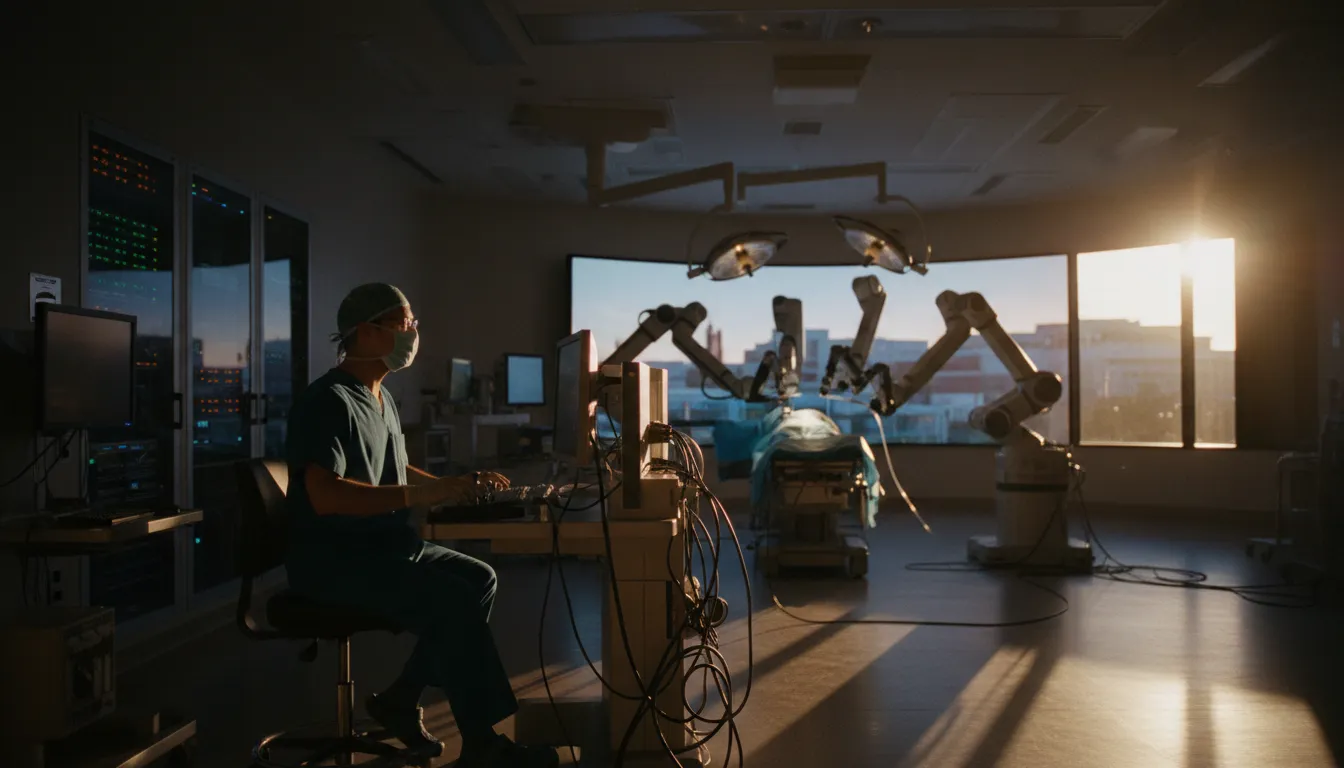
The operating theatre in Gibraltar looked normal enough — nurses, anaesthetists, a robotic arm poised over the patient. What was missing was the surgeon. Professor Prokar Dasgupta sat at a console in London, more than 2,400 kilometres away, guiding instruments through a man's body with a lag of just 48 milliseconds. The procedure — a prostate cancer operation — went, in the words of the medical team, extremely well. The patient was back on his feet four days later.
The milestone, described by ITV News as the UK's first long-distance robotic surgery, is a vivid illustration of a technology that has been decades in the making: telesurgery, or remote robotic surgery. It promises to bring world-class surgical expertise to patients who would otherwise never have access to it.
What Is Telesurgery?
Telesurgery — sometimes called cybersurgery or remote surgery — is the use of robotic systems and high-speed telecommunications to allow a surgeon to perform an operation on a patient who is not in the same room, building, or even country. As News-Medical.net explains, the robotic system remains in direct contact with the patient while the surgeon sits at a console at a remote location and controls every movement.
The robotic platform typically consists of several key components:
- Robotic arms — positioned over the patient, holding surgical instruments and a camera
- Surgeon's console — a workstation where the surgeon views a magnified 3-D image of the surgical field and manipulates hand controls
- Haptic feedback system — technology that simulates the sense of touch, letting the surgeon "feel" tissue resistance, even from far away
- High-speed data link — usually fibre-optic cable, with 5G as a backup or alternative
The console translates the surgeon's hand movements into precise, scaled-down motions of the robotic arms. Motion scaling — typically 3:1 or 5:1 — filters out hand tremors and converts large gestures into tiny, accurate incisions.
A Brief History: From New York to Strasbourg
The concept of operating at a distance is older than most people realise. The pivotal moment came on 7 September 2001, when French surgeon Jacques Marescaux, sitting at a console in New York City, removed the gallbladder of a 68-year-old patient lying in an operating theatre in Strasbourg, France — 6,230 kilometres away. The procedure, dubbed Operation Lindbergh after the pioneering transatlantic aviator, used the ZEUS robotic system and dedicated fibre-optic lines provided by France Telecom, achieving a round-trip latency of around 155 milliseconds.
Operation Lindbergh proved the concept was medically viable. Since then, robotic platforms have grown more capable, communications networks faster, and clinical teams more experienced — culminating in milestones like the London-to-Gibraltar operation more than two decades later.
Why Latency Is Everything
The single most critical technical factor in telesurgery is latency — the delay between the surgeon's movement and the robot's response. Research published in PubMed Central is unambiguous: a latency of 0–200 milliseconds is the safe window, with most surgeons barely noticing the gap. Beyond 300 ms, surgical skill measurably deteriorates. Above 700 ms, the procedure is considered unsafe.
This is why the choice of network infrastructure matters enormously. Fibre-optic cables remain the gold standard, delivering the lowest and most predictable delays. The London-Gibraltar operation used a fibre-optic primary link with a 5G backup — a configuration that produced the remarkably low 48-millisecond lag recorded during the procedure.
The arrival of 5G networks is considered transformative for the field. With peak latency below 10 milliseconds in ideal conditions and far greater bandwidth than 4G, 5G opens the door to telesurgery in locations where laying fibre cable is impractical — rural hospitals, ships, disaster zones, or military field units.
What Stands in the Way
Despite spectacular demonstrations, telesurgery is not yet routine. Several barriers remain, according to a review in PMC:
- Cost — the robotic platforms and specialist infrastructure are expensive, limiting access to well-funded hospitals
- Cybersecurity — a hacked or jammed connection mid-operation is a life-threatening scenario, and no robust global security standard yet exists
- Regulation — legal frameworks governing liability, licensing, and cross-border medical practice have not kept pace with the technology
- Patient trust — many patients feel uneasy about a surgeon they cannot see performing an irreversible procedure
The Promise: Surgery Without Borders
The long-term vision is compelling. In many parts of the world, specialist surgeons are concentrated in a handful of major cities, while patients in rural or remote areas wait months for procedures that could save or transform their lives. Telesurgery could, in principle, make the world's best surgical expertise available anywhere with a fast internet connection.
Emergency medicine stands to benefit especially. Stroke intervention and cardiac surgery, where every minute counts, could be performed by a specialist who is physically unreachable in time but digitally present within milliseconds. Battlefield medicine is another frontier being actively explored.
The technology is not science fiction. It is already working — tested in clinical settings, streamed live to conferences, and, in at least one case, leaving a patient feeling fantastic four days after surgery he could not have had locally at all.