How Spacewalks Work—and Why They're So Risky
Every time an astronaut floats outside a spacecraft, months of preparation and layers of life-saving technology stand between them and the void. Here's how extravehicular activities (EVAs) actually work.
The Moment the Hatch Opens
When two NASA astronauts floated out of the International Space Station in March 2026 to install a solar-array modification kit, they were performing one of the most complex and dangerous tasks in human history. A spacewalk — formally called an extravehicular activity (EVA) — is any work an astronaut performs outside a pressurized spacecraft. The view is extraordinary. The margin for error is nearly zero.
Since Alexei Leonov first stepped outside the Soviet Voskhod 2 capsule in March 1965, astronauts have conducted more than 260 spacewalks at the International Space Station alone, accumulating thousands of hours of work in open space. Yet every EVA remains an extraordinary engineering and physiological challenge.
The Spacesuit: A One-Person Spacecraft
The suit an astronaut wears during a spacewalk is not simply protective clothing — it is a self-contained spacecraft. NASA's Extravehicular Mobility Unit (EMU), introduced in 1982 and used on the ISS ever since, weighs roughly 280 pounds (130 kg) on Earth and can sustain a human for up to 8.5 hours, including a 30-minute emergency reserve.
The EMU shields astronauts from three lethal threats simultaneously:
- Extreme temperature swings — surfaces in sunlight can reach +250°F (+121°C); in shadow, they plunge to −250°F (−157°C)
- Micrometeoroids and orbital debris — tiny particles traveling at up to 17,500 mph
- Radiation — cosmic rays and solar particles that Earth's atmosphere normally filters
Putting the suit on alone takes about 45 minutes. Astronauts must pre-size and check every layer, seal every joint, and verify life-support systems before venturing outside.
The Pre-Breathe Problem
One of the most counterintuitive aspects of spacewalk preparation is the risk of decompression sickness — the same condition that threatens deep-sea divers who surface too quickly. The ISS cabin is pressurized to roughly the same as sea level (14.7 psi), while the EMU suit operates at only 4.3 psi to allow flexibility. Drop the pressure too fast and dissolved nitrogen bubbles form in the blood and joints, causing crippling pain or worse.
To prevent this, astronauts spend hours breathing pure oxygen before a spacewalk to flush nitrogen from their tissues. Since 2006, most ISS crews have used a "camp-out" method: spacewalkers sleep overnight in the Quest airlock module with its pressure gradually reduced, accelerating nitrogen purge while they rest. Pre-breathe protocols can add four or more hours to an EVA day.
The Airlock: Gateway to the Void
The airlock is the bridge between the pressurized station and open space. It has two sealed hatches. The crew enters from the station side and seals the inner hatch, then the airlock is slowly depressurized until it matches the vacuum outside. Only then can the outer hatch be opened safely — without any air escaping into the station. After the EVA, the process reverses: the outer hatch closes, the airlock repressurizes, and the inner hatch can open again.
Staying Tethered — and What Happens if You're Not
Astronauts use safety tethers — essentially short cables — to keep themselves connected to the station structure at all times. They also wear a device called SAFER (Simplified Aid For EVA Rescue), a backpack-mounted system of small nitrogen-jet thrusters. If an astronaut becomes untethered and drifts away, SAFER gives them a chance to maneuver back before the ISS moves out of reach. It is a last resort — the situation it is designed for has never occurred during an ISS EVA.
Training: Five Hours in the Pool for Every Hour in Space
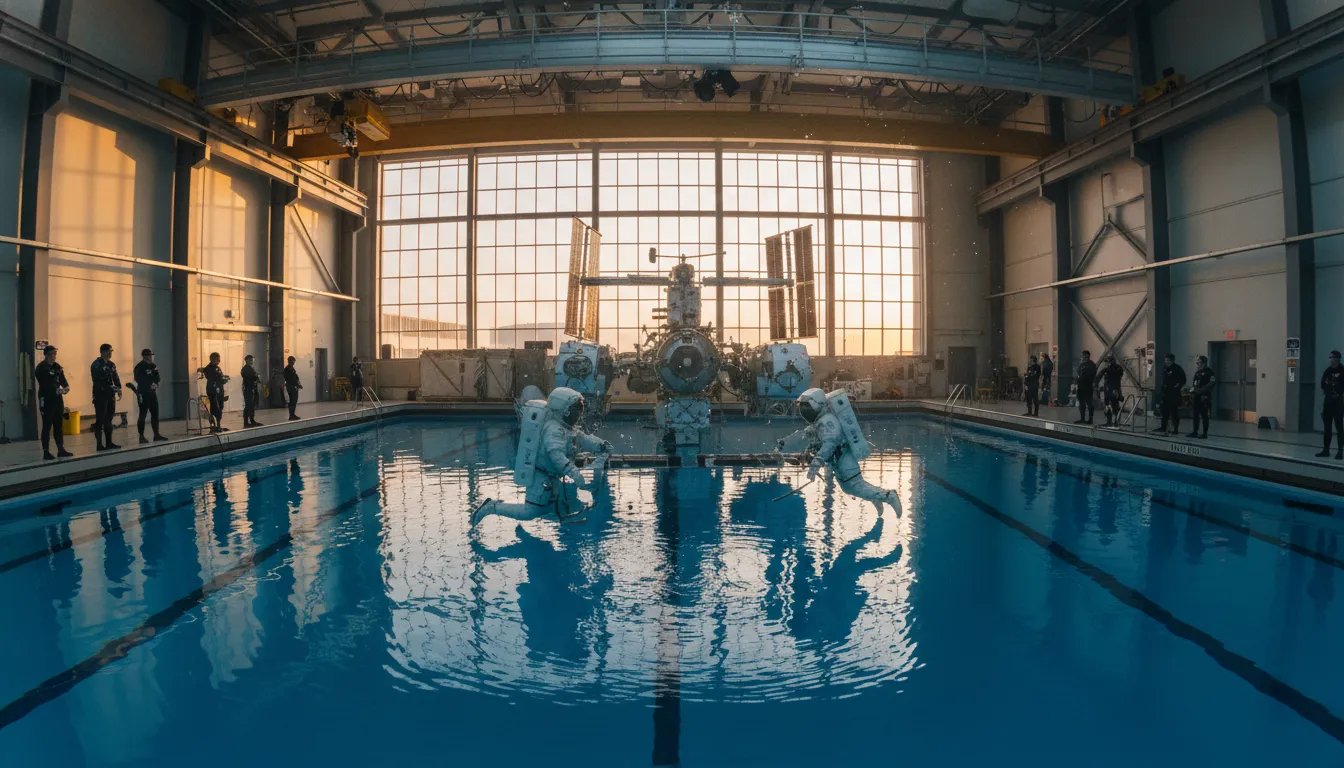
For each hour of scheduled EVA time, astronauts train approximately five to seven hours underwater at NASA's Neutral Buoyancy Laboratory (NBL) at Johnson Space Center in Houston. The NBL holds 6.2 million gallons of water with full-scale replicas of ISS modules submerged inside. Neutral buoyancy simulates the weightlessness of orbit more effectively than any other ground-based method, letting crews rehearse precise tool use and body positioning in near-real conditions.
Why Spacewalks Still Matter
Robotic arms and remotely operated systems handle many ISS tasks, but certain jobs still require human hands. Upgrading power systems, replacing cooling pumps, repairing scientific equipment, and installing new hardware all demand dexterity that no current robot can fully replicate in an unstructured orbital environment. The ongoing installation of roll-out solar arrays (iROSAs) — which will increase the station's power output by 20–30% — is a prime example: each array must be physically prepared and connected by suited astronauts.
As space agencies plan lunar surface operations under the Artemis program and eventually crewed Mars missions, EVA technology is being redesigned from the ground up. The challenges multiply: moonwalks in lunar dust, Mars suits coping with a thin CO₂ atmosphere. But the fundamental principle remains the same as it was in 1965 — suit up, breathe carefully, clip in your tether, and step outside.