What Is the Strait of Hormuz and Why It Matters
A 21-mile-wide chokepoint between Iran and Oman moves roughly one-fifth of the world's daily oil supply. Here is how the waterway works, why it is so hard to replace, and what would happen if it closed.
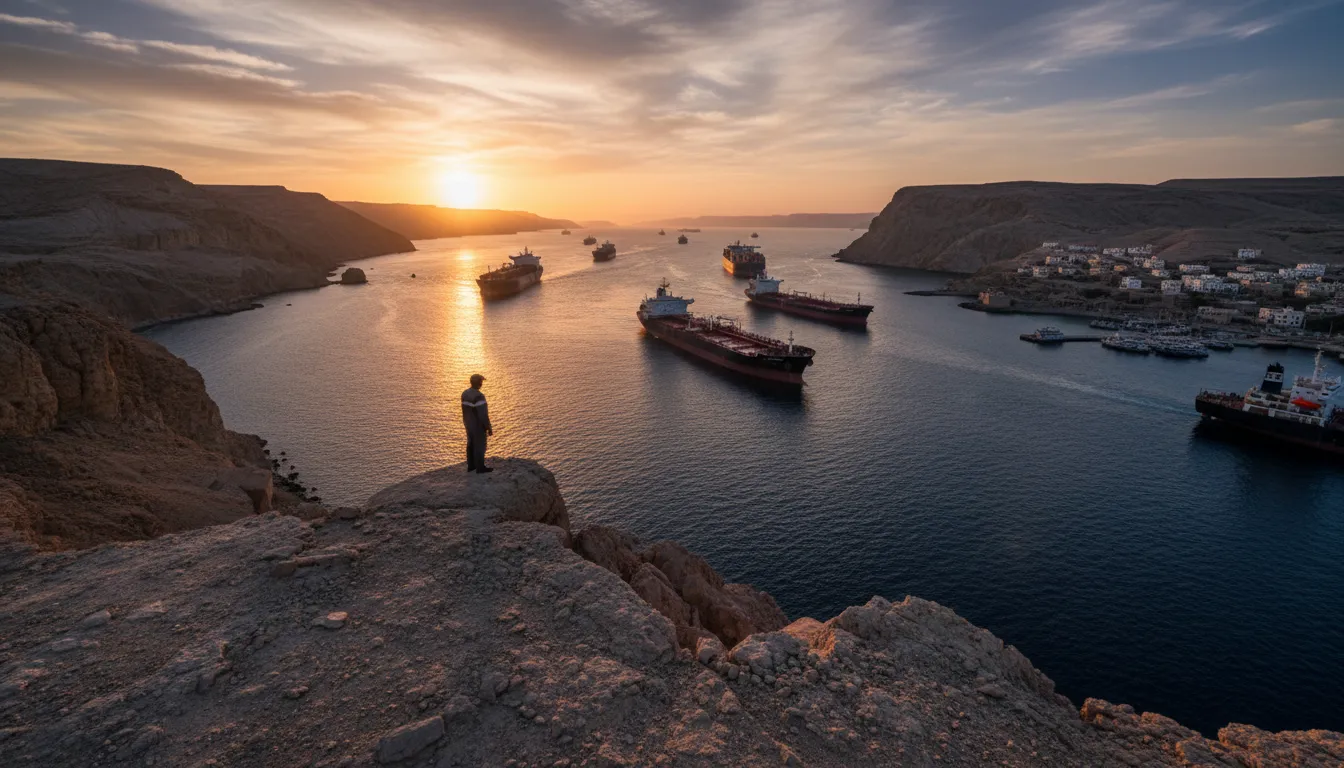
The World's Most Critical Oil Chokepoint
At its narrowest, the Strait of Hormuz stretches only 21 miles (33 kilometres) across — roughly the width of the English Channel at Dover. Yet this sliver of water between Iran to the north and Oman to the south is arguably the single most strategically important waterway on Earth. Every day, roughly 20 million barrels of oil flow through it, equivalent to about one-fifth of the world's total petroleum consumption, according to the U.S. Energy Information Administration (EIA).
Where It Is and How It Works
The Strait connects the Persian Gulf — bordered by Saudi Arabia, the UAE, Kuwait, Qatar, Bahrain, Iraq, and Iran — to the Gulf of Oman and ultimately the Arabian Sea and Indian Ocean. It is the only maritime exit for most of the Gulf's oil-producing nations.
To manage the constant flow of massive supertankers, the Strait operates two narrow shipping lanes, each roughly two miles wide, with one lane for inbound and one for outbound traffic. These channels run primarily through the territorial waters of Oman, though they clip Iranian waters as well. Under the United Nations Convention on the Law of the Sea (UNCLOS), ships enjoy the right of transit passage — meaning they can move through such international straits continuously and unimpeded, even within another nation's territorial sea.
Who Depends on It
Nearly every major oil producer in the Persian Gulf relies on the Strait. Saudi Arabia alone accounts for roughly 38% of total oil flows through Hormuz — about 5.5 million barrels per day — according to the EIA. The UAE, Kuwait, Iraq, Qatar, and Iran also ship their exports through the same passage.
On the receiving end, Asia dominates: approximately 84% of crude oil transiting the Strait is destined for Asian markets. China receives about one-third of its total oil imports through Hormuz. Japan and South Korea are also heavily dependent. The International Energy Agency (IEA) notes that a disruption here would be felt globally, not just in Asia, because oil is priced on world markets.
The Strait also carries around one-fifth of global liquefied natural gas (LNG) trade, primarily from Qatar — one of the world's largest LNG exporters.
Why There Is No Real Alternative
Two pipeline systems can theoretically bypass Hormuz. Saudi Arabia's East-West Crude Oil Pipeline connects Gulf fields to the Red Sea port of Yanbu, with a capacity of up to 5 million barrels per day. The Abu Dhabi Crude Oil Pipeline (ADCOP) runs to the port of Fujairah on the Gulf of Oman, handling roughly 1.8 million barrels per day.
The problem: even running both pipelines at full capacity, analysts at UNCTAD and the EIA estimate only about 2.6 million barrels per day of bypass capacity is realistically available — against the 20 million barrels that flow through the Strait daily. Ships diverting around Africa's Cape of Good Hope would add 10 to 14 extra days at sea and thousands of nautical miles, driving freight costs sharply higher.
Iran's History of Threats
Iran sits along the Strait's entire northern coastline and has repeatedly threatened to close it during periods of tension with the United States and its allies. During the Iran-Iraq War in the 1980s, the so-called "Tanker War" saw mines, gunboats, and airstrikes threaten Gulf shipping, prompting the U.S. Navy to escort neutral tankers through the passage. Iran renewed closure threats during nuclear standoffs in 2011 and 2019.
Whether Iran could actually shut the Strait is a matter of fierce debate. Doing so would violate UNCLOS, and the U.S. Fifth Fleet — based in Bahrain — exists partly to guarantee freedom of navigation. Still, Iran possesses shore-based missiles, mines, and fast-attack boats that could make passage dangerously costly, even if a full closure proved impossible to sustain.
Why Any Disruption Hits Everyone
Because oil is a globally traded commodity, a supply shock in the Persian Gulf translates almost instantly into higher prices everywhere — at the pump in Germany, the factory floor in Vietnam, the grocery store in Brazil. The Congressional Research Service has concluded that even a temporary closure would trigger "substantial supply delays and a significant spike in world energy prices." Strategic petroleum reserves held by IEA member countries could buffer a short disruption, but a prolonged closure would quickly exhaust those buffers.
The Strait of Hormuz is, in essence, a geographic accident that history made indispensable. Until the world's energy mix shifts decisively away from Gulf oil, this 21-mile bottleneck will remain one of the pressure points where geopolitics and global economics collide most forcefully.


