How Tropical Peatlands Work—and Why They're Burning
Tropical peatlands store more carbon than all the world's forests combined, yet wildfires in these ecosystems have reached a 2,000-year high. Here's how they work, why they matter, and what threatens them.
The World's Most Underrated Carbon Vault
Imagine a sponge the size of a continent, soaked with thousands of years of compressed plant matter, quietly locking away nearly half of all the carbon stored in the world's soils. That's essentially what tropical peatlands are — and most people have never heard of them.
Covering just 3% of Earth's land surface, peatlands store more than 600 gigatonnes of carbon, equivalent to twice the carbon held in all the world's forests combined, according to the UN Environment Programme (UNEP). Tropical peatlands — concentrated in Southeast Asia, the Congo Basin, and the Amazon — represent the most carbon-dense fraction of this system. And they are now burning at levels not seen in at least 2,000 years.
What Is Peat, and How Does It Form?
Peat is essentially ancient, partially decomposed plant material. In waterlogged conditions, dead vegetation doesn't fully break down — oxygen can't reach the submerged organic matter, so decomposition slows to a near standstill. Over centuries and millennia, layer after layer of plant debris accumulates, trapping the carbon that the plants originally absorbed from the atmosphere.
In tropical regions, this process is accelerated by the sheer productivity of rainforest ecosystems. Dense vegetation dies, falls, and piles up in permanently flooded basins. The result is peat deposits that can extend several metres deep and take thousands of years to form. A single metre of tropical peat may represent up to 1,000 years of carbon accumulation.
Tropical peatlands also have a unique chemistry that helps them persist despite warm temperatures. Their organic material has a higher aromatic content and lower carbohydrate content than peat in colder climates, making it more resistant to microbial breakdown — a natural adaptation that keeps carbon locked away even in the heat, as explained in research published in Nature Communications.
Where Are Tropical Peatlands Found?
The three great tropical peatland regions are:
- Southeast Asia — Indonesia and Malaysia hold the largest share, concentrated in Borneo, Sumatra, and the Malay Peninsula. These are also the most heavily threatened.
- The Congo Basin — Central Africa hosts one of the world's largest continuous peat deposits, much of it only recently mapped by scientists.
- The Amazon Basin — Extensive Amazonian peatlands stretch across Peru, Colombia, and Brazil, storing billions of tonnes of carbon in relatively intact condition.
Why Tropical Peatlands Matter for the Climate
When peatlands are drained, burned, or cleared, the carbon stockpiled over millennia is suddenly released. The IUCN estimates that damaged peatlands already emit approximately 1.9 gigatonnes of CO₂ equivalent every year — around 5% of all human-caused greenhouse gas emissions — despite covering less than 0.4% of the world's land surface. That is a staggering disproportion.
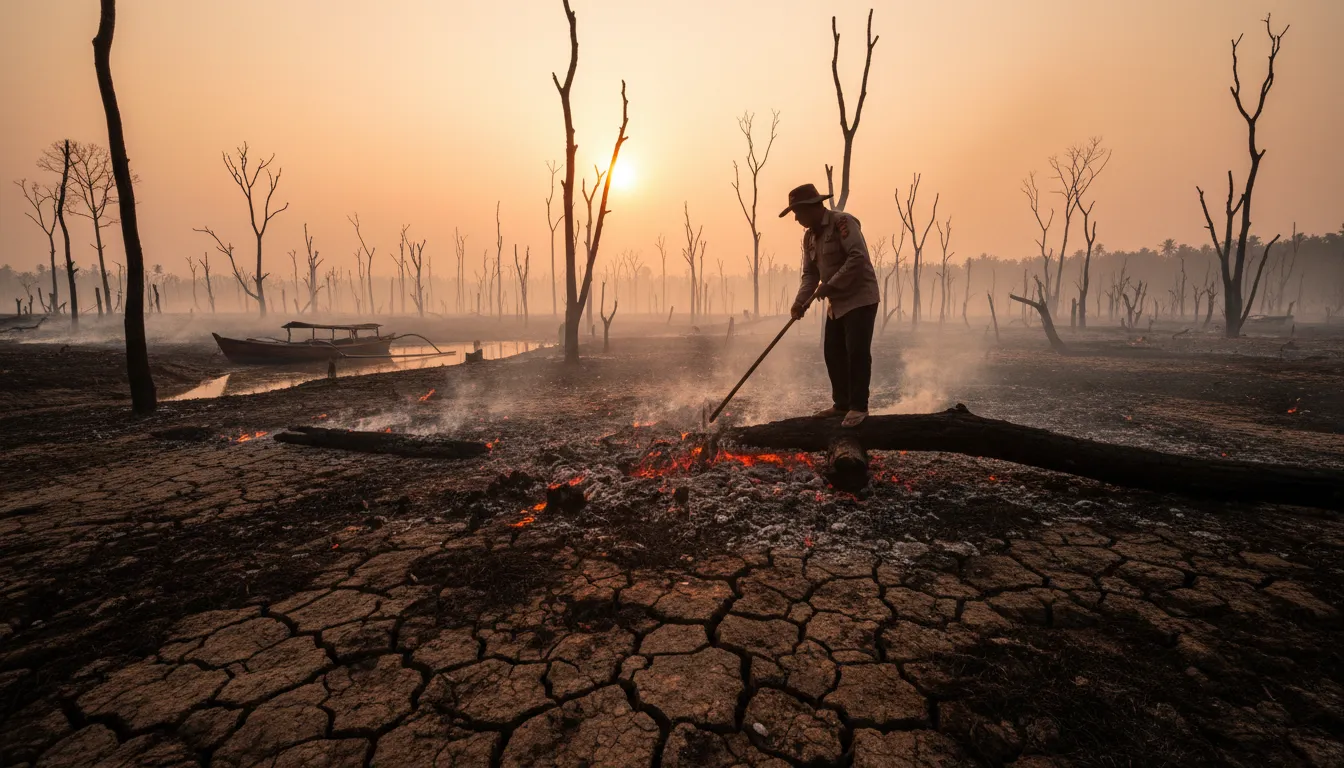
Burning is especially destructive. Unlike a forest fire, which consumes above-ground biomass, a peatland fire burns underground, incinerating accumulated organic matter that took centuries to build. Peat fires can smoulder for months, are extremely difficult to extinguish, and release carbon at a far higher rate per hectare than any surface fire.
The 2,000-Year Burning Record
A study published in March 2026 by researchers at the University of Exeter revealed that wildfire activity in tropical peatlands has reached its highest level in over two millennia. Analysing charcoal and pollen records spanning 2,000 years, the team found that fires actually declined for more than a thousand years, tracking natural climate patterns. That long-term trend reversed sharply in the 20th century.
The surge is concentrated in Southeast Asia, where vast areas of peatland have been drained and cleared for palm oil plantations and agricultural development. Draining peat removes the water that protects it from igniting. Once dry, it becomes a fire-prone fuel source. More remote peatlands in South America and Africa have so far been less affected — but scientists warn this could change as population growth and agricultural expansion continue.
Protecting What Remains
Despite their enormous importance, UNEP estimates that only 19% of the world's peatlands are formally protected. Roughly 15% have already been drained.
The good news is that restoration is possible. Rewetting drained peatlands — a process called paludiculture when combined with adapted agriculture — can halt carbon release and, over time, allow peat to resume its role as a carbon sink. According to UNEP, conserving and restoring tropical peatlands could cut global greenhouse gas emissions by up to 800 million tonnes of CO₂ equivalent per year, roughly 2% of annual global emissions.
The Global Peatlands Initiative, formed in 2016, brings together 46 international partners and key tropical peatland nations — Indonesia, the Republic of Congo, the Democratic Republic of Congo, and Peru — to coordinate protection efforts. The science is clear: preserving these largely invisible ecosystems may be one of the most cost-effective climate interventions available.


