How Strategic Petroleum Reserves Work
When oil markets spiral out of control, governments reach for a powerful emergency tool: strategic petroleum reserves. Here is how these vast underground oil banks work, who controls them, and when they get used.
The World's Emergency Oil Banks
When a crisis strikes a major oil-producing region, energy markets can seize up within days, sending fuel prices soaring and threatening entire economies. To defend against that risk, the world's wealthiest nations maintain vast emergency stockpiles of crude oil — hidden underground, ready to flood markets within two weeks of a government decision. These are strategic petroleum reserves, and they are one of the most consequential tools in modern energy policy.
Born From an Oil Embargo
The idea took shape during one of the most disruptive episodes in modern economic history. In October 1973, Arab members of OPEC imposed an oil embargo on the United States and other Western nations in retaliation for their support of Israel in the Yom Kippur War. Oil prices quadrupled. Petrol stations ran dry. Long queues formed at forecourts across the US and Europe.
The crisis exposed how dependent industrialised economies were on imported oil — and how completely unprepared they were to cope with a sudden supply cut. In response, the United States passed the Energy Policy and Conservation Act in 1975, signed by President Gerald Ford, which created the US Strategic Petroleum Reserve (SPR). Simultaneously, the newly formed International Energy Agency (IEA) required all member countries to hold oil stocks equivalent to at least 90 days of net oil imports.
Salt Caverns and Water Physics
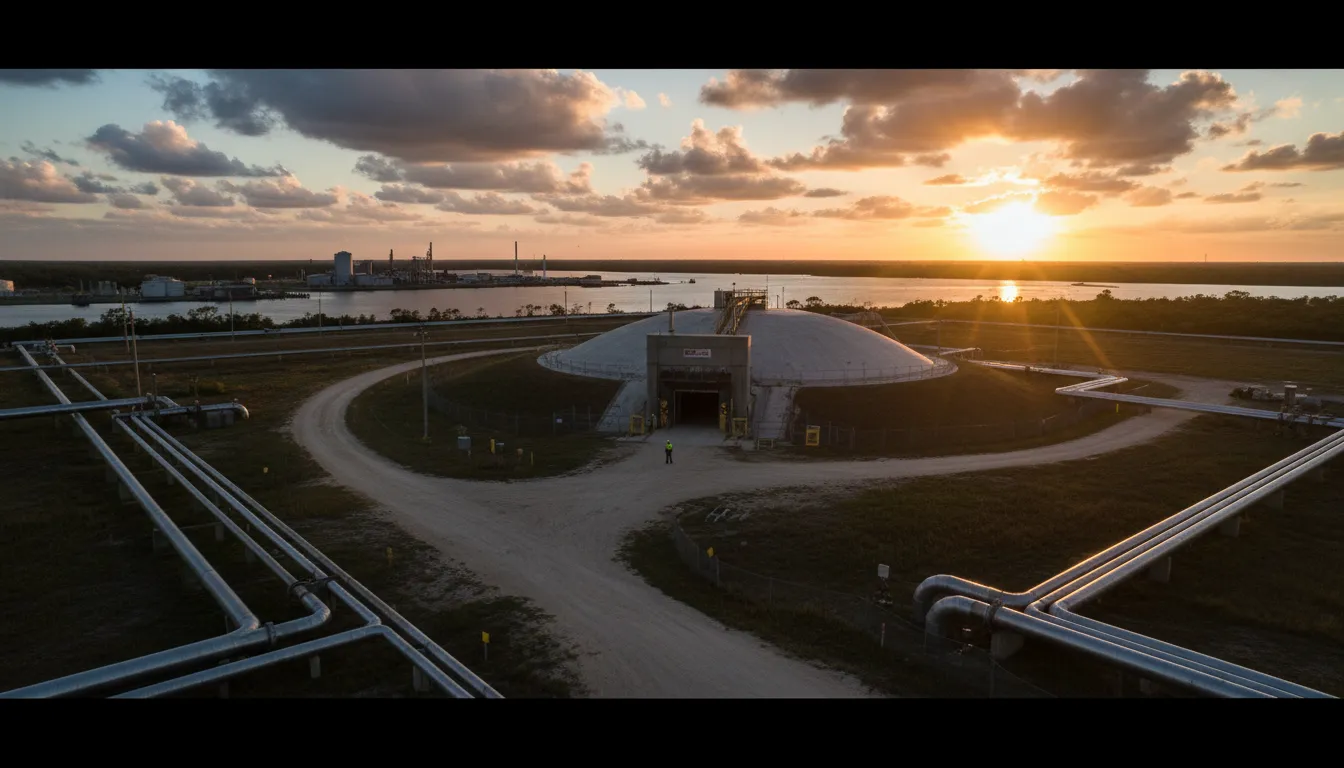
The US SPR is stored in four sites along the Gulf Coast of Texas and Louisiana — not in metal tanks, but in natural underground salt domes. The Department of Energy hollowed out these caverns by drilling into salt formations and pumping in fresh water, which dissolves the salt. The resulting brine is piped offshore. Each cavern averages about 60 metres wide and 600 metres deep, holding between 6 and 37 million barrels.
Extracting stored oil exploits a simple physical principle: oil floats on water. To withdraw crude, engineers pump fresh water into the bottom of a cavern. The water rises and pushes the oil upward to the surface. The process is remarkably efficient — the DOE estimates underground storage costs roughly one-tenth of above-ground tank storage. The US SPR has a total capacity of 714 million barrels, making it the largest emergency oil stockpile in the world.
The IEA's Collective Shield
The US reserve is just one piece of a global safety net. The IEA's 32 member nations collectively hold roughly 1.2 billion barrels of emergency oil, according to agency data. Each country has flexibility in how it meets its 90-day obligation — through government-owned stocks, commercially held industry inventories, or stocks stored abroad under bilateral agreements.
In a severe disruption, the IEA can trigger a collective action, asking each member to release stocks proportionate to its share of total IEA oil consumption. This coordinated approach amplifies market impact: a single country releasing reserves may be shrugged off by traders, but a simultaneous release by 32 nations sends a powerful signal.
When Reserves Have Been Released
Emergency releases have been authorised only a handful of times, each tied to a major geopolitical or natural disaster:
- 1991 — Gulf War: The US released 17.3 million barrels during Operation Desert Storm, helping stabilise markets rattled by Iraq's invasion of Kuwait.
- 2005 — Hurricane Katrina: The storm knocked out 95% of Gulf of Mexico crude production. The SPR loaned 5.4 million barrels to refiners to prevent fuel shortages.
- 2011 — Libyan civil war: A coordinated IEA release of 60 million barrels (30 million from the US alone) offset Libyan supply disruptions during the Arab Spring.
- 2022 — Russia-Ukraine war: The largest release in SPR history: President Biden authorised 1 million barrels per day for 180 days — 180 million barrels total — after Russia's invasion of Ukraine sent energy prices surging globally.
Does It Actually Work?
The evidence is mixed. The 1991 release is widely seen as a success, with oil markets remaining calm throughout the Gulf War. The 2011 IEA release produced only a temporary price dip before markets rebounded within a week. The 2022 drawdown helped cool prices modestly but drained US reserves to their lowest levels in four decades, raising questions about refilling capacity and long-term readiness.
Critics argue that strategic reserves are better suited to short, sharp supply shocks than to prolonged geopolitical conflicts, where the root cause of high prices — geopolitical uncertainty — cannot be resolved by pumping more crude. Supporters counter that even a temporary price reduction buys governments precious time to find alternative supplies and negotiate diplomatic solutions.
A Tool With Real Limits
Strategic petroleum reserves are not bottomless. They must be refilled — ideally during periods of low prices — and refilling takes time and money. The physical infrastructure, meanwhile, requires continuous maintenance. As the Council on Foreign Relations notes, the long-term strategic value of the SPR depends on governments resisting the temptation to draw on it for short-term political purposes rather than genuine emergencies.
For now, these vast underground caverns remain one of the few direct levers that governments can pull when oil markets spiral beyond control — a legacy of the 1970s energy shock that remains as relevant as ever.